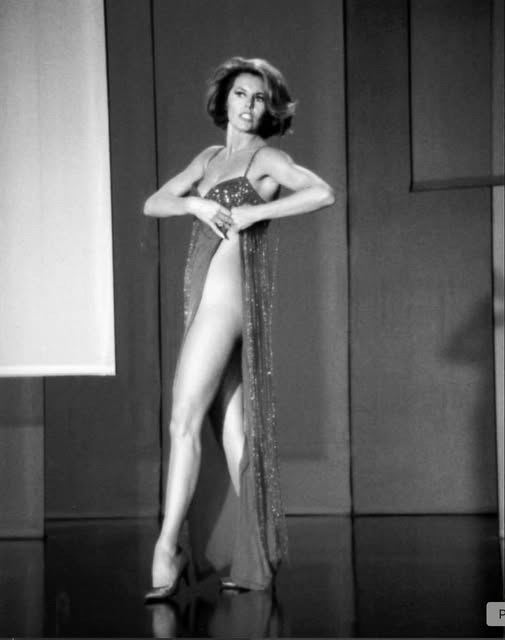
Cyd Charisse could do nearly everything—sing, act, and move as if music lived in her bloodstream.
Born Tula Ellice Finklea in Amarillo, Texas, in 1922, she was a fragile child who survived polio before she was six. Ballet became her therapy and, eventually, her destiny. Her brother’s lisped nickname “Cyd” replaced “Sis,” marking the beginning of a transformation from a recovering little girl into one of Hollywood’s most magnetic figures. By her teens, she had left Texas for Los Angeles, where rigorous training shaped both her grace and grit, turning physical recovery into timeless artistry.
Charisse’s gift was movement that spoke louder than words. MGM signed her in the 1940s, where she climbed from chorus dancer to leading star. In Singin’ in the Rain (1952), her performance opposite Gene Kelly—especially the “Broadway Melody” ballet—made her an icon. Without uttering a line, she commanded the screen with a single glance and a measured step. Later, with Fred Astaire in The Band Wagon (1953), she embodied elegance and intimacy; their duet “Dancing in the Dark” remains one of cinema’s purest portrayals of love. She matched both Astaire’s lyricism and Kelly’s athleticism, her style a seamless fusion of classical control and emotional heat.
Beyond her famous legs, it was Charisse’s timing that made her unforgettable—the way she paused just before a beat, stretched rhythm into feeling, and turned stillness into suspense. Through the 1950s she starred in Brigadoon, Silk Stockings, and Party Girl, bringing wit, drama, and sensuality to every frame. Offscreen, she lived quietly, married for six decades to singer Tony Martin, raising two sons and avoiding Hollywood scandal. Tragedy touched her life in 1979 when her daughter-in-law died in a plane crash, yet she met grief with the same poise and dignity that marked her career.
Honored late in life with the National Medal of Arts in 2006, Charisse’s legacy endures far beyond the golden age of musicals. She proved that beauty could be fierce, discipline could be graceful, and art could be born from resilience. From a child rebuilding her strength after polio to a dancer who turned movement into poetry, Cyd Charisse remains a symbol of endurance and artistry—a woman who didn’t just follow music but became its living expression.