Grief hung heavy over the reception hall on the day we buried my father-in-law, a man I loved like my own.
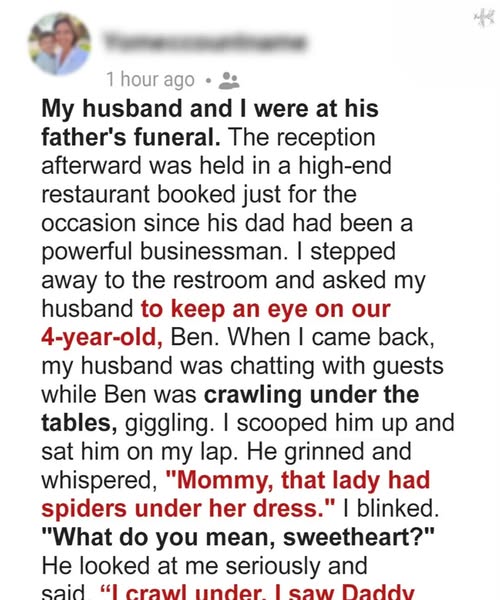
Everything felt muffled: voices, footsteps, even my own heartbeat. But children don’t see grief the way adults do. My four-year-old son, Ben, wandered between tables, crawling underneath white linen like it was a makeshift playground. When I guided him back to me, his face wasn’t playful anymore. His tiny hand tugged on my dress, his voice a breath against my ear: “Mommy, I saw Daddy touch another lady’s leg.” I felt the floor tilt beneath me. He pointed toward Rachel—my husband’s lifelong “family friend”—smiling too softly beside him. That whisper, innocent and unfiltered, struck with a truth I didn’t want to believe but could no longer ignore.
In the days that followed, Arthur’s distance twisted from grief into something colder, sharper—too many late nights, too many turned-over phones, too many moments where he flinched when I asked simple questions. I tried to silence my doubts, but my instinct had already awakened. With shaking hands, I logged into the old shared work email we once used. What I found gutted me: hotel confirmations, late-night confessions, photos, and messages from trips he had insisted were “all business.” While I raised our son, held our home together, and mourned alongside him, he had been living a second life with Rachel. I didn’t confront him—not yet. I documented everything, screenshot by screenshot, receipt by receipt, building the quiet foundation of an escape.
One month later, Arthur was served divorce papers at his office. He didn’t see it coming; betrayal had made him arrogant. In court, the evidence spoke louder than I ever could. I walked away with full custody of Ben and, in poetic symmetry, the judge granted a portion of Arthur’s father’s company—his legacy—to Ben as his rightful inheritance. Arthur’s expression that day was a mixture of regret and dawning realization: not only had he lost our marriage, but he’d also lost the façade he built his life around. I felt no satisfaction in his unraveling—only a deep, cleansing peace that settled into the hollow places he’d left behind.Now, our home is just the two of us—quiet, steady, and honest. No secret emails, no late-night excuses, no lies glossed over with practiced smiles. Some nights, when Ben asks why Daddy doesn’t live with us anymore, I hold him close and say gently, “Sometimes grown-ups make mistakes, sweetheart. But telling the truth helps us find our way again.” And when he asks if I’m happy—really happy—I can finally answer without hesitation, “Yes. Happier than I’ve ever been.” Because his small whisper at a funeral didn’t just expose a betrayal—it gave me back my life.