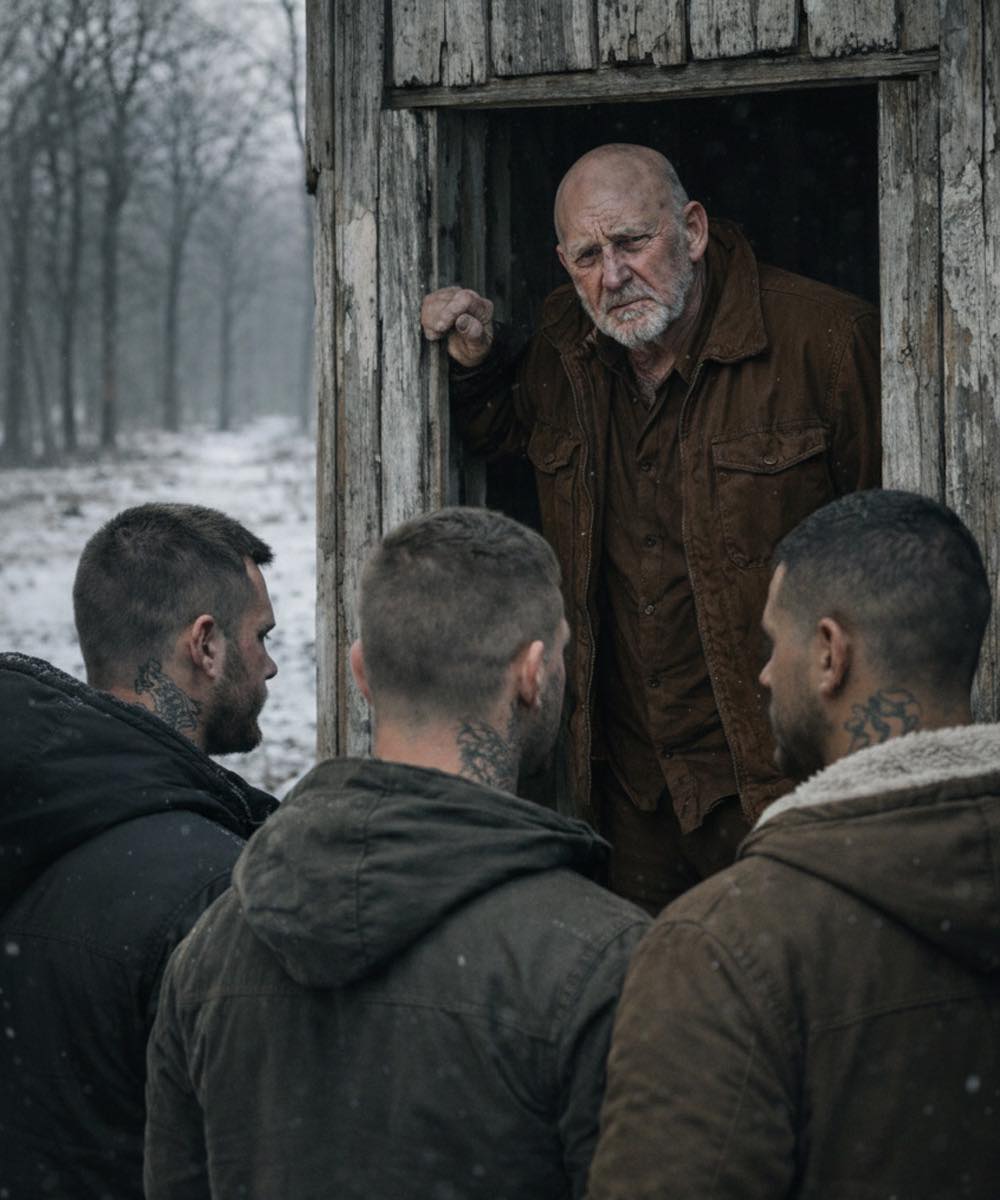
The three of them had a system.
Find someone alone. Study their routine. Make sure there were no visitors, no family, no neighbors who might ask questions. Then show up confident, loud, and fast. Fear did the rest.
They had just come out of prison, but not a single one of them had plans to go straight. If anything, they were sharper now. Colder. More strategic.
The house on the corner had caught their attention months ago.
Large yard. Solid structure. No cars in the driveway except an old truck that barely moved. An elderly man lived there alone. A daughter somewhere in another city. No one visiting. No one checking in.
Easy prey.
That’s what they called it.
They knocked just after sunset.
The door opened slowly.
An old man stood there wearing black trousers and a worn leather jacket. His face was lined but steady. His eyes clear, sharp in a way that didn’t match his age.
“You weren’t expecting us,” one of the men said with a crooked grin, “but we’ve come.”
The old man’s gaze moved calmly from one to the other—tattoos, clenched fists, restless shoulders.
“What do you want?” he asked, voice even.
“Your house,” another replied. “Sign it over and we’ll leave peacefully.”
“No,” the old man said without hesitation. “Anything else?”
The tallest one stepped forward. “Old man, don’t act confused. Give us the house, or we’ll take it.”
You don’t have many years left anyway,” the third added, smirking.
The old man narrowed his eyes slightly.
“Are you stupid,” he asked quietly, “or deaf?”
The grin vanished.
“What did you say?” one snapped, grabbing him by the collar.
The old man didn’t flinch. Not even a blink.
Then something changed.
He exhaled slowly. “Ah. I didn’t recognize you right away. Come inside. I’ll make tea. I’ll find the documents myself.”
The men exchanged glances. Satisfaction flickered between them.
They stepped inside.
The door shut behind them with a heavy click.
The sound echoed more than it should have.
“Sit,” the old man said, gesturing toward the sofa.
They sat, though not comfortably. One leaned back too casually. Another stayed closer to the hallway. The third never took his eyes off the old man.
The old man walked to the front door and locked it.
The key turned once.
Twice.
He checked it.
Then he turned back to them.
“Now,” he said, voice low, “we can talk privately.”
Something in the room shifted.
The air felt tighter.
He sat opposite them, back straight, hands resting on his knees.
“You don’t know me,” he began calmly. “I don’t expect you to. But your fathers might.”
No one laughed.
“I used to run this neighborhood,” he continued. “Not from a porch chair. From the streets. I served time. More than once. Not for petty theft. For serious things.”
One of the men tried to scoff. “You trying to scare us with bedtime stories?”
The old man leaned forward slightly.
“You made two mistakes,” he said softly. “First, you walked into my house with threats. Second, you decided age means weakness.”
He tilted his head toward a closed door down the hallway.
“In that room,” he said evenly, “is enough firepower to ensure none of you leave.”
Silence.
It wasn’t the threat that unsettled them.
It was how casually he delivered it.
“I won’t shout,” he added. “I don’t need to.”
The man who had grabbed him earlier shifted in his seat.
“You think we believe you?”
The old man’s eyes locked on his.
“Test it.”
No raised voice.
No tremor.
Just certainty.
The three men looked at each other now—not smug, not amused.
Calculating.
Because here was the truth: if he was lying, he was a bold liar. And bold liars can be dangerous.
If he wasn’t lying…
They were trapped in a locked house with a man who wasn’t afraid of prison.
The one nearest the door stood first.
“Let’s go,” he muttered.
The others didn’t argue.
The old man rose slowly and unlocked the door.
He stepped aside.
“The right decision,” he said.
They walked out without another word. No insults. No threats. No backward glance.
The gate slammed.
Footsteps faded down the street.
Inside the house, the old man stood quietly for a moment, listening.
Then he walked to the hallway door, opened it, and revealed… nothing.
No weapons. No ammunition. Just a small storage room filled with old paint cans and gardening tools.
He closed it gently.
Age had taken his strength.
But not his mind.
And sometimes, the most powerful weapon in a house isn’t what’s behind a locked door.
It’s the man standing in front of it.