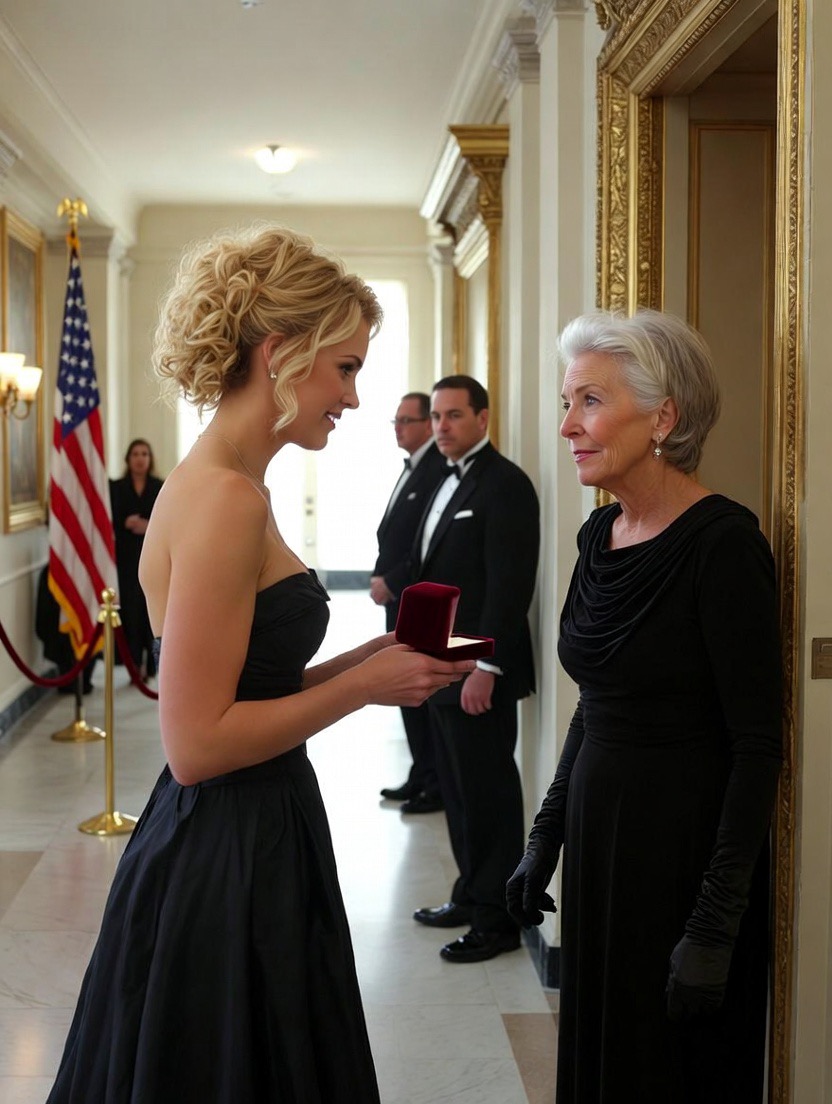
The first time I heard my mother call me a beggar, there were chandeliers over my head and a velvet watch box in my
hands. A security guard in a navy blazer had his fingers wrapped gently around my elbow, like he’d been trained not to leave marks. Behind him, through the glass doors of the ballroom at a five-star hotel off Central Park, I could see my parents bathed in golden light.
My father was raising a champagne flute. My younger brother was laughing, his arm slung around my younger sister’s shoulders. A banner in cursive script floated over their heads: “50 Years of Love.”
“Get this beggar out of here,” my mother said, without even stepping fully into the hallway.
Her words slid through the crack in the door and hit me harder than the February wind waiting outside. I stood there in a four-thousand-dollar dress, mascara streaked down my face, the velvet box sweating in my palm, and understood with a cold, clinical clarity that after ten years of acting as my family’s personal ATM, I had just been overdrafted. —
Two hours earlier, I had walked into the lobby of the Plaza feeling like an impostor in my own life.
The marble floors were polished enough to catch every ounce of light from the crystal chandeliers. The air smelled like fresh flowers and old money. Women in shimmery dresses floated past me, the kind who look like they were born knowing which fork to use and how to pronounce the names of French wines.
I moved through them in a pale, fitted gown from a designer whose clothes usually lived on the Upper East Side, not in my downtown closet. My hair had been coaxed into soft waves by a stylist in SoHo. My makeup had been painted on like armor.
The only thing betraying me were the faint tremors in my hands and the way my heart was hammering against my ribs. In my right hand, I held the velvet box with the Swiss watch set I’d bought for my parents. Six thousand dollars’ worth of precision timekeeping—fifty years, measured in gears and diamonds.
In my left, my phone buzzed with texts from my best friend Stacy. Send pics, she’d written. I need to be angry about how good you look.
I’d snapped a quick mirror photo in the hotel bathroom: smooth dress, smoky eyes, the kind of woman who should be gliding into a ballroom where everyone is thrilled to see her. Instead, when I walked up to the entrance of the event space, a man in a black suit stepped forward. “Good evening, ma’am,” he said.
“Name, please?”
“Megan Campbell,” I answered, shifting the watch box to my other hand. He tapped on the tablet, frowning lightly. “I’m sorry, Ms.
Campbell, I don’t see your name on the guest list.”
“That’s… impossible,” I said, with a little laugh that sounded too high, too thin. “I booked the event. The banquet.
The open bar. The band. I wired the deposit from my account.”
The manager appeared at his side, all soft eyes and polished customer-service empathy.
“Ms. Campbell,” he said, “your name was removed from the list last night. Per the hosts’ request.”
I stared at him.
“The hosts?”
“Your parents,” he said quietly. The watch box suddenly felt heavy. “There’s been a mistake,” I insisted.
“Let me talk to my mother.”
After a hesitation that lasted just long enough to bruise my pride, the manager nodded and signaled to one of the staff. The heavy doors cracked open a few inches. Sound spilled out first—music, laughter, the clink of glassware.
My mother didn’t bother coming all the way into the hallway. She hovered just beyond the threshold, framed in the warm light of the ballroom. Her gold dress caught every flash from the photographer’s camera.
Behind her, I could see my father grinning beside a champagne tower, my brother Mike and my sister Erica flanking them like bookends. “Megan,” my mother said, like she’d picked up a call she hadn’t wanted to answer, “we thought you weren’t coming.”
“I’m literally right here,” I replied, my voice thinner than I wanted. “Mom, this is your anniversary.
I paid for—”
She cut me off with a small, irritated wave. “This is a family event,” she said. “It’s really for close family only.”
“Family without me?” My throat tightened.
I held out the velvet box. “I brought a gift. For you and Dad.”
She didn’t even reach for it.
Her eyes slid right over the box like it was a takeout container. “Please take that away,” she said to the nearest waiter, like I wasn’t there. “Get it out of here.”
Then, with a flick of her hand toward me—the same little flick she used on telemarketers and street canvassers—she added, “Actually, get her out.
Get this beggar out of here.”
The word landed in my chest like a dropped brick. Beggar. This, after I’d wired over seven thousand dollars just for the banquet deposit.
After ten years of quietly paying their overdue bills, rescuing my brother’s businesses, covering my sister’s vacations, adding my card whenever there was an emergency. I didn’t argue. I didn’t plead.
I stood there long enough to hear the laughter swell as the doors swung shut, then let the security guard escort me back to the lobby. He was gentle. That almost made it worse.
“Ma’am,” he said softly, “I’m really sorry. I know this is… unusual.”
“Don’t be,” I murmured. My voice sounded like it was coming from somewhere above my own head.
“You’re just doing your job.”
On a monitor near the concierge desk, the live feed from the ballroom was playing for the staff. I watched my mother glow for the camera, watched my father give a toast. In the corner of the screen, my brother lifted his glass, and my sister leaned in, laughing.
It was a perfect family portrait. I just wasn’t in it. The velvet watch box was still in my hand.
The cab driver took one look at me when I slid into the back seat—smeared makeup, high-end dress, bare shoulders shaking—and didn’t say a word. “To downtown,” I whispered. Outside, Manhattan blurred into streaks of light and rain.
February wind rattled the windows when we hit the FDR Drive. I pressed the velvet box against my chest like it could hold me together. My building is one of those glass-and-steel towers in the Financial District, the kind my mother always called “ant hills” whenever I invited them to visit.
“We like real homes, Megan,” she’d sniff. “Not boxes in the sky.”
My “box in the sky” was a two-bedroom condominium on the thirty-second floor with floor-to-ceiling windows and a kitchen an interior designer had once called “aspirational.” I’d bought it with my own money at thirty-two, after years of grinding in a venture capital firm and then launching my own consulting agency. My clients trusted me with their retirement funds, their kids’ college savings, their “don’t lose this” nest eggs.
The irony wasn’t lost on me: the woman they trusted to guard millions of dollars had just been thrown out of a party she paid for. In the underground garage, the silence hit harder than the wind. Rows of parked cars sat under fluorescent lights, humming softly.
I pulled into my spot, cut the engine, and just sat there. I looked down at myself—ruined makeup, expensive fabric bunched around my knees, the watch box in my lap—and something inside me finally snapped. The sound that ripped out of my chest didn’t feel human.
It bounced off concrete and metal and came back to me as something wild and unpretty. It was the sound of thirty-four years of “don’t take it personally,” of “you know your brother needs more help than you,” of “you’ll understand when you’re older,” finally tearing free. When my phone rang, the screen lit up with Stacy’s name.
“How’s the golden couple?” she chirped, as if nothing in the world was wrong. “Are you already on your second glass of champagne? Send me a picture of that dress.
I want to resent you properly.”
I pressed the phone to my ear, swallowing air that tasted like metal. “They threw me out,” I said. There was a pause as the words dropped between us.
“What?”
“They took my name off the guest list,” I managed. “My mom called me a beggar.”
The silence on the other end wasn’t empty. It crackled with horror.
“Where are you?” Stacy asked. “Garage,” I said. “In my car.”
“Do not drive,” she ordered.
“I’m coming over. Stay put.”
Twenty minutes later, she was banging on my window. I unlocked the door and she slid into the passenger seat, her hair still damp from a shower, no coat, sneakers half-laced.
“Get upstairs,” she said, her voice low and firm. “You are not falling apart in a parking garage.”
In my living room, under recessed lights and next to a couch I’d once chosen because the fabric didn’t stain easily, I told her everything. The manager, the crack in the ballroom doors, the way my mother wouldn’t step into the hallway, the way she’d let “beggar” roll off her tongue like it was nothing.
Stacy reheated leftover pilaf from my fridge, poured red wine into mismatched glasses, then walked behind me and unzipped my dress. The fabric slid to the floor with a soft whisper. “This isn’t just a bad family dynamic,” she said eventually, her brows drawn tight.
“This is emotional abuse, Meg. You know that, right?”
“I’m not abused,” I protested automatically. “I’m the strong one.
I’m the one who fixes things.”
“Yeah,” she said. “You fix everything for everyone else. And they treat you like a walking debit card.”
My eyes burned again.
“I can’t be a victim,” I muttered. Stacy tilted her head. “What if you’re a smart woman who’s finally realizing she’s been used?”
Something shifted in my chest.
It was like someone had just drawn a thin, straight line through a page of scribbles. “I have a spreadsheet,” I blurted. “Of course you do,” Stacy said, setting her glass down.
“You’re you. What kind of spreadsheet?”
“The money,” I said. “All the money I’ve given them.
Just in case.”
I padded into my home office in bare feet and grabbed my laptop. On the couch, I opened a file with a name that suddenly felt like a bad joke: family_expenses.xlsx. Rows filled the screen.
Dates. Transfers. Card payments.
Notes I’d left for myself at two in the morning. “Mike—barber shop equipment.” “Mom—property tax shortfall.” “Erica—Mexico girls’ trip.” “Parents—Palm Springs spa retreat.”
At the bottom of the page, a total glowed in the corner of the screen. 153,470.00.
For years, that number had just been digits. An abstract tally I never really let myself translate. Now, my brain did the math automatically.
“About two hundred thousand dollars,” I whispered. I stared at the total until the digits blurred. Two hundred thousand dollars.
That was more than the down payment on my condo. That was a comfortable retirement account. That was a year of traveling the world with a backpack.
That was a small house near the beach somewhere in Florida. That was a startup founded and funded. That was an entire alternate life.
I scrolled. Erica’s kids’ tutors: twelve months straight at sixteen hundred a month. New bedroom furniture for my parents: five thousand.
My parents’ three-week spa stay in Palm Springs: eleven thousand. The first build-out for Mike’s barbershop: thirty-six thousand. Renovation of my parents’ apartment’s outdated kitchen and bathroom: over forty thousand.
Every line item was a piece of time I’d traded at a desk in Manhattan, hours I’d sat in conference rooms under fluorescent lights, the stress I’d carried in my shoulders and jaw. “I fed them,” I said quietly. “I clothed them.
I funded their vacations, their hobbies, their second chances. And they called me a beggar.”
Stacy looked at the screen like it was medical imaging. “This is ten years of your life,” she said.
I nodded. “I thought that’s what love was,” I admitted. “You share, you help, you pick up the slack.
But their love always came with a bill attached. Real love…”
I thought about the crooked house Mike had drawn in kindergarten, hanging on the wall for thirty years. The way my parents had screamed with pride when he scored a C in math after barely studying.
“When I won a district math competition at nine, I came home with a certificate,” I said. “My dad told me to sit with Mike and help him memorize his times tables. He didn’t even read the certificate.
But that stick-figure house? That was framed.”
I remembered my graduation from NYU’s business school, standing on stage in a purple robe, scanning the crowd for them. “They didn’t come when I graduated college,” I said.
“Mom said Mike had finals and was stressed, so they couldn’t make the drive. Mike’s exam anxiety outranked my entire degree.”
Stacy exhaled slowly. “Middle child?” she asked.
“Exactly,” I said. “Middle child, invisible child, competent child. The one who ‘would figure it out.’ And I did.
I figured out graduating with honors, finding a job in a venture fund, surviving fourteen-hour days so I could eventually run my own firm. And when I finally made it…”
“They pressed the ‘withdraw’ button,” Stacy finished. I didn’t remember lying down.
I remembered the glow of my laptop, the velvet watch box on the coffee table, and the number at the bottom of the spreadsheet burning through my eyelids when I finally fell asleep. The price of admission to a family that still didn’t consider me “close.”
The next morning, my phone buzzed before the sun made it over the neighboring buildings. Stacy was snoring on my couch, wrapped in a throw blanket.
I tiptoed into the kitchen, started the coffee maker, and grabbed my phone from the counter. The first notification wasn’t a text. It was an alert from my bank.
Shared card ending in 7321: New charges. My stomach dropped. A few years earlier, in one of my softer moments, I had opened a separate credit card under my name, “for emergencies.” I’d handed my parents the number and said, “Use this if something urgent comes up and you can’t reach me.”
Somehow, my entire family had gotten hold of it.
I opened the app. Overnight, there had been a flurry of activity. Additional banquet charges from the hotel—roughly four thousand dollars.
A tab at a rooftop bar in Midtown—two thousand. A custom cake from a famous New York bakery—seven hundred. They had continued the party after I’d been escorted out.
On my card. The app couldn’t calculate the cost of humiliation, but I mentally added that to the total. I set the phone down on the counter and opened Instagram.
The very first photo in my feed was my mother on her friends’ stories. She was standing beside a three-tiered cake, gold accents gleaming, my father’s arm slung around her shoulders. Her caption underneath another shot read, “Fifty years of love.
So grateful for my beautiful family.”
Not one word about who had paid for the venue. Or for the band. Or for the open bar.
Something inside me finally stilled. For the first time in years, I wasn’t scrambling to explain, to excuse, to minimize. I poured a mug of coffee, sat at my kitchen table, and opened my email.
“Good morning, Ella,” I wrote to my assistant. “When you have a moment, please pull a full breakdown of all family-related expenses from the last twelve months and send me the contact information for our corporate attorney.”
Ella responded in ten minutes. On it.
Are you okay? Better than I’ve been in a long time, I typed back, and hit send. By lunchtime, she’d sent the spreadsheet.
Fresh numbers stared back at me. Half the banquet already paid—seven thousand. A Mediterranean cruise I’d booked for my parents as a surprise, departing in a month—three thousand.
A family resort vacation for Erica, her husband, and their kids, scheduled in two weeks—four thousand. A landlord expecting a transfer for Mike’s newest barbershop location—two thousand. A renewal for my parents’ country club in New Jersey—seven thousand.
Thirty-six thousand dollars in obligations, not including the random Venmo transfers and “just this once” wires. “Treat it like a troubled portfolio,” I murmured to myself. That I knew how to do.
I called our attorney. Mr. Stein had the kind of unflappable tone that made you feel like your crisis was just another Tuesday.
I laid it all out—the ten years of undocumented transfers, the shared card, the anniversary incident. “Legally speaking,” he said, “anything you gave them without a written agreement specifying repayment will be considered a gift. The courts don’t generally recognize family loans that exist only as ‘we’ll pay you back someday.’”
“I figured,” I said.
“What about the future stuff? Bookings and renewals that are in my name?”
“Those you can absolutely cancel,” he answered. “If the contracts are between you and the vendors, you have the right to terminate.
There may be penalties, but the refunds will come back to you. As for your brother’s ventures—all without paperwork?”
“Gifts,” I finished. “Essentially.”
I thanked him and hung up.
Ella called as soon as she saw the calendar note disappear. “They are going to lose their minds,” she warned. “Megan, this is going to be a storm.”
“Let them,” I said calmly.
“I am done treating my life like a public utility.”
The next two hours, I stayed in work mode. I built a more detailed register of the last decade, sorting by recipient and year. Then, because I’m me, I calculated the opportunity cost—what those amounts would be worth now if I had invested them in the market instead of letting them leak out through “emergencies.”
By the time I was finished, the totals were brutal.
Roughly two hundred thousand dollars in direct support. About forty-five thousand more in forgone gains. A quarter of a million dollars.
“The price of your family,” Ella said quietly when I shared the screen with her. “I prefer to think of it as tuition,” I replied. “For a very expensive lesson.”
Then I sent the cancellation emails.
I called the cruise line first. “Hi, this is Megan Campbell,” I said when the representative picked up. “I need to cancel booking number…” I read the numbers off my notes.
“I understand there’s a penalty. Please process the refund to the original payment method.”
“Yes, Ms. Campbell,” the woman said.
“After the fee, you’ll receive ninety-five percent back.”
Ninety-five percent freedom. Next, the resort where Erica’s family trip was booked. “Cancel the package completely,” I said.
“Keep the penalty. Consider it a lesson fee.”
I made a note to send my nephews some pocket money for their piggy banks. None of this was their fault.
Then the landlord for Mike’s latest location. “Hi, this is Megan Campbell. I’m calling to let you know that no further transfers will be coming from my account.
Any agreements you have with my brother will need to be handled directly with him.”
A pause. “So you’re no longer backing him?” the landlord asked. “That’s correct,” I said.
“You and he will need to work something out without me.”
Finally, I called the country club. “This is Megan Campbell,” I said. “Please do not renew my parents’ membership.
Remove my card from their file. Any future invoices should go directly to them.”
I saved the Plaza for last. “Good afternoon, this is Megan Campbell.
I paid the deposit for Saturday’s anniversary event.”
“Yes, Ms. Campbell,” the coordinator said, her voice careful. “How can we help you?”
“I’m not asking for the deposit back,” I said.
“But I want all additional charges canceled—the extra bar tab, the added décor, everything that hasn’t already been billed to my card. Please invoice my parents directly for any remaining balance.”
A beat. “Certainly,” she said.
“We can do that.”
“And one more thing,” I added. “Please transfer my original deposit to Harbor Light Children’s Hospice in Brooklyn. As an anonymous donation.”
The line stayed silent long enough that I wondered if the call had dropped.
Then, “We’ll handle it exactly as you requested.”
By early evening, the work was done. The cruise was gone. The resort trip evaporated.
The club renewal canceled. The barbershop transfer blocked. The deposit for the party that had exiled me redirected to dying children who actually needed it.
My phone showed thirty-four missed calls and a handful of increasingly frantic texts. I opened my email instead. To: Immediate Family
Subject: Financial Boundaries
As of today, I wrote, I will no longer be financing any family members.
All existing obligations have been canceled where possible. The shared card has been closed. Please do not contact me for money going forward.
I hit send, then went into my phone settings and blocked their numbers. The silence that followed wasn’t empty. It was breathable.
For one beautiful week, my life sounded like my own. No buzzing phone. No “emergency” texts.
No guilt-drenched voicemails. Stacy came over with takeout and a bottle of wine. “How does it feel?” she asked, sitting cross-legged on my couch, chopsticks in hand.
“Strange,” I admitted. “Like I’ve taken off a heavy coat I was so used to I forgot I was wearing it.”
“And?” she pressed. “And I’m cold,” I said honestly.
“And lighter. And furious. And relieved.
All at once.”
She raised her paper cup of red wine. “To your Independence Day,” she toasted. We clinked.
By the end of that week, my phone was lighting up again, despite the blocks. New numbers. Unknown numbers.
Shared cousins’ numbers I hadn’t saved in years. Mike: You sabotaged my business. Do you know what you’ve done?
Erica: The kids are sobbing. They were counting down the days to that trip. How could you do this to them?
My father: After everything we’ve done for you, this is how you repay us? You’re a disgrace. I stared at the messages, then put my phone face-down.
At seven in the morning on day eight, someone leaned on my buzzer like the building was on fire. “Ms. Campbell,” the concierge’s voice crackled through the intercom, uncertainty in his tone, “there’s a group here asking to come up.
They say they’re your family.”
My stomach went cold. “Send them up,” I said, my voice even. I had a right to look them in the eye.
A few minutes later, my video monitor flickered on. My parents stood in the hallway in their coats. Mike, jaw clenched, arms folded.
Erica, eyes already brimming with tears, her two kids pressed close to her hips. I opened the door before they could knock. They didn’t wait to be invited in.
They pushed past me, their outrage entering the apartment before their bodies did. “You’ve completely lost it,” Erica burst out. “Do you have any idea what it’s like to tell your children their vacation is canceled?
They’re devastated.”
“You killed my shop,” Mike added, voice rising. “I had that location lined up. The landlord is threatening legal action.
You can’t just cut off funding like that.”
My mother clutched her mink coat—one I had bought her for Christmas two years earlier—tightly around herself. “I had to call everyone,” she said, her voice pitched high. “I told them my daughter had some sort of episode.
How do you think this makes us look?”
My father didn’t say anything for a long moment. He just studied me, his jaw hard, eyes flat. Finally, he spoke.
“You will fix this,” he said. “Today. We raised you, young lady.
Remember that when you decide to spit in our faces.”
Ten years ago, that tone would have folded me in half. Now, it only made me tired. “No,” I said simply.
The word dropped into the room like a stone into deep water. Everything went very quiet. Then the noise exploded.
“You are ungrateful,” my father shouted. “You’re abandoning your family,” my mother sobbed. “You think you’re better than us now with your fancy apartment and your high-and-mighty job.”
“You owe us!” Erica cried.
“We were there for you growing up. We fed you, clothed you. Don’t act like you did all of this alone.”
I let them talk until their words started repeating.
Then I walked to my desk, grabbed my laptop, and opened the spreadsheet. “This,” I said, setting it on the kitchen island and swiveling the screen toward them, “is ten years of my life with you in numbers. Every transfer.
Every card payment. Every ‘loan’ that never came back.”
They fell quiet, almost against their will. “Here,” I pointed, “Erica’s all-inclusive Mexico trip.
Here, Mike’s self-service car wash idea. Here, Mom and Dad’s Palm Springs spa retreat. Here, the kitchen renovation.
Here, upstate property taxes. Here, Mike’s first barbershop. Here, the latest one you’re yelling about.”
I scrolled to the bottom.
“Two hundred thousand dollars,” I said, tapping the total. “Plus what I could have earned if I’d invested it instead. About a quarter of a million in opportunity cost.
Do you know what that means?”
My father’s lips pressed into a thin line. “You’re twisting this,” my mother said, her voice wavering. “We never meant to hurt you.”
“Every family has hard times,” my father added.
“We’re not perfect. You don’t abandon your parents because they’re not perfect.”
I swallowed once. “Do you remember what you called me at the hotel?” I asked my mother.
She blinked. “I was upset,” she said. “I don’t remember my exact words.”
I met her eyes.
“You told security to ‘get this beggar out of here,’” I said. “That beggar wired your banquet deposit. That beggar booked your cruise.
That beggar has been paying your bills for a decade. So let me be very clear: as of today, your beggar is closed for business.”
Tears welled up and spilled down her cheeks. In the past, those tears would have sent me scrambling for my wallet.
Now, they just looked like water. “From now on,” I continued, “there will be no more loans. No more surprise gifts.
No more last-minute bailouts. You are all adults. You are capable of working and budgeting and dealing with the fallout of your choices.
I am done sacrificing my future to polish the façade of a family that doesn’t even claim me in public.”
“If you walk away from us like this,” my father hissed, “you are no longer our daughter.”
I almost laughed. “And when, exactly,” I asked quietly, “have I ever truly been your daughter?”
No one answered. They left eventually, one by one, their anger trailing behind them into the hallway.
When the door clicked shut, the apartment felt cavernous. Not because it was empty. Because, for the first time, there were no invisible hands reaching into every drawer.
I stood by the window and watched the city move below, people rushing to work, cabs honking, the world spinning on like nothing important had happened. Inside me, something enormous had shifted. It took about eight months for the shockwaves to fully roll through their lives.
I learned the details in pieces—from my cousin Liz, from whispered updates at extended family gatherings I didn’t attend, from the occasional message that slipped past my filters. First, they sold the upstate house. Without my money, the property taxes and the repairs were too much.
They moved into a one-bedroom apartment in Queens, a building with thin walls and an aging elevator. My mother told the neighbors they had two children—Mike and Erica. I was a ghost.
Mike shut down his latest LLC. Debt collectors started calling. Without my quiet infusions of cash, his big ideas hit the hard wall of reality.
Erica took out her first loan in her own name to remodel her kitchen. She complained about the interest on Facebook. I scrolled past, thumb steady.
My photos disappeared from their social media. On the family group chat, it was as if I’d never existed. They posted old holiday pictures carefully cropped.
Any shot that included me vanished. If you’d looked at their curated lives online, you’d think they had always been a family of four. In therapy, my psychologist, Dr.
Karen Lewis, called it “erasure.”
She was in her early sixties, all soft sweaters and sharp eyes, with an office in a brownstone on the Upper West Side. I started seeing her after the first wave of “flying monkeys,” as she put it, swept in. That’s what she called the relatives and family friends who suddenly remembered my number once I stopped paying.
“Your mom is sick with worry,” my aunt Valerie said over the phone, her voice heavy. “Her blood pressure is through the roof. Do you really want to be responsible for that?”
“Your parents love you,” an old family friend wrote in a long message.
“They’ve always done their best. Maybe you overreacted. You only get one mother.”
Even one of my former professors from NYU reached out after my parents apparently went on a sympathy tour.
“I heard you’re having some conflict at home,” he said gently. “You know, in our culture, we honor our parents. We don’t abandon them.”
My responses were short and polite.
“I’m not available to mediate their feelings,” I wrote. “If you were silent when they humiliated me, please also be silent about my boundaries.”
In Dr. Lewis’s office, she would sit with her notebook in her lap and listen as I replayed each guilt trip.
“You’re not an ATM, Megan,” she would remind me. “You’re a person. You are allowed to exist without earning your right to be in the room.”
“I know,” I said once, picking at the seam of the couch.
“At least, I know it here.” I tapped my temple. “My body still flinches when the phone vibrates.”
“That’s years of conditioning,” she said. “It won’t disappear overnight.
But every time you don’t answer, every time you hold a boundary, you’re teaching your nervous system a new story.”
Sometimes I left her office feeling like I’d grown a spine where before there had only been nerves. While their world contracted, mine expanded. Without a second household—or three—to secretly bankroll, my business suddenly had room to breathe.
I opened a second office in Chicago, hired two brilliant junior analysts, Katie and Tony, and finally took the vacation I’d been postponing for years. A long weekend in Santa Fe with Stacy, hiking red rock trails, eating tacos on patios, and sleeping without my phone under my pillow. I gave an interview to a financial podcast about women and money.
Offhand, I mentioned how easy it is to lose six figures to “family obligations” when you don’t have boundaries. The host latched onto the idea. “Would you be willing to talk about that more?” she asked.
A few months later, Bloomberg ran a piece about “toxic family financing” featuring my anonymous case study—a professional woman in Manhattan who had quietly poured two hundred thousand dollars into relatives who treated her like a bottomless resource. My inbox flooded with replies. I thought I was the only one, people wrote.
I’ve been paying my parents’ mortgage for ten years. My brother keeps asking for startup money. My sister uses my card “just until payday” every month.
I didn’t feel like a victim anymore. I felt like someone who had walked out of a burning house and was now turning around to shout, “The door is unlocked. You don’t have to stay inside.”
Somewhere in that first year of freedom, late one night after too many hours of scrolling through those stories, I found an online support group—a private corner of Facebook for people who had cut financial ties with abusive or exploitative families.
We met once a month in person at a restaurant in the East Village. There was Gina, who had been quietly paying her parents’ rent while living with a roommate. Sam, whose older brother went from crypto to NFTs to whatever the latest scheme was, always with his hand out.
Cassie, who’d been supporting a mother who spent everything on psychics. We sat around a long table, eating pasta and sharing stories, sometimes laughing so hard strangers turned to stare, sometimes dabbing at our eyes with paper napkins. For my thirty-fifth birthday, Stacy insisted on a party.
“Not a Manhattan rooftop blowout,” she said. “Just a real one.”
We gathered at my friend Gina’s walk-up in Brooklyn. The ceilings were low, the kitchen small, the furniture a collection of Craigslist finds.
She’d strung IKEA fairy lights around the windows. The coffee table was covered in bowls of chips and homemade cookies. Somebody’s playlist rotated through old pop songs.
Cassie jiggled her three-month-old son on her hip, introducing him proudly as “timely proof that contraception sometimes fails.”
I looked around the room at all these people who loved me for my sarcasm, my terrible dance moves, my insistence on bringing spreadsheets to brunch debates—not for my ability to pay their bills. I felt something ease under my ribs. “You’re thinking deep thoughts,” Stacy said, nudging me with her shoulder.
“I’m thinking…” I searched for the right words. “I’m thinking this is the first birthday where no one is mentally calculating what they can ask me for.”
She clinked her plastic cup against mine. “Welcome to adulthood, Campbell,” she said.
“Where your family can’t repossess your cake.”
Later that night, after people had drifted home and I was loading sticky cups into Gina’s sink, the doorbell rang again. “I swear, if that’s my downstairs neighbor complaining about the noise…” Gina muttered, heading for the intercom. “It’s two women,” she said, surprise in her voice as she peered through the peephole.
“One of them looks like your dad.”
I went cold. She opened the door. My aunt Margaret stood there—my father’s younger sister—with my cousin Liz at her side.
They both looked uncertain, like they weren’t sure whether they’d just walked into enemy territory. “Aunt Margaret?” I said. “Happy birthday, honey,” she said, pulling me into a quick, tight hug that smelled like cold air and drugstore perfume.
“We won’t stay long.”
Liz wrung her hands, then thrust an old, yellowing envelope toward me. “This is from Grandma Eleanor,” she said. “She gave it to Dad years ago with instructions to pass it to you when you ‘stood up for yourself.’ Your mother always said you weren’t ready.
I disagreed. I took it when… well, when that night at the Plaza happened. It felt like the right time.
I should’ve brought it sooner. I’m sorry.”
My throat tightened. I hadn’t heard my grandmother’s name spoken out loud in a long time.
I stepped back into the hallway and opened the envelope with shaking fingers. Inside was a folded letter, written in my grandmother’s neat, old-fashioned script, and a recent statement from a brokerage account. Megan, my brave girl, the letter began.
If you’re reading this, it means you finally did what I always knew you would do: you chose yourself. I read on, my vision blurring. I always knew you were the strong one.
The others needed daily help. You only needed to know that I believed in you. This account is yours, and only yours.
I set it up long ago so you would have something that didn’t come with strings attached. Use it when you have finally had enough. Love, Grandma Eleanor.
My grandmother had been gone seven years. While I’d been hemorrhaging money into my parents’ lifestyle, a separate account in my name had been quietly compounding. I looked at the brokerage statement.
The total balance stared up at me. The same number I’d seen at the bottom of my spreadsheet, only now it sat in my hands as something I hadn’t been forced to earn by bleeding for everyone else. “That was her last fight with your mother,” Aunt Margaret said softly.
“Grandma insisted the money was for you alone. Your mother was furious. She said it wasn’t ‘fair’ to the others.
After Grandma passed, your mother kept saying you weren’t ready. I knew better.”
I swallowed past the lump in my throat. “Thank you,” I said.
The words felt too small. “We’re proud of you,” Liz added. “I should’ve spoken up sooner when they were using you like that.
I’m sorry I stayed quiet.”
My eyes stung, but the tears felt different. Not hot and shameful—just human. “Better late than never,” I said.
Part of Grandma’s legacy went into something I knew would make her smile wherever she was. We filed the paperwork for the Eleanor Campbell Foundation—a small nonprofit that provides emergency grants and scholarships to young women who, like me, had been financially entangled with families that treated them as resources instead of daughters. The rest of the money stayed in its account, still working quietly in the background.
I didn’t need it to survive anymore. I needed it to remind me that not all love comes with invoices. One snowy evening in late December, I stood at my own window, a mug of cocoa warming my hands, watching flakes swirl in the streetlights thirty-two stories below.
My apartment was noisy. Stacy and Gina were arguing in the kitchen about whether Die Hard counted as a Christmas movie. Sam was on the couch, reading a scene from his now-published short story collection to Cassie, who was bouncing baby Tim on her knee.
Katie and Tony, my analysts, were huddled near the windows, comparing New Year’s resolutions. Fairy lights glowed along the bookshelves. The coffee table was covered in half-empty glasses and bowls of chips.
Someone had spilled salsa on the rug. It was perfect. I glanced at the velvet watch box sitting on the shelf by the TV.
I’d kept it, not as a reminder of the night I was thrown out of a ballroom, but as evidence of the line I’d drawn. The watches had long since been sold, the money donated to the hospice along with my deposit. The empty box remained.
Once, it had been a symbol of how far I was willing to go to earn a seat at my parents’ table. Now, it was proof that I could buy myself a future instead. I turned away from the window and stepped back into the noise.
“Earth to Megan,” Stacy said, snapping her fingers in front of my face. “You with us?”
“Yeah,” I said, smiling. “Just thinking.”
“Dangerous,” Tony joked.
I laughed. For the first time, the sound felt free. This was my family now.
Not the one I’d been born into, with its rulebook and its price list, but the one I’d built. People who showed up with casseroles and cheap wine, not invoices. People who loved me for my sarcasm and my spreadsheets and my stubbornness, not my credit limit.
When midnight finally ticked over—on a cheap digital clock, not a Swiss masterpiece—we clinked glasses and yelled happy new year out the open windows. I looked around the room, at this messy, loud, imperfect circle of humans, and felt something settle deep in my chest. So this is what it feels like, I thought.
To shut down the ATM and still be invited to the party. Later, when I told this story online, the comments came in like they always do. Some people said I went too far.
Others said I hadn’t gone far enough. I know what I think. For ten years, I treated my life like an open checkbook.
I let people call me a beggar while they cashed my generosity. Two hundred thousand dollars later, I finally did the math. So now I’ll ask you: if you were me, would you have done anything differently?
Tell me in the comments. I’m listening. When I finally hit “post” on the story, I half expected the internet to shrug.
Instead, my phone lit up like Times Square. At first it was a few hearts from friends, a couple of “proud of you” messages, the usual digital warmth. Then strangers started leaving comments so long they had to break them into parts.
“My mom did this to me with her mortgage.”
“I paid for my sister’s wedding and wasn’t even invited to the rehearsal dinner.”
“I thought I was crazy for resenting my parents. Thank you for making me feel less alone.”
I sat on my couch with a mug of lukewarm coffee, thumb scrolling and scrolling, watching people pour out stories they’d never said out loud. Different names.
Different cities. The same ache. Somewhere between the third and thirtieth story about a “loan” that never came back, something clicked into place.
It wasn’t just me. Have you ever read a stranger’s story and felt like they’d broken into your diary? I spent that whole weekend replying when I could, hitting “like” when I didn’t have words, walking away from my phone when the waves of other people’s pain got too strong.
Stacy finally stole the phone out of my hands on Sunday afternoon. “You can’t be tech support for every person with a toxic uncle,” she said, dropping it face down on the counter. “Take a breath.
Let other people talk to each other.”
“I started it,” I argued. She rolled her eyes. “You lit a match in a room full of gas.
The fire is going to spread whether you hover over it or not. Go shower. You smell like stress.”
She was right.
The old version of me would have tried to fix everyone. The new version was still learning how to let people fix themselves. A few weeks later, my inbox pinged with a subject line that made my stomach drop.
From: Mom
Subject: Hospital
My first, irrational thought was, She found my burner email. Then I remembered I’d never actually gone full witness protection. I’d only blocked numbers.
Emails still had a way in. I hovered over the message for a full minute before clicking. Megan,
Your father is in the hospital.
He had a minor stroke. The doctors say he needs rehab. Insurance doesn’t cover everything.
We’re already stretched thin with the move and the bills. You know how the system is. We need you.
Mom. No “love.” No “how are you.” Just a problem and a solution she’d already penciled in: me. My first instinct was the same as it had always been.
Pull up my banking app. Run numbers in my head. See where I could squeeze.
My second instinct—new, shaky, but present—was to close my eyes and breathe. “What are you feeling?” Dr. Lewis’s voice echoed from our last session.
“Guilt,” I muttered to my empty kitchen. “Fear. Anger.
All of the above.”
“And what do you want?”
I wanted my father to get the care he needed. I also wanted not to disappear into their crisis like a sugar cube dropped in hot coffee. When you’ve spent your whole life converting panic into action, sitting still feels like a crime.
I forwarded the email to Dr. Lewis with a single question mark and booked an emergency appointment. “What do I do?” I asked as soon as I sat down on her couch the next day.
She folded her hands, considering. “What do you want to do?” she asked back. “I want to help,” I admitted.
“But I don’t want to open the floodgates again. If I write one check, they’ll treat it like the old days. Like the ATM just needed a reboot.”
“So maybe the question isn’t ‘Do I help?’” she said gently.
“Maybe it’s ‘How do I help without abandoning myself?’”
I stared at the framed print behind her desk—a watercolor of the Hudson at dusk. “What does that even look like?” I asked. “It looks like options,” she said.
“You can visit without paying. You can send information instead of money. You can choose a specific, limited way to contribute and communicate that boundary clearly.
Or you can choose not to engage financially at all and tolerate their anger. There isn’t one right answer.”
“What would you do?” I asked. “I’m not your parent,” she said.
“I’m your therapist. My job is to help you live with your choice, not make it for you.”
I half-smiled. Fair.
That night, I lay in bed staring at the ceiling, the glow from the city seeping in around the blinds. If you were me, would you walk into that hospital room? Sleep came in jittery fragments.
In the morning, I replied. Mom,
I’m sorry to hear about Dad. I hope he recovers quickly.
I am not in a position to provide financial support. That hasn’t changed. I can visit for a short time on Saturday afternoon.
Please let me know which hospital and room. Megan. I hit send with my heart pounding.
Then I grabbed my keys before I could talk myself out of leaving the apartment. Movement felt better than obsessing over the little “sent” notification. The hospital was in Queens, a squat building with peeling paint on the railings and a parking lot full of compact cars and minivans.
I took an Uber from Manhattan, the driver weaving through midday traffic while a radio host chattered about the Knicks in the background. On the ride, I watched storefronts roll by—laundromats, nail salons, small grocery stores with fruit stacked out front. The city looked different here than it did from my thirty-second-floor windows.
More real, in some ways. In the elevator up to the neuro wing, my palms went slick. The fluorescent light hummed overhead.
A volunteer pushed a cart of paperbacks down the hall, the covers curling from use. My mother was waiting outside my father’s room, arms crossed, coat still on like she might bolt at any second. “Megan,” she said, surprised, as if she hadn’t read my email.
“Hi, Mom,” I answered, keeping my voice steady. For a moment, neither of us moved. Then she stepped aside.
Inside, my father looked smaller than I remembered. He was propped up in the narrow bed, one side of his face a little slack, an IV in his hand. The heart monitor beeped steadily.
The TV mounted in the corner was muted, basketball players running up and down a court in silence. “Hey, Dad,” I said quietly. His eyes flicked to me.
“Oh,” he said, like I was a delivery that had arrived late. “You came.”
“I said I would,” I replied. There was a strange humility in seeing the man who’d once filled doorways now swallowed by hospital sheets.
“How are you feeling?” I asked. “Like someone hit pause on half my body,” he grunted. “Doctor says I’ll need therapy.
Lot of it.”
Silence stretched between us. “You look good,” he said finally, his gaze skimming my jeans and sweater. “Successful.”
“I am,” I said.
“Business is going well.”
“That’s good,” he murmured. He didn’t ask what I did day to day. He never had.
My mother slipped in behind me, clutching a stack of insurance printouts. “The rehab center the doctor recommended has a waitlist,” she said. “But there’s a private facility with better reviews.
The co-pays are outrageous. Your brother and sister just don’t have it.”
There it was. The familiar pivot from “how are you” to “what can you cover.”
“I’m sorry,” I said, turning to face her fully.
“I told you in my email. I’m not funding anything.”
Her eyes flashed. “This is your father,” she hissed.
“I know,” I said softly. “And I’m here. I came to see him.
I’ll bring him some books. I’ll drive you home today if you need a ride. But I’m not writing checks anymore.”
My father watched us argue like we were a show he’d seen before.
“You’ve changed,” my mother said. “Yes,” I answered. “I have.”
The hinge had turned.
She threw the papers onto the plastic chair. “I hope you can sleep at night knowing your father’s therapy got downgraded because his daughter is selfish,” she snapped. I swallowed.
Old Megan would have broken right there. “Mom,” I said quietly, “I’ve spent ten years not sleeping because I was too busy worrying about everyone else’s bills. I’m not going back.”
She opened her mouth, then closed it.
My father cleared his throat. “Leave it, Mary,” he said, voice rough. She stared at him like he’d betrayed her.
I turned back to him. “If rehab at the fancy place doesn’t work out,” I said, “there are good therapists at the public center, too. Ask the social worker to help you apply.
That’s literally their job. Don’t let pride stop you.”
He didn’t answer. I stayed twenty minutes.
We talked about the weather, about the Knicks, about how the hospital coffee tasted like burnt cardboard. When I left, my mother didn’t follow me to the elevator. I walked out of the building into the brittle cold air and exhaled so hard my lungs hurt.
It was the strangest mix of emotions—grief, guilt, relief. But underneath it all, there was something solid. I had gone into the old battlefield and walked out without surrendering.
Have you ever done something that broke your own heart a little just so you could stop letting other people break it for you? Word got back to the extended family, of course. It always does.
At the next support group dinner, I told the story between bites of spaghetti. “So now I’m the daughter who abandoned her sick father,” I concluded, twirling pasta around my fork. Gina snorted.
“In my mom’s version, I ripped the roof off her house and danced while it rained inside,” she said. “They’re always going to narrate it so they’re the victims.”
“When I stopped paying my brother’s rent,” Sam said, “he told everyone I wanted him homeless. People who’ve always had a safety net don’t understand what it means when you finally step back and let gravity do its job.”
Cassie wiped marinara off baby Tim’s chin.
“You know what my therapist said?” she added. “That sometimes the kindest thing you can do is stop protecting people from the consequences of their own choices. Otherwise they never learn.
They just keep choosing you as their cushion.”
I let that sink in. Consequences felt cruel when you loved the person they landed on. But endless rescue had its own cruelty.
Later that night, walking home under a sky that refused to snow even though the air tasted like it should, I thought about my grandmother. About the money she’d tucked away, earning quietly while I bled publicly. About the foundation we’d built in her name.
We’d given our first grants that month—small amounts to help women relocate, pay off predatory credit cards opened by relatives, hire attorneys to get their names off fraudulent loans. One of the applications had stuck with me. A twenty-two-year-old nursing student in Ohio whose parents had ruined her credit score by taking out cards in her name.
In her essay, she’d written, I want to help people in the ER someday. I just don’t want to be financially bleeding out on the floor myself while I do it. We sent her a grant to clear the worst of the debt and paid for a session with a financial counselor.
When she wrote back, she attached a picture of herself in scrubs, grinning, her hair pulled up in a messy bun. Underneath, she’d typed, I didn’t know strangers could care about me like this. I printed the email and pinned it above my desk.
It felt like a small, quiet reply to the word beggar. The seasons rolled by. Spring inched into summer.
The city thawed. I added plants to my balcony and tried not to kill them. Business stayed good.
The foundation grew faster than I’d expected, picked up by a couple of podcasts and a niche news outlet that loved the “estranged daughter turns pain into policy” angle. My parents stayed in Queens. Sometimes, Aunt Margaret would slip updates into her emails.
Your dad’s walking better. Your mom joined a church group. They still don’t say your name out loud, but I see the way they check their phones when the mail comes, like they’re waiting for something.
“What are they waiting for?” I asked Dr. Lewis one Wednesday. “A sign that their old playbook still works,” she said simply.
“Do you think they’ll ever really change?” I asked. She thought for a moment. “I think people change when staying the same becomes more painful than doing the work,” she said.
“Some people never hit that threshold.”
“And if they don’t?”
“Then your job isn’t to drag them across the line,” she replied. “It’s to live your life on the right side of it.”
Her words sat with me on the subway ride home, the car rocking gently as we rattled downtown. What line was I willing to hold even if no one else crossed it with me?
The next time I saw my parents in person was almost two years after the hospital visit. Aunt Margaret called to say that Uncle Joe had passed away—one of those uncles who’d always smelled like sawdust and peppermint, who’d slipped me twenty-dollar bills at Christmas when I was a kid and whispered, “Don’t tell your mother.”
“They’re doing a small memorial at the funeral home in Yonkers,” she said. “I thought you’d want to know.”
I knew what she wasn’t saying.
Your parents will be there. You’re going to walk into a room where the old gravity still exists. Stacy offered to come with me.
“I’ll sit in the back,” she said. “I’ll pretend I’m someone’s plus-one. If it gets weird, we’ll make an excuse and leave.
I am not above faking a work emergency.”
The funeral home was all beige carpet and fake plants, the air perfumed with something that tried to cover grief and failed. My parents sat in the second row, Mike and Erica beside them. My father now used a cane.
My mother’s hair was thinner, the dye line at her roots more obvious. I slipped into a seat near the back with Stacy. When the service ended, people stood in awkward clusters, balancing Styrofoam cups of coffee and paper plates of cookies.
Aunt Margaret pulled me into a quiet corner. “They know you’re here,” she murmured. “It’s your choice whether you talk to them.”
My heart thudded so hard I could feel it in my fingertips.
Across the room, my mother turned, following some invisible thread, and saw me. For a moment, we just looked at each other. Then she started walking.
“Megan,” she said when she reached me. “Hi, Mom,” I answered. Up close, the years showed.
Fine lines, tired eyes, the small ways someone’s body keeps score. “I didn’t think you’d come,” she said. “It’s Uncle Joe,” I replied.
“He always bought the good Christmas candy. I owed him a goodbye.”
Her mouth twitched like she wanted to smile and didn’t quite remember how. “We’re not… well,” she said slowly.
“Your father’s pension isn’t what they said it would be. The rent keeps going up. Everything keeps going up.”
There it was again.
The familiar on-ramp to a request. I held up a hand. “If this is leading to money,” I said gently, “stop.
Please.”
She closed her eyes for a second. “I don’t know how to talk to you without… that,” she admitted. For the first time, it sounded like a confession, not a weapon.
“You could start with ‘How are you?’” I suggested. She opened her eyes. “How are you?” she asked.
I let the question sit between us for a heartbeat. “I’m okay,” I said. “I’m working.
I have friends who feel like family. I’m… building something that helps people. I sleep better.”
She nodded once.
“You look… happy,” she said. “I am,” I answered. My father shuffled over, leaning on his cane.
“So, this is what it takes,” he grumbled. “A funeral to get you in the same room as your family.”
Stacy stepped a little closer to my side, a quiet, living boundary. “I’ve been in rooms with my family,” I said calmly.
“You just didn’t recognize me as part of it.”
He snorted. “Still dramatic,” he muttered. “Still alive,” I countered.
He gave a half shrug, the closest thing to a concession I was going to get. “We’re leaving,” my mother said, looking over her shoulder at Mike and Erica. “Come say goodbye before you disappear again.”
It was meant as a jab.
I let it glide past. “I’m not disappearing,” I said. “I’m just not living in the story where my only role is to pay.”
They walked away.
I watched them go, feeling a strange mixture of sorrow and peace. Have you ever stood in a room full of people who share your face and realized the only thing you still have in common is history? On the drive back to the city, Stacy flipped through radio stations, finally landing on a throwback song we used to scream-sing in college.
“You okay?” she asked. “I think so,” I said. “It’s like… seeing an old house you used to live in.
You remember every creaky stair and leaky window. You don’t want to move back in.”
She nodded. “Good,” she said.
“Because your current house has better snacks.”
Years ago, I would have measured my life in what I gave away. These days, I measure it in something else. The first emergency grant that kept a woman from moving back in with the boyfriend who hit her when she couldn’t pay rent.
The text from the nursing student in Ohio saying, I passed my boards. The way baby Tim’s eyes light up when he sees me and reaches out chubby hands, no idea that I once thought love had to be earned in installments. The nights I go to bed and my last thought isn’t a calculation of someone else’s bills.
There are still moments when the old guilt creeps up. When I see an older man with a cane on the subway and think of my father. When I pass a jewelry store window and remember the watch set I once carried like an offering.
But now, those memories feel like chapters in a book I’ve already read. I don’t have to go back and live them again. Sometimes, late at night, I reread the comments under my story.
I read about grown children who finally said no and were cut off. About people who wish they could help but genuinely can’t. About others who are still in the middle, one foot in the old script, one foot out, terrified to make the jump.
If that’s you, I see you. What would you tell the younger version of yourself who thought love was something you could buy in installments? I don’t have tidy advice.
I only have my own turning points. Standing in a hotel hallway in a dress that cost more than my first car while my mother called me a beggar. Watching two hundred thousand dollars glow at the bottom of a spreadsheet.
Redirecting a banquet deposit to a hospice full of kids who had never heard of me and never would. Opening an envelope from a grandmother who believed in me enough to leave me a future with no strings attached. Saying one small, solid word in my living room while my family yelled.
No. If there’s a moment in my story that hits you hardest, it’s probably the one that rhymes with something in your own life. Was it the hallway at the Plaza?
The spreadsheet on my couch? The hospital room in Queens? The letter from Grandma Eleanor?
Or the day I finally shut down the ATM and realized the world didn’t end? If you’re reading this on Facebook at the end of a long day, maybe squeezed in between work and dishes and everyone else’s needs, I’d honestly love to know. Which moment punched you in the gut a little, in a good way?
And if you’ve ever drawn a first line with your own family—big or small, money-related or not—what did it look like? Maybe your boundary was as simple as, “I can’t talk right now.”
Maybe it was, “I won’t co-sign that loan.”
Maybe it was, “If you keep talking to me like this, I’m hanging up.”
Those sentences don’t come with fireworks. They come with shaking hands and racing hearts and, sometimes, slammed doors.
But they’re the building blocks of a different life. I used to think being a good daughter meant never letting my parents feel lack. Now I think being a good adult means not letting anyone, including your parents, spend your life like it’s their credit line.
So if any part of my story sounds like yours, even a little, and you feel like sharing, I’m here. Not as your bank. Just as someone who finally did the math and chose to live with the answer.