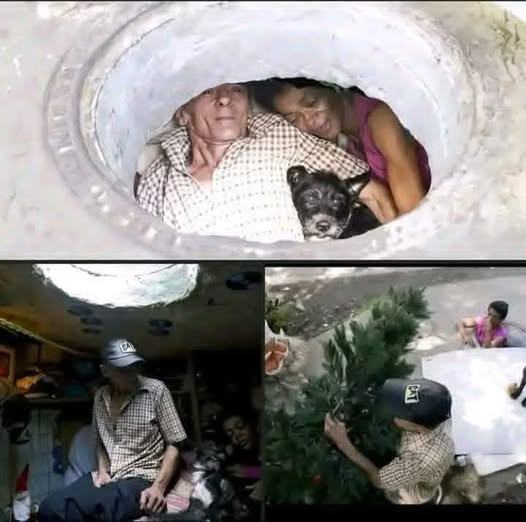
In many modern cities, the threshold between stability and total displacement has become dangerously thin.
As the cost of living climbs and affordable housing becomes a vanishing luxury, an increasing number of individuals are forced to navigate a world that no longer has a place for them. For one couple and their dog, this reality has manifested in the most utilitarian of spaces: the hollow, cold interior of a massive concrete drainage pipe. This is not a choice made for comfort or a bohemian desire for “tiny living”; it is a stark, calculated act of survival in an environment that…
In many modern cities, the threshold between stability and total displacement has become dangerously thin. As the cost of living climbs and affordable housing becomes a vanishing luxury, an increasing number of individuals are forced to navigate a world that no longer has a place for them. For one couple and their dog, this reality has manifested in the most utilitarian of spaces: the hollow, cold interior of a massive concrete drainage pipe. This is not a choice made for comfort or a bohemian desire for “tiny living”; it is a stark, calculated act of survival in an environment that offers few alternatives.
From a distance, the pipe appears to be nothing more than discarded construction material—a relic of a city’s infrastructure. However, as one draws closer, a human story emerges from the gray concrete. Inside, a mattress is wedged against the curved wall, and personal belongings are arranged with a heartbreaking level of care. There are small items—a comb, a stack of folded clothes, perhaps a book—that suggest a daily routine persists even here. The narrow, circular space offers only the most basic protection from the elements, but in the absence of a traditional home, this improvised shelter becomes a sanctuary where the couple can rest, regroup, and simply endure the night.