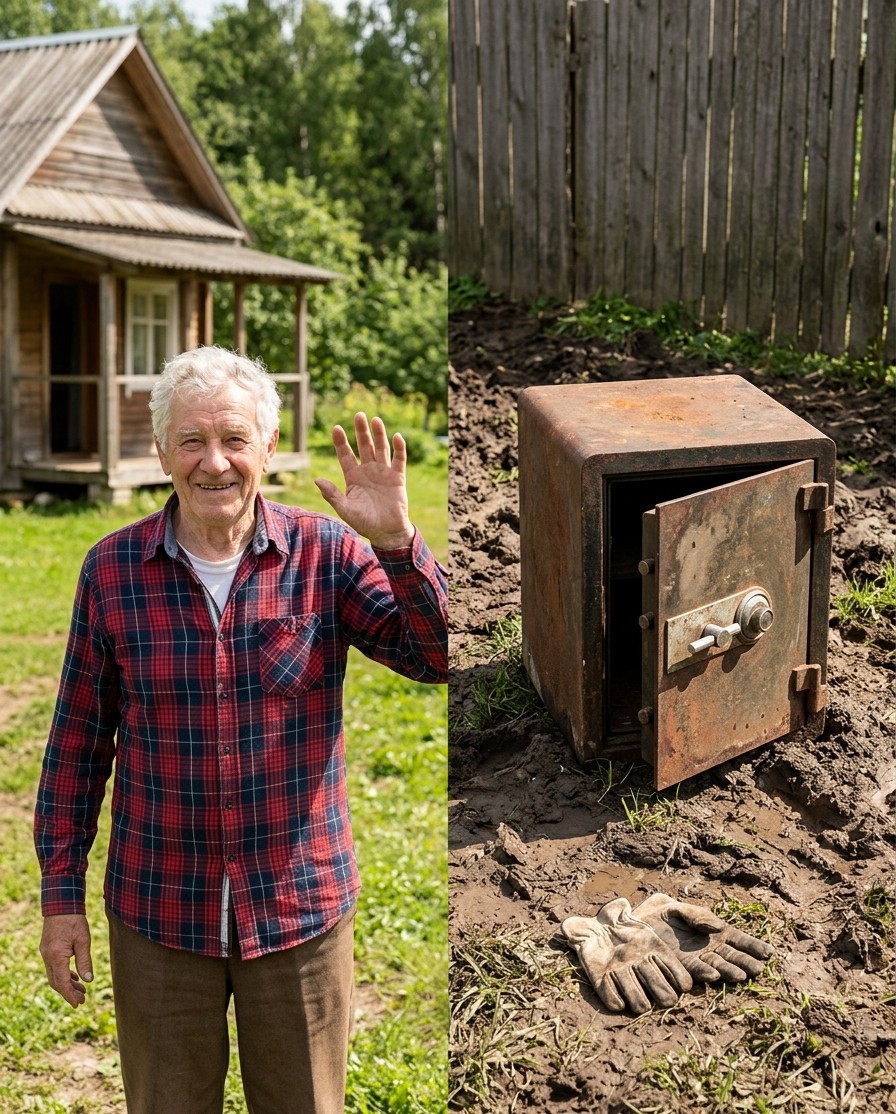
I am a thirty-eight-year-old mother, raised by my own mother, Nancy, to keep life orderly and certain things unspoken. I followed that structure closely. My life with my husband, Richie, was steady, predictable, and, I believed, complete.
That sense of certainty shifted when my elderly neighbor, Mister Whitmore, passed away. The morning after his funeral, I found an envelope in my mailbox with my name written in his careful, familiar handwriting. Inside was a short letter.
He wrote that something had been buried in his yard for decades and asked me to look beneath the old apple tree.
Richie offered to come with me, but I chose to go alone. The yard was quiet, the tree unchanged. I began digging without fully knowing what I expected to find.
It didn’t take long before the shovel hit something solid—a small metal box, worn by time. Inside, there was a photograph of a young man holding a newborn under hospital lights. Alongside it was my original birth bracelet.
The letter beneath explained what the items already suggested. My mother had been nineteen. The man had been forced out of her life.
He had not left entirely—he had moved next door. Close enough to see, but not to speak.
Richie found me still sitting there, trying to make sense of something that didn’t fit into the life I thought I understood. I called my mother.
When she arrived and saw the photograph, there was no need for questions to begin with. She explained the pressure she had faced, the conditions placed on her, and the decision she made to move forward without him. She said it was to protect me.
I listened, but I didn’t leave it there. Protection can be real, but so can avoidance. And the two are not always the same.
The days that followed were not loud, but they carried weight.
Family members offered their views, some in defense, some in quiet agreement. At one dinner, my aunt said my mother had done what she had to do. I answered calmly that she had done what she felt able to do at the time—but that did not remove the impact of what was left unspoken.
My mother apologized. Not as a resolution, but as an acknowledgment.
Later, I visited his grave. I brought apple blossoms, not as a gesture of sentiment, but as something simple and fitting.
We had lived side by side for years without knowing the truth of that closeness. That cannot be changed.
What can change is what I carry forward.
Forgiveness, if it comes, will take time. But clarity has already arrived.
And some truths, once uncovered, no longer ask to be buried again.
Linda spent her sixtieth birthday preparing a careful meal for her six children. For years, she had carried the weight of the household alone after her husband left, raising them through different stages of life until they stood on their own. That evening, she set the table with intention—linen napkins, polished china, small details that mattered to her.
She expected noise, presence, something shared. But as the hours passed, the house remained still. By nine, the food had cooled, the candles had burned low, and her calls went unanswered.
What began as anticipation settled into something quieter, heavier—the feeling of being overlooked.
At fifteen minutes past nine, a knock came at the door. A young police officer stood outside and handed her a note from her youngest son, Grant. The message was brief and unclear, asking her not to question anything and to come with him.
The request carried no explanation, and the way it was delivered left little room for ease. She got into the car, not because she felt reassured, but because something in her told her it needed to be followed through. The drive was silent, and uncertainty filled the space where answers should have been.
When they arrived at the community center, the lights came on to reveal her children waiting inside.
There was a banner, an attempt at celebration—but the moment did not land the way they intended. Linda did not move toward them immediately. The evening she had just lived through was still present.
She spoke clearly about what had happened—the hours alone, the unanswered calls, the confusion of being brought there without explanation. It wasn’t anger without reason. It was the result of being set aside without care.
The atmosphere shifted. What they had planned as a surprise now stood in contrast to what she had experienced.
Then another car arrived, and Grant entered in uniform. The son she had once worried about had quietly built something steady for himself.
His intention had been to show that change—to offer something meaningful. But intention and impact had not aligned. What he wanted to give had been overshadowed by how it was carried out.
Still, something in the room adjusted.
Not everything was undone, but it was understood more clearly. Linda’s response softened—not by forgetting what had happened, but by seeing what had been attempted beneath it. They sat together, not at the table she had prepared, but in a simpler setting.
It wasn’t the evening she had imagined, but it was no longer empty either.
Before the night ended, her children spoke with more awareness than they had shown before. Not promises made lightly, but an acknowledgment that presence matters, and that care is not something to assume.
And sometimes, that realization comes after a moment that should have been handled better—but still leaves something worth keeping.
Aviation Incident Raises Safety Concerns
An accident during landing at LaGuardia Airport in New York City on Sunday, March 22, has drawn attention to the precision required in coordinated operations. Reports indicate that an aircraft collided with an emergency vehicle on the runway, resulting in the loss of both pilots onboard.
Incidents of this nature do not come from a single failure, but from a breakdown within a system that depends on clear communication and timing.
Miscommunication During Emergency Response
Initial findings suggest that emergency crews were responding to a separate situation when a lapse in coordination with air traffic control led to the vehicle being positioned incorrectly. Audio recordings and footage reportedly capture the moments leading up to the collision, including acknowledgment of error. While investigations will determine exact responsibility, the situation reflects how even brief misalignment in critical systems can carry serious consequences.
Passenger Recounts the Moment
One passenger, Rebecca Liquori, described the experience from inside the aircraft.
She recalled hearing a scraping sound, followed by a sudden impact. For those onboard, the uncertainty in those moments was as difficult as the event itself. Without clear information, passengers had to respond quickly, unsure of what might follow.
Liquori, a nurse, noted that people moved to evacuate not out of panic, but out of a shared understanding that hesitation could increase risk.
Pilots Credited With Minimizing Harm
As more details emerged, attention turned to the actions taken in the cockpit. According to passenger accounts, the pilots reduced speed before impact, which likely limited the severity of the collision. Their decisions, made under pressure and with little margin for error, appear to have prevented a wider loss of life.
At the same time, their own lives were lost—a reminder that responsibility in such roles often carries unseen weight.
Officials Respond, Investigation Continues
Zohran Mamdani confirmed that a full investigation is underway. He also acknowledged the coordinated efforts of responders and passengers, noting that many acted with presence of mind during evacuation. In situations like this, outcomes depend not only on procedures, but on how individuals respond when procedures fall short.
Remembering the Victims
Beyond the technical questions now being examined, there remains the human loss at the center of the incident.
The two pilots are being remembered not only for their final actions, but for the responsibility they carried throughout their work. Their response in those last moments reflects a standard that is not defined by recognition, but by commitment to others, even under the most difficult conditions.
A Measured Reflection
Events like this often lead to calls for immediate answers. Those answers matter, but so does how they are reached.
Careful investigation, clear accountability, and steady correction are what prevent repetition. What remains now is not only to understand what happened, but to ensure that what can be corrected, is.
Rising Middle East Tensions and Policy Remarks
Amid ongoing strain in the Middle East following earlier joint military actions by the United States and Israel, Donald Trump shared an update on Truth Social. He described recent discussions between the US and Iran as “very productive,” suggesting that there may be movement toward easing tensions.
In the same message, he stated that he had instructed what he referred to as the “Department of War”—rather than the official Department of Defense—to delay a planned military action targeting Iran’s energy infrastructure. The delay, he noted, would last five days and depend on how negotiations develop.
Public Reaction and Focus on Presentation
While the substance of the message carried geopolitical weight, much of the public response shifted toward how it was delivered. Readers pointed out several spelling and phrasing errors, drawing attention to the tone and structure of the post.
Reactions ranged from criticism to concern, with some viewing the lack of precision as a sign of haste. In matters tied to international stability, even small lapses in communication tend to draw heightened scrutiny.
Post Removed and Reissued
The original version, written entirely in capital letters, was later deleted. By that point, it had already circulated widely through screenshots.
A revised version followed, correcting the earlier mistakes while keeping the central message unchanged. In it, Trump again emphasized that discussions with Iran had been constructive and that there remained a possibility of reducing hostilities. He confirmed that military actions would remain paused during ongoing talks and closed with a brief note of acknowledgment to readers.
A Measured Reflection on Communication
This moment illustrates how communication, particularly in sensitive geopolitical contexts, carries more than information—it reflects judgment and discipline.
The message itself suggested a pause and an opening for dialogue, which holds value. At the same time, the way it was presented became part of the story. When stakes are high, clarity is not a formality; it is part of responsibility.
A Midnight Call That Changed Everything
The phone rang in the middle of the night.
Even before I answered, something in me had already tightened. When I saw Leo’s name, I didn’t hesitate—but I wasn’t calm either.
Leo is nineteen. My son.
For years, it has been just the two of us, learning how to move forward together. He still kisses my cheek before leaving the house, still says “Love you, Mom” without holding back. That kind of closeness doesn’t come easily, and I never took it for granted.
But that night, his voice carried something unfamiliar.
A Stranger Coming Home
“Mom?” he said, quieter than usual.
“What’s wrong?” I asked.
“Nothing… just stay awake for me.”
There was a pause.
“I’m bringing someone home.”
“At this hour?” I tried to keep it light.
“A girl?”
“No,” he said. “She’s important. I want you to meet her.”
There was something in the way he said it—not urgent, but weighted.
Less than an hour later, the hospital called.
There had been an accident.
At the Hospital
By the time I arrived, everything felt distant and immediate at the same time.
Leo was alive, but in surgery. The other passenger—a young woman—was in critical condition, with no identification.
A nurse handed me a small bag with her belongings. Inside were ordinary things—until I reached a silver locket.
I opened it.
Inside was a photo I knew.
Not because I had kept it—but because I had tried not to remember it.
Me, younger, holding a newborn I never raised.
Some things don’t disappear. They wait.
The Truth Comes Forward
Hours later, Leo woke. Weak, but aware.
His first concern wasn’t himself.
“Is she okay?” he asked.
I told him what I could.
He explained how he had met her—Elena.
She didn’t have much of a story to share, only fragments. The locket was one of the few things she carried with certainty. He said she felt safe with him, though neither of them fully understood why.
I asked him her name again, just to be sure.
“Elena,” he said.
“She showed me the photo. I thought you might recognize it.”
There was no reason to hold back anymore.
I told him the truth. About the pregnancy.
The decision. The child I had let go of before I was ready to understand what that meant.
He listened.
“She’s my sister?” he asked.
“Yes,” I said.
Facing What Was Left Unsaid
Leo asked me to see her.
Not as a stranger—but as someone I had already known, in a way that hadn’t been allowed to continue.
When I entered her room, there was no clarity, only presence. Machines, quiet movement, and a face that felt both unfamiliar and known.
I didn’t try to explain everything at once.
I held her hand and spoke simply.
About the past.
About what I didn’t do. About what I could do now.
“I’m here,” I said. “And I’m not leaving.”
There was a small movement.
Then another.
Her eyes opened slowly.
“You’re the woman in the locket,” she said.
“Yes.”
Something Reconnected
The next day, Leo walked in beside me. Still recovering, but steady enough.
“Hey,” he said.
“Hey,” she answered.
There was no rush to define what we were. No need to name it immediately.
“I guess I finally brought you home,” he said quietly.
She looked at both of us.
“Yeah,” she replied.
“You did.”
What Remains
Not everything can be undone. Time moves in one direction, and some decisions carry forward whether we’re ready or not.
But there are moments when something returns—not perfectly, not completely—but enough to begin again.
Family is not always built in one clear line. Sometimes it separates.
Sometimes it comes back together in a way you didn’t expect.
What matters is what you do when it does.
And whether, this time, you stay.