The Duke Found His Enemy’s Bride Left Out In The Cold—And Instead Of Walking Away, He Made A Choice No One Expected…

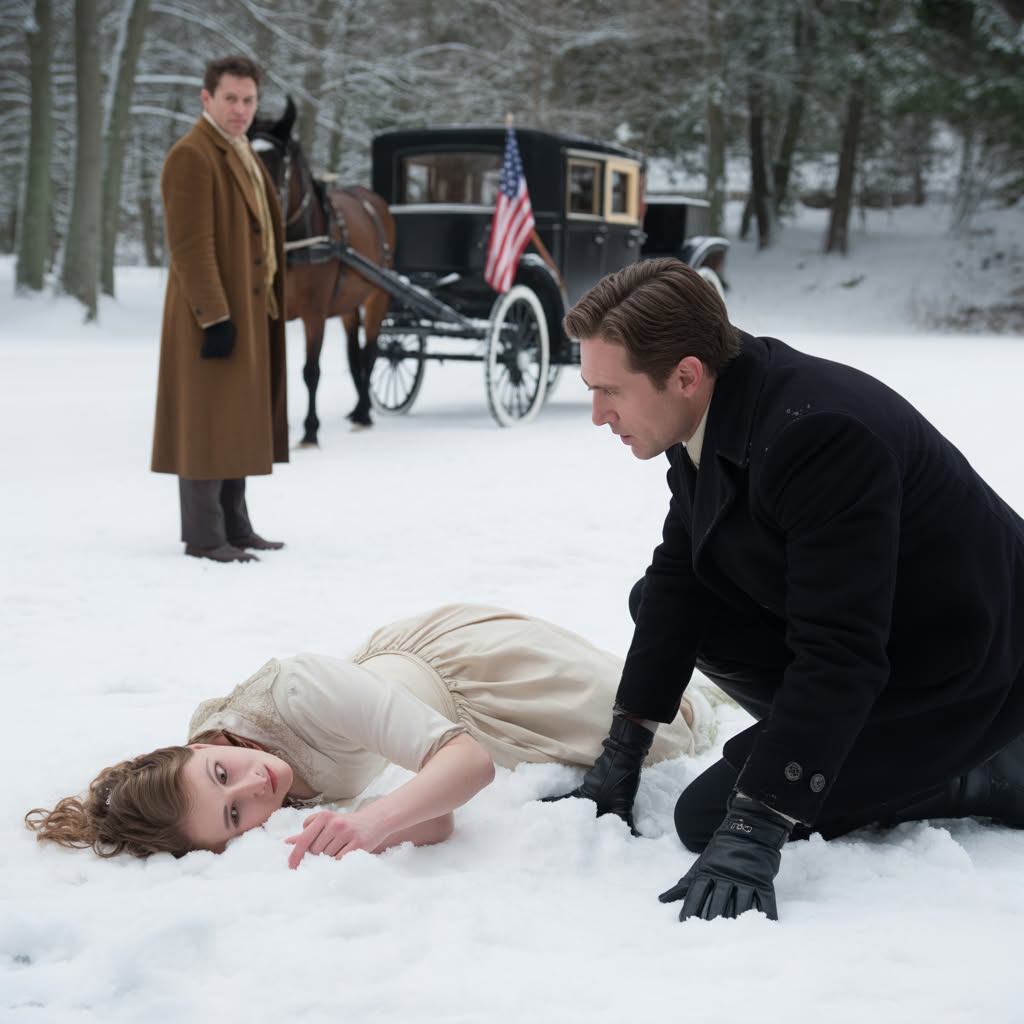
The snow had stopped falling an hour ago, leaving the forest road silent except for the wind. Rosalind Greymont lay in a drift beside the path, her cream traveling dress soaked through, her left arm bent at an angle that promised pain if she tried to move it. Blood had dried along her temple where her head struck a rock when Caspian Holtworth pushed her from the carriage.

She remembered his face in those final moments. Not angry, not cruel—just practical, like he was discarding something broken.

“You know too much, Rosalind,” he’d said, his voice steady over the sound of the storm. “I gave you a choice. Keep quiet. Marry me. Play your role.”

“But you had to be righteous. You had to threaten to expose everything.”

She’d found the ledgers three days ago, hidden in his father’s study during what was supposed to be a pleasant visit to the Holtworth country estate. Numbers that didn’t match. Investments that didn’t exist. Dozens of families—widows, orphans, elderly lords who trusted Lord Holtworth with their money—all of them being systematically robbed.

When she confronted Caspian, demanding he make it right before she would marry him, he smiled. That same charming smile he’d used when he proposed.

“You’re very noble,” he’d said, “and very foolish.”

The next morning, he suggested a romantic carriage ride through the forest to clear the air before the wedding. She believed him because she wanted to believe him.

Fool.

Now she lay in the snow, watching her breath form small clouds that dissipated into nothing. The cold had stopped hurting twenty minutes ago. She knew what that meant.

Her body was giving up.

No one would find her. This road was barely used in winter. Caspian had planned it perfectly: when she didn’t return, he’d express concern, organize a search party in the wrong direction, and eventually declare it a tragic accident. He’d say she insisted on walking ahead when the carriage wheel stuck.

“I lost sight of her in the storm.”

Her family would grieve. The wedding would be canceled. Caspian would wait a respectable period, then marry someone else—someone who didn’t ask questions—and the families he was robbing would never know.

Rosalind closed her eyes. She tried to do the right thing.

It had killed her.

The sound of hoofbeats made her eyes snap open. A single rider moved fast through the forest, probably someone trying to get home before dark. She tried to call out, but her voice was barely a whisper. Her throat was too cold.

The rider drew closer.

Please, she thought. Please see me.

The horse slowed. Stopped.

Rosalind forced her head to turn, pain shooting through her neck. Through blurred vision, she saw a man dismount—tall and dark against the white landscape. He moved with swift efficiency, kneeling beside her.

“Christ,” he muttered.

Strong hands touched her face, her neck, checking for injuries. His gloves were leather, expensive. His coat was black wool, tailored.

“A gentleman, then. Or a lord.”

“Can you hear me?” His voice was deep, controlled. “Can you speak?”

“Cold,” she managed.

“I know. Stay still.”

He removed his coat and wrapped it around her, then lifted her with surprising gentleness. She gasped as pain flared through her arm.

“Your arm is broken,” he said, carrying her toward his horse. “Possibly ribs as well. How long have you been here?”

“Don’t know.”

He positioned her carefully on the saddle, then mounted behind her, one arm holding her secure against his chest.

“The nearest inn is fifteen kilometers,” he said. “Can you stay conscious that long?”

“I’ll try.”

“Try harder. I didn’t find you just to watch you die.”

The ride blurred into fragments: the warmth of his body behind her, the steady rhythm of the horse, his voice occasionally asking questions to keep her awake.

“What’s your name?”

“Who did this to you?”

“Stay with me.”

She must have lost consciousness despite his efforts, because the next thing she knew, she was being carried into warmth and light. Voices surrounded her, a woman’s cry of alarm, the man’s steady commands.

“Send for a physician. Hot water. Blankets. Now.”

Rosalind was laid on something soft—a bed. Hands removed her wet clothing and replaced it with dry linen. The physician came, his touch impersonal as he set her arm, bound her ribs, stitched the wound on her temple.

Through it all, she heard the man’s voice in the background speaking to the innkeeper.

“She’ll need the room for at least a week. Send the bill to Ravenfield Manor, and send word to no one without my permission. Is that clear?”

Ravenfield Manor.

Even through the haze of pain and exhaustion, Rosalind recognized the name.

Dorian Vale, Duke of Ravenfield—the most powerful man in the Northern Territories, the man Lord Holtworth called the enemy at every family dinner.

She’d been found by Caspian’s greatest rival.

Rosalind didn’t know if that made her lucky or damned.

She woke to firelight and silence. The room was small but clean, the bed soft beneath her back. Her left arm was splinted and bound, her head throbbed, but she was warm and alive.

“You’re awake.”

Rosalind turned her head carefully toward the voice. The Duke sat in a chair beside the window, watching her with pale gray eyes that seemed to see too much. In the firelight, his features were sharp—strong jaw, straight nose, dark hair touched with silver at the temples—despite looking no older than his early thirties.

He wore no coat now, just a white shirt and dark waistcoat, sleeves rolled to his elbows. He looked like a man who had better things to do than sit vigil over a stranger.

“How long?” she asked, her voice rough.

“Two days. The physician says you’re fortunate. Another hour in the cold and we’d be having a different conversation.”

“Thank you.”

The words felt inadequate. You saved my life.

“Yes.”

He stood, walking to the small table beside her bed where a pitcher of water waited. He poured a glass and helped her sit up enough to drink.

“Now you’re going to tell me why I had to.”

Rosalind drank slowly, buying time.

“I don’t understand.”

“You were left in the middle of a forest road during a snowstorm. Your injuries suggest you fell from a moving carriage. Someone wanted you dead—or at least gone.”

He set the glass down, his gaze never leaving her face.

“Who?”

She could lie. She should lie. But what was the point?

“Lord Caspian Holtworth,” she said quietly.

Something flickered in the Duke’s eyes—recognition, interest.

“You’re the Holtworth bride,” he said. It wasn’t a question.

“Was,” she managed. “I suppose I’m nothing now.”

“Why would your fiancé try to kill you?”

Rosalind looked at the fire.

“Because I found proof that his family has been embezzling from their investors for years. Widows. Pensions. Trust funds. Everything.”

“When I told him I couldn’t marry him unless he made it right, he decided I was a problem that needed to disappear.”

“And you believed he’d take you for a romantic carriage ride after that conversation.”

“I wanted to believe people could change.”

She met his eyes.

“Clearly, I was wrong.”

The Duke studied her for a long moment. Then, unexpectedly, he smiled. It was a small, cold thing.

“You threatened to expose the Holtworths.”

“Yes. I have proof. I saw the ledgers. I can identify which investments are fraudulent. I know names, dates, amounts…”

She paused.

“But I don’t have the documentation. Caspian has that.”

“But you remember enough to destroy them.”

“If anyone would believe me.”

Rosalind laughed bitterly.

“Who would? I’m a disgraced bride with no family connections and no credibility. Caspian will say I’m lying out of spite.”

The Duke walked back to his chair, settling into it with the grace of a predator.

“What if someone with credibility backed your claims?”

“Like who?”

“Like me.”

Rosalind’s heart beat faster.

“Why would you do that?”

“Because I’ve been trying to destroy the Holtworths for twenty years. They’ve blocked every reform I’ve proposed, undermined every alliance I’ve built, and personally cost me more than you can imagine.”

His voice was quiet, controlled, utterly certain.

“You have information I need, and you need protection they can’t penetrate.”

“What are you suggesting?”

Dorian Vale leaned forward, elbows on his knees.

“Marry me instead.”

The room seemed to tilt.

“You can’t be serious.”

“I’m always serious about strategy. You marry me, you become a duchess—untouchable. Under my protection, Caspian can’t reach you.”

“You help me build a case against his family. Testimony. Details. Everything you remember. We destroy them together.”

“That’s insane.”

“That’s practical.” He stood. “You have no family who can shelter you. If you try to go home, Caspian will find a way to finish what he started.”

“If you try to disappear, you’ll spend your life looking over your shoulder. But as my wife, you’re beyond his reach.”

Rosalind tried to sit up fully, gasping as pain shot through her ribs.

“You don’t even know me.”

“I know enough. You chose conscience over safety. You threatened a powerful family because it was right. You survived being left to die.”

He walked to the window, looking out at the snow-covered landscape.

“I’ve spent years playing politics with these people. You took action. I respect that.”

“But you don’t love me.”

“No.”

“And you don’t love me.”

“This isn’t about romance, Miss Greymont. It’s about survival and strategy.”

He glanced back at her.

“I’ll have papers drawn up. You’ll have your own rooms in Ravenfield Manor. We’ll maintain separate lives. In public, we’ll play the role of a respectable marriage.”

“In private, we’ll work to dismantle the Holtworths piece by piece.”

“And if I refuse?”

“Then I’ll pay for your recovery here and leave you to your fate.”

“But know this—Caspian believes you’re dead. The moment you surface anywhere, that changes. He’ll come for you, and next time I won’t be there to find you.”

The fire crackled in the silence. Rosalind thought of Caspian’s face as he pushed her from the carriage. The cold. The certainty that she would die alone. She thought of the families being robbed, the widows losing everything, the children who would inherit nothing because of Holtworth greed.

And she thought of the man by the window offering her a devil’s bargain wrapped in protection.

“If I do this,” she said slowly, “I want your word that you’ll pursue justice for the families they’ve harmed. Not just revenge—justice.”

Dorian turned to face her fully.

“You’re negotiating terms while lying in a sick bed with broken bones.”

Those are my terms.

Something that might have been respect crossed his face.

“Agreed. Justice, not just revenge. Anything else?”

“I want to know what you get out of this beyond political victory.”

He was quiet for a moment.

Then, “The Holtworths killed someone I cared about five years ago. They made it look like an accident. I’ve never been able to prove it.”

His voice remained steady, but his eyes were ice.

“So yes, Miss Greymont, I want revenge. But I’ll settle for justice if that’s what it takes to destroy them.”

Rosalind understood revenge. She understood wanting someone to pay for their cruelty.

“One more condition,” she said. “If at any point I become a liability to you—if this arrangement puts you in danger—you let me go. No argument.”

“That won’t happen.”

“Promise me anyway.”

Dorian crossed the room and stood beside her bed. He extended his hand.

“I promise. Do we have an agreement?”

She looked at his hand—strong, scarred across the knuckles—belonging to a man who had just offered to make her a duchess so they could destroy their common enemies.

She’d been left in the cold to die. Now she was being offered a chance to fight back.

Rosalind took his hand.

“We have an agreement.”

His grip was firm, warm.

“Then rest, Miss Greymont. When you’re well enough to travel, I’ll take you to Ravenfield. We have work to do.”

He released her hand and moved toward the door.

“Your Grace,” she called after him.

He paused, looking back.

“Why were you on that road in the middle of a storm?”

For a moment his expression shifted—something almost vulnerable beneath the controlled surface.

“I was coming back from my northern estates. That road is the fastest route, even in winter.”

He opened the door.

“I don’t believe in fate, Miss Greymont. But I’m grateful I chose speed over comfort that day.”

Then he was gone, leaving Rosalind alone with the fire and the weight of the choice she just made. She’d been abandoned in the cold by a man who saw her as a problem.

Now she’d bound herself to a man who saw her as a weapon.

Rosalind closed her eyes and hoped she’d chosen the lesser danger.

Four days later, Rosalind sat in a carriage emblazoned with the Ravenfield crest, watching the countryside roll past while her ribs ached with every bump in the road. The physician had protested the journey, but the Duke had simply paid him double and ordered the carriage prepared with extra cushions.

“The longer you stay at that inn, the more questions people ask,” Dorian had said that morning. “Ravenfield is isolated, safer, and we have better physicians.”

Now she was traveling to a manor she’d never seen, to marry a man she barely knew, to become part of a scheme she didn’t fully understand.

Dorian rode on horseback alongside the carriage, checking on her periodically. He was a careful guardian, she’d learned—impersonal, but thorough. He made sure she ate, that her injuries were tended, that she had everything she needed.

But he never touched her beyond necessity, never asked about her life before, never revealed anything of himself. It was like being cared for by a very efficient ghost.

As the sun began to set, they crested a hill, and Ravenfield Manor came into view.

Rosalind expected something grand. She hadn’t expected a fortress.

Gray stone walls rose four stories, topped with crenellations like a castle. Narrow windows stared out over manicured grounds that stretched for miles. The main building was flanked by two wings, creating a U-shape around a central courtyard.

Everything about it spoke of power, age, and absolute control.

“It’s beautiful,” she said when Dorian appeared at the carriage window.

“It’s defensible,” he corrected. “My family built it during the Civil War. We’ve held it ever since.”

He opened the carriage door.

“Can you walk?”

“I can try.”

He helped her down carefully, his hands steady on her waist. The moment her feet touched the ground, the manor’s main doors opened and staff began streaming out.

Rosalind froze.

“I thought you said this would be private.”

“The marriage will be. But the staff needs to meet their new duchess.”

He offered his arm.

“Remember, you’re not a victim here. You’re the woman who survived what should have killed her. Stand like it.”

She took his arm, drawing on every lesson her mother had ever taught her about posture and deportment. Her ribs screamed in protest, but she kept her spine straight.

The staff assembled in two lines, at least thirty people—from the ancient butler to the youngest scullery maid. At the front stood a woman with steel-gray hair and a spine to match.

“Your Grace,” the woman said with a precise curtsy. “Welcome home.”

Dorian nodded.

“This is Miss Rosalind Greymont. She’ll be the Duchess of Ravenfield within the week. She’s recovering from an accident and requires care. See to it.”

The woman’s sharp eyes took in Rosalind’s splinted arm, the fading bruises on her temple, the careful way she held herself. Something like approval flickered across her face.

“Of course, Your Grace. Welcome to Ravenfield, Miss Greymont. We are honored to serve you.”

“Thank you,” Rosalind said, keeping her voice steady despite the pain. “I look forward to learning from you all.”

It was a simple response, but the woman’s expression softened slightly.

“Your rooms have been prepared in the East Wing. If you need anything, I am at your disposal.”

Dorian released Rosalind’s arm.

“Mrs. Langley will show you to your quarters. Rest tonight. Tomorrow, we’ll discuss arrangements.”

He walked away before she could respond, disappearing into the manor like he’d already forgotten she existed.

Mrs. Langley cleared her throat.

“This way, Miss.”

The manor’s interior matched its exterior—stone and dark wood, tapestries depicting battle scenes, portraits of stern-faced ancestors. Mrs. Langley led Rosalind through corridors that seemed to go on forever, up a grand staircase, and finally into the East Wing.

“The Duke keeps to the West Wing,” Mrs. Langley explained. “You’ll find him in the library most evenings or in his study during the day. He values privacy.”

“And what does he value in a duchess?” Rosalind asked.

Mrs. Langley paused, her hand on a door handle.

“Honestly, I don’t know. We’ve never had one before.”

She opened the door.

“These are your rooms. I hope they suit.”

The suite was larger than Rosalind’s entire childhood home: a sitting room with a fireplace, a bedroom with a four-poster bed, a dressing room with empty wardrobes, and a private bathing room with a copper tub.

“It’s… overwhelming,” Rosalind admitted.

“You’ll adjust. Most do.”

Mrs. Langley moved to the fireplace, stoking it to life.

“The Duke has ordered a seamstress to call tomorrow. You’ll need appropriate gowns. He’s also arranged for tutors—etiquette, dance, household management.”

“You have six weeks before your first public appearance. Six weeks to become a duchess.”

“Being one takes longer,” Mrs. Langley added, straightening. “But if I may speak frankly, Miss: the Duke doesn’t make careless decisions. If he brought you here, he believes you can do this. Don’t prove him wrong.”

After Mrs. Langley left, Rosalind sank onto the edge of the bed, finally allowing herself to feel the full weight of exhaustion. Her arm throbbed, her ribs ached, her head pounded, but she was alive—and she’d made a bargain that would either save her or destroy her.

Through the window, she could see the forest in the distance, dark trees against a darkening sky. Somewhere out there was the road where she’d nearly died. The spot where Caspian had left her.

He thought she was dead.

Good.

Let him think that while she learned to become something he couldn’t touch.

A knock at the door startled her.

“Come in.”

A young maid entered carrying a tray.

“Mrs. Langley sent dinner, miss. And the Duke asked me to give you this.”

She handed Rosalind a small leather-bound book.

“What is it?”

“His instructions, miss. He said you should read it tonight.”

The maid left.

Rosalind opened the book, finding pages filled with precise, angular handwriting.

Miss Greymont,

You’ll find the next six weeks challenging. I’m not a patient teacher, and I have high expectations, but I believe you’re capable of meeting them.

These pages contain everything you need to know about Ravenfield, its history, its politics, and the role you’ll play. Study them. Your survival depends on understanding this world.

We’ll dine together each evening at eight. Be punctual. We’ll use that time to discuss your progress and coordinate our strategy against the Holtworths.

Remember our agreement. You help me destroy them. I keep you safe. Everything else is negotiable.

—Vale

Rosalind closed the book and looked at the dinner tray. Cold roast chicken, bread, cheese. Simple food, but more than adequate.

She ate mechanically, her mind already racing through the implications of what she’d agreed to.

She’d been left in the cold to die by a man who pretended to love her. Now she’d bound herself to a man who never pretended anything.

Somehow, that felt like the more honest danger.

The next three weeks passed in a blur of lessons and bruises. The tutors Dorian hired were thorough and merciless. Rosalind learned which fork to use for fish, how to curtsy to varying ranks of nobility, which topics were acceptable in polite conversation, and which would end her career before it began.

She learned that Ravenfield Manor had been in the Vale family for four hundred years, that Dorian’s grandfather had been a war hero, that his father had died when Dorian was nineteen—leaving him to manage estates, investments, and political alliances most men didn’t master until middle age.

She learned Dorian woke at dawn, worked until midnight, and never seemed to sleep. He hated small talk but excelled at strategic conversation. He remembered everything anyone ever told him and used that information like currency.

And she learned he was ruthlessly focused on destroying the Holtworths.

“Tell me again about the ledgers,” he said one evening over dinner. They sat at opposite ends of a table built for twenty, the distance between them symbolic.

Rosalind set down her fork.

“Lord Holtworth’s study. Third shelf behind a copy of Principles of Political Economy, red leather binding, three volumes.”

“What was the largest embezzlement you saw?”

“Lady Thornbury’s late husband’s trust. Fifty thousand pounds supposed to be invested in textile manufacturing. Instead, it was diverted to cover the Holtworth family’s personal debts.”

Dorian made a note in the small book he always carried.

“Lady Thornbury has influence with the Queen. If we can prove that theft, it starts to build momentum.”

“How do we prove anything without the ledgers?”

“We find other evidence—bank records, witnesses, patterns of behavior.”

He looked up.

“And we get you in front of people who matter. Once you’re established as the Duchess of Ravenfield, your word carries weight. It’s harder to dismiss you as a scorned bride.”

“So I’m bait.”

“You’re an asset. There’s a difference.”

“Is there?”

Dorian’s expression didn’t change.

“Bait is disposable. Assets are protected. Which do you think I’d fight for?”

It wasn’t a declaration of affection, but it was, in its way, a promise.

“The wedding is scheduled for Friday,” he continued. “Private ceremony, just us and two witnesses. Afterward, you’ll legally be untouchable by Caspian. Then we accelerate the plan.”

“What plan exactly?”

“You’ll make your first public appearance in three weeks. Lady Peyton’s weekend house party. It’s the most exclusive social event of the season.”

He paused.

“Including the Holtworths.”

Rosalind’s stomach turned.

“You want me to face him?”

“I want you to stand beside me as my duchess while he watches everything he threw away become something he can never touch.”

“And I want you to do it with your head high.”

“What if he tries something?”

“He won’t. Not with me there. Not with witnesses.”

Dorian’s voice was cold and certain.

“But he will know you survived, and that knowledge will eat him alive.”

That night, Rosalind stood at her window, watching snow fall over the gardens. In two days, she’d marry a man who rescued her from death. In three weeks, she’d face the man who tried to kill her.

She should have been terrified.

Instead, she felt something sharper—something that tasted like rage and justice mixed together. Caspian left her in the cold because he thought she was powerless.

It was time to prove him wrong.

The wedding took place in Ravenfield’s private chapel on a Friday morning when frost covered the windows like lace. Rosalind wore a simple gown of pale blue silk, the only formal dress the seamstress had finished in time. Her arm was still splinted, hidden beneath long sleeves.

Dorian stood at the altar in formal black, his expression unreadable. The vicar looked uncomfortable, clearly aware this was not a love match.

The ceremony was brief. Traditional vows spoken without emotion, rings exchanged with efficiency. When the vicar pronounced them married, Dorian didn’t kiss her. He simply offered his hand, and she took it.

“The Duchess of Ravenfield,” the vicar said, and Rosalind felt the weight of the title settle over her like armor.

They signed the marriage registry in silence. Mrs. Langley and the butler witnessed, then quietly left.

“It’s done,” Dorian said, releasing her hand. “You’re safe now. Legally, financially, socially—Caspian can’t reach you.”

“Don’t thank me. We both got what we needed.”

He adjusted his cuffs, preparing to leave.

“The staff will celebrate tonight—traditional for a ducal wedding. You should make an appearance.”

“And you?”

“I have work.”

He paused at the chapel door.

“You did well today. You looked exactly like a duchess should.”

It wasn’t a compliment about her appearance. It was approval of her performance, and somehow that meant more.

That evening, Rosalind attended the servants’ celebration in the great hall. Mrs. Langley helped her dress in a deep green gown that made her feel almost beautiful despite the splint. The staff toasted her health, wished her happiness, and welcomed her to Ravenfield with genuine warmth.

Dorian never appeared.

Rosalind found him later in the library, surrounded by papers and ledgers. He looked up when she entered, raising an eyebrow.

“Shouldn’t you be celebrating?” he asked.

“I wanted to thank you properly for everything.”

“You already did.”

“I mean it.” She stepped closer. “You saved my life. You gave me protection. You’re helping me seek justice.”

“I know this marriage serves your purposes, but it saved mine too.”

Dorian set down his pen, studying her with those pale gray eyes that seemed to see straight through her.

“You’re not what I expected.”

“What did you expect?”

“Someone more fragile. More damaged by what happened.”

“I am damaged,” Rosalind said quietly. “I just refuse to let it show.”

Something shifted in his expression.

“Good. Showing weakness in this world gets you killed.”

“Is that why you never show it?”

“I don’t have weaknesses.”

“Everyone has weaknesses, Your Grace.”

Dorian stood and walked to the fireplace. For a long moment he stared at the flames. Then, unexpectedly, he spoke.

“I had a sister younger than me by five years. Sweet, kind—everything this family didn’t deserve.”

His voice remained controlled, but Rosalind heard the edge beneath it.

“She fell in love with a man Lord Holtworth had chosen for his own daughter. When my sister refused to step aside, there was an accident.”

“I’m sorry.”

“The driver swore the wheel had been tampered with. But he was a servant. His word meant nothing, and Lord Holtworth had witnesses claiming my sister had been drinking.”

“The inquest ruled it an accident.”

Dorian’s hands clenched.

“I’ve spent five years gathering proof. I’ve never found enough.”

“But you never stopped trying.”

“No,” he said. “And I never will.”

He turned to face her.

“So when I tell you I’ll protect you from them, understand? It’s not altruism. It’s strategy. You’re the weapon I’ve been waiting for.”

Rosalind crossed the library until she stood close enough to see the lines of exhaustion around his eyes.

“Then let me be a weapon that actually strikes. Not just bait. Not just testimony.”

“Let me fight beside you.”

“You don’t know what you’re asking.”

“I know exactly what I’m asking. I want them to pay. For what they did to me, to your sister, to all the families they’ve robbed. I want justice.”

She held his gaze.

“And I want them to know I survived.”

Dorian studied her for a long moment.

Then, slowly, he nodded.

“All right. We’ll do this together. But you follow my lead. No impulsive actions. No confrontations without strategy.”

“Agreed.”

He extended his hand.

“Then welcome to the war, Duchess.”

She shook it, feeling the calluses on his palm, the strength in his grip.

“Thank you for letting me fight.”

“Don’t thank me yet. War isn’t clean, and the Holtworths won’t go down easily.”

That night, alone in her rooms, Rosalind stood at the window, watching the moon rise over Ravenfield’s gardens. She touched the ring on her finger, heavy gold with the Vale family crest.

She was the Duchess of Ravenfield now. Protected. Armed. Ready.

Somewhere in London, Caspian believed she was dead—rotting in some forgotten corner of the forest, buried by snow.

Soon, he’d learn the truth.

The woman he left in the cold hadn’t died.

She’d become something far more dangerous.

Three days later, Rosalind stood in Ravenfield’s drawing room, listening to Mrs. Langley explain the intricacies of seating arrangements for formal dinners when a messenger arrived from London.

“Your Grace,” the young man said breathlessly to Dorian. “Current news from Lord Peyton.”

Dorian opened the letter, his expression unchanging as he read. Then he looked at Rosalind.

“Lady Peyton has extended an invitation to her weekend house party. It’s in ten days, not three weeks as I’d planned.”

He handed her the letter.

“The Holtworths will be there. This is happening sooner than expected.”

Rosalind read the elegant script. Her hands trembled slightly.

Ten days.

Ten days until she faced Caspian.

“I’m not ready,” she admitted.

“You’re ready enough. Your arm has healed. The tutors say you’ve mastered the essentials.”

“And more importantly,” Dorian said, stepping closer, “you’re angry. That anger will carry you through. Use it.”

“What if I freeze? What if I can’t do this?”

“Then you remember what he did to you. You remember he left you in the cold to die.”

“And you walk into that house party as living proof that he failed.”

Mrs. Langley stepped forward.

“If I may, Your Grace, perhaps the duchess needs practice. A rehearsal of sorts.”

Dorian nodded slowly.

“Agreed. We’ll host a small dinner here three days from now. I’ll invite people who matter—minor nobility, a few political allies.”

“You’ll practice being the Duchess of Ravenfield in a controlled environment.”

715
179
238

Rosalind’s stomach churned.

“And if I fail at that—”

“You won’t,” Dorian cut in. “Because failure isn’t an option anymore.”

He turned to Mrs. Langley.

“Arrange it. Six guests. Formal dinner. All the traditional protocols.”

The next three days were a controlled nightmare. Rosalind practiced conversation, memorized names and titles, learned which topics were safe and which would end her credibility. The seamstress delivered three new gowns, each more elaborate than the last.

The night of the dinner, Rosalind stood in her dressing room, studying her reflection. Deep burgundy silk made her look older, more sophisticated. Sapphires—Dorian’s mother’s, apparently—glittered at her throat and ears. Her dark hair was arranged in an elegant style that hid the last traces of her injury.

She looked like a duchess.

She didn’t feel like one.

A knock at the door.

Dorian entered, dressed in formal black and white. He stopped when he saw her, something flickering across his face too quickly to identify.

“You look appropriate,” he said finally.

“Is that a compliment?”

“It’s an assessment.” He offered his arm. “Are you ready?”

“No,” she said honestly. “But I’ll do it anyway.”

“That’s all I ask.”

The guests were already assembled in the drawing room when they descended the grand staircase together. Rosalind recognized them from her studies: Lord and Lady Ashford, close political allies of Dorian’s; Lord Thornton, a widower with influence in banking; Lady Grantham, an older woman known for her sharp wit and sharper judgment; and Sir Edmund Price, a barrister with connections to Parliament.

“The Duke and Duchess of Ravenfield,” the butler announced.

All eyes turned to Rosalind. She felt their assessment like physical weight, searching for flaws, measuring her worthiness, judging whether she belonged.

Dorian’s hand covered hers where it rested on his arm—barely noticeable, but steady.

“Lord Ashford, Lady Ashford,” Dorian said smoothly. “May I present my wife, Rosalind.”

Rosalind curtsied exactly as her tutor had taught her.

“I’m delighted to meet you.”

Lady Ashford smiled, and it seemed genuine.

“And we you, Your Grace. Ravenfield has been without a duchess far too long.”

Dinner was a carefully orchestrated dance. Rosalind remembered which fork to use, which topics to pursue, how to deflect questions about her family without seeming evasive.

She laughed at Lord Thornton’s jokes, complimented Lady Grantham’s brooch, and engaged Sir Edmund in discussion about legal reforms for widows’ rights—a topic she actually cared about.

Dorian watched from the head of the table, his expression neutral.

But when Lady Ashford mentioned the embezzlement scandals plaguing London’s investment houses, Rosalind saw him lean forward slightly.

“It’s unconscionable,” Lady Ashford was saying. “These families trust their savings to supposedly reputable men, and they’re systematically robbed.”

“My late husband’s estate was managed by such an investment house,” Lady Grantham added. “I’ve often wondered if the returns were as honest as claimed.”

Rosalind saw her opening.

“Forgive me, but which house managed your husband’s estate?”

“Holtworth and Associates,” Lady Grantham said. “Do you know it?”

The room went silent. Every eye turned to Rosalind.

She met Lady Grantham’s gaze.

“I know it well. And if I were you, I’d demand a full audit of your account.”

“Why would you suggest that?” Lord Thornton asked.

Dorian’s voice cut through the tension.

“My wife has reason to believe the Holtworths may not be as trustworthy as their reputation suggests.”

“What kind of reason?” Sir Edmund asked, even implied.

Rosalind chose her words carefully.

“I was briefly acquainted with their family practices. What I observed troubled me—investments that existed only on paper, returns that seemed manufactured.”

“I can’t prove anything definitively, but I would never trust them with my own funds.”

“That’s quite an accusation,” Sir Edmund said.

“It’s an observation based on personal experience,” Rosalind replied. “Nothing more.”

Lady Grantham set down her wine glass with a sharp click.

“I think I will demand that audit. Thank you, Your Grace.”

The conversation shifted, but Rosalind felt the shift in the room. She’d planted seeds. Small ones, but seeds nonetheless.

After the guests departed, Dorian found her in the library nursing a glass of sherry.

“You did well tonight,” he said.

“I felt like I was walking on glass.”

“You were,” he said. “And you didn’t break.”

He poured himself whiskey.

“Lady Grantham will order that audit. When she finds discrepancies—and she will—she’ll talk. The rumors will spread.”

“Is that enough?”

“It’s a start. Reputations crumble from small cracks.”

He sat across from her.

“You planted the first crack tonight.”

Rosalind studied him.

“You arranged this, didn’t you? You invited Lady Grantham specifically because you knew she’d invested with them.”

“I arranged everything. That’s how I win.”

“And what happens when we actually face them? At Lady Peyton’s party?”

Dorian’s expression hardened.

“We make them bleed.”

The week before the house party passed in a storm of preparation—more lessons, more rehearsals, more strategic planning. Dorian drilled her on every name she’d encounter, every potential conversation, every possible trap.

“Caspian will try to discredit you,” he said during one of their evening sessions. “He’ll suggest you’re mentally unstable, that the accident damaged your mind, that you’re making wild accusations for attention.”

“How do I counter that?”

“By being calmer than he is. More rational. More credible. Let him get angry. You stay composed.”

The night before they were scheduled to leave for Ashcombe Hall, Rosalind couldn’t sleep. She kept seeing Caspian’s face as he pushed her from the carriage, kept feeling the cold, the certainty that she would die.

Around midnight, she gave up and went down to the library, seeking distraction in books. She found Dorian there, standing at the window with a glass of whiskey, staring out at the gardens.

“Couldn’t sleep?” he asked without turning.

“You?”

“I don’t sleep much.” He glanced at her. “Nervous about tomorrow?”

“Terrified.”

“Good. Fear keeps you sharp.”

He turned to face her fully.

“Rosalind, I need you to understand something. What we’re doing is dangerous. The Holtworths won’t take our accusations lightly. They’ll fight back hard.”

“I know.”

“And they’ll target you because you’re the weakness they think I have.”

“Are you?”

Dorian was quiet for a moment.

“Then I’m starting to be.”

The admission hung between them like the snow that fell the night he found her.

Rosalind crossed the library until she stood close enough to see the exhaustion in his eyes.

“For what it’s worth, I’m grateful you found me that night. Even if it was just strategy, even if I’m just a weapon—I’m grateful to be alive.”

“You’re not just a weapon,” he said, voice rough. “Not anymore.”

“Then what am I?”

He reached out slowly, giving her time to pull away, and touched her cheek. His hand was warm, calloused, gentle.

“I don’t know yet,” he said. “But I know I’d fight to keep you safe, and that’s more than strategy.”

Rosalind’s breath caught.

“Dorian—”

“Tomorrow we face them,” he interrupted, dropping his hand. “Together. Whatever happens, you stay close to me. Understood?”

“Understood.”

“Get some rest. We leave at dawn.”

She started to leave, then turned back.

“Dorian, thank you for seeing me as more than just useful.”

He didn’t answer, but his eyes said what his words wouldn’t.

That night, Rosalind dreamed of snow and cold and darkness. But this time, when she woke, she wasn’t alone in the forest.

She was standing in the library at Ravenfield, and Dorian was reaching for her hand.

Ashcombe Hall rose from manicured parkland like something from a fairy tale, all cream stone and soaring windows, surrounded by gardens that seemed to go on forever. As their carriage approached, Rosalind counted at least a dozen other vehicles already present.

“Lady Peyton invited forty guests,” Dorian said, watching her reaction. “All carefully chosen for influence, wealth, or scandal value.”

“Which category do we fall into?”

“All three.” He adjusted his cravat. “Remember the plan. We arrive together. We’re polite but reserved. We observe.”

“We don’t engage the Holtworths directly unless they approach us. And if Caspian sees me, he will see you. That’s the point. Let him realize you survived. Let him wonder how much you’ve told me.”

“Let him panic.”

The carriage stopped. Footmen rushed to open the door. Dorian descended first, then offered his hand to Rosalind. She took it, stepping out into afternoon sunlight and the curious gazes of at least twenty guests strolling the grounds.

Whispers started immediately.

“Is that the new Duchess of Ravenfield?”

“I heard she was nobody.”

“She doesn’t look like nobody.”

Rosalind kept her spine straight, her hands steady on Dorian’s arm. She wore deep emerald silk that brought out the color in her eyes and diamonds at her throat that proclaimed her status beyond question.

Lady Peyton herself waited at the entrance, a formidable woman in her sixties with sharp eyes and sharper judgment.

“Your Grace,” she said to Dorian with a curtsy. “How delightful to have you. And this must be your bride.”

“Lady Peyton.” Dorian inclined his head. “May I present my wife—Rosalind, Duchess of Ravenfield.”

Rosalind curtsied perfectly.

“Thank you for including us in such distinguished company, Lady Peyton.”

Lady Peyton’s eyes swept over her, assessing everything.

“You’re younger than I expected. I hope that won’t be disappointing.”

“We’ll see.”

“Come. I’ll show you to your rooms. We dine at eight.”

As they followed Lady Peyton through halls lined with portraits and into a wing of guest suites, Rosalind heard voices from the drawing room they passed.

One of them was Caspian’s.

Her steps faltered.

Dorian’s hand covered hers immediately.

“Steady,” he murmured. “Not yet.”

Their rooms were luxurious: a suite with a sitting area, bedroom, and private balcony overlooking the gardens. As soon as the door closed behind Lady Peyton’s housekeeper, Rosalind sank into a chair.

“He’s here. Right now. In this house.”

“What if he recognizes me immediately? What if he causes a scene?”

Dorian knelt in front of her, taking her hands.

“Look at me. You are the Duchess of Ravenfield. You outrank him. You have me beside you, and you have the truth on your side.”

“He’s the one who should be afraid.”

Rosalind looked at their joined hands.

“When did you start believing in me?”

“When you negotiated terms while lying in a sick bed with broken bones.”

He stood.

“Rest before dinner. I’ll come collect you at seven.”

“Where are you going?”

“To observe. To listen. To see who knows what.” He paused at the door. “And to make sure certain people know you’re here.”

After he left, Rosalind stood on the balcony watching guests stroll through gardens below. She saw Lady Grantham speaking with two other older women. She saw Lord Ashford in conversation with a man she didn’t recognize.

Then she saw him.

Caspian Holtworth stood near a fountain, laughing at something his companion said. He looked exactly as she remembered—tall, fair-haired, handsome in a way that seemed designed to deceive. He wore confidence like expensive cologne.

He had no idea she was standing two floors above him, watching.

Rosalind’s hands clenched on the balcony railing.

Tonight, he would learn the truth.

The question was: would she survive the revelation?

Dinner was held in Ashcombe Hall’s grand dining room, a space designed to showcase wealth and intimidate guests. Forty people sat at a table that gleamed with silver and crystal. Lady Peyton held court at the head, orchestrating conversation like a conductor with an orchestra.

Rosalind sat beside Dorian, three seats from Lady Peyton. Across from her sat Lady Ashford. Down the table she could see Caspian and his parents, Lord and Lady Holtworth, looking every inch the respectable aristocrats they pretended to be.

Caspian hadn’t seen her yet. He was engaged in conversation with the woman beside him, his attention focused away.

“Breathe,” Dorian murmured.

“I am breathing.”

“You’re holding your breath. Relax. Let him discover you naturally.”

The first course was served. Conversation flowed around neutral topics—weather, hunting, the upcoming season in London. Rosalind participated where expected, smiled when appropriate, and waited.

It was Lady Peyton who made the introduction inevitable.

“Lord Holtworth,” she called down the table. “Have you met the new Duchess of Ravenfield? I don’t believe you were in town for their wedding.”

Caspian looked up from his plate.

His eyes found Rosalind.

And his face went absolutely white.

The fork dropped from his hand, clattering against china.

Conversation stopped.

Everyone turned to look.

“I—excuse me. I apologize.”

Caspian fumbled for his fork, his hands visibly shaking.

“The Duchess of Ravenfield,” he said. “You said.”

“Indeed.” Lady Peyton’s eyes sharpened. “Are you quite all right, Lord Holtworth? You’ve gone pale.”

“Forgive me. A moment of… I thought the Duchess reminded me of someone.”

Someone who died, he couldn’t quite finish.

Rosalind finished silently.

“How interesting,” Dorian said, his voice carrying down the table. “Do you know my wife, Lord Holtworth?”

Every eye was on them now, the entire table watching.

Lady Holtworth stepped in smoothly.

“I don’t believe we’ve had the pleasure, Your Grace. Welcome to our circle.”

Rosalind met Lady Holtworth’s eyes.

“Thank you. Though I believe your son and I have met briefly before my marriage.”

“Have you?” Lady Holtworth’s smile didn’t waver. “How lovely.”

Caspian recovered enough to speak.

“I must have been mistaken. Forgive me. The Duchess is… unexpected.”

“I’ll take that as a compliment,” Rosalind said smoothly.

Dorian’s hand found hers under the table—a brief squeeze. Approval.

The conversation moved on, but Rosalind felt Caspian’s eyes on her for the rest of the meal. She saw his mind working, trying to understand how she was alive, how she’d become a duchess, how she was sitting at this table instead of rotting in the forest.

Let him wonder.

After dinner, the party moved to the drawing room for cards and conversation. Rosalind found herself surrounded by curious guests, all wanting to know about the mysterious new duchess who’d appeared from nowhere.

She told them a carefully edited version: a whirlwind courtship, a private wedding, her gratitude for Dorian’s protection. Nothing about being left to die. Nothing about Holtworth crimes.

Not yet.

Dorian stayed close, watching Caspian watch Rosalind. The tension in the room was palpable, everyone aware something was happening but not quite certain what.

Around ten, Rosalind stepped onto the terrace for air. She needed a moment away from the watching eyes, the whispered speculation.

She heard footsteps behind her.

“You should be dead.”

Rosalind turned. Caspian stood in the doorway, his earlier charm replaced by something darker.

“But I’m not,” she said calmly.

“How?” His voice was tight. “I left you in the middle of nowhere. In a storm. You were injured. You should have frozen.”

“Someone found me,” she said. “Someone who actually cared whether I lived or died.”

“Ravenfield.”

Caspian’s lip curled. “Of course. My family’s greatest enemy.”

“You went straight to him.”

“I didn’t go to him. He found me dying in the snow.”

Unlike you, she didn’t say, but the words hung between them.

Caspian moved closer, his voice dropping.

“What did you tell him?”

“Everything.”

“You’re lying.”

“If I told him about the ledgers, he’d have already moved against your family. Perhaps he’s waiting. Building a case. Making sure every accusation is ironclad.”

Rosalind held her ground.

“You tried to kill me, Caspian. Did you really think there wouldn’t be consequences?”

“I should have made certain you were dead.”

“Yes,” Rosalind said quietly. “You should have.”

A new voice joined them.

Dorian stepped onto the terrace, his presence immediately protective.

“But you didn’t. And now she’s beyond your reach.”

Caspian laughed, but it sounded desperate.

“Beyond my reach? She’s a nobody who married above her station. One wrong word, one scandal, and society will tear her apart.”

“She’s the Duchess of Ravenfield,” Dorian said, voice ice. “She outranks you. She’s under my protection.”

“If you threaten her again, I’ll destroy you. Not through politics. Not through strategy. Personally.”

“You can’t prove anything.”

“Not yet. But I will. And when I do, everyone will know what you did to her. To my sister. To every family you’ve robbed.”

Caspian’s mask cracked.

“Your sister was an accident.”

“My sister was murdered,” Dorian said. “And I will prove it.”

Dorian stepped between Rosalind and Caspian.

“This conversation is over. Return to the drawing room and stay away from my wife.”

For a moment, Caspian looked like he might argue. Then he saw the absolute certainty in Dorian’s eyes and backed down.

“This isn’t finished,” he muttered.

“No,” Rosalind said. “It’s not. But it will be soon.”

Caspian stalked back inside.

Rosalind’s hands were shaking now that the confrontation was over. Dorian turned to her immediately.

“Are you all right?”

“I stood my ground. I didn’t collapse. I think that counts as all right.”

“You were magnificent.” His hands cupped her face, searching her eyes. “But we need to be more careful. He’s panicking. That makes him dangerous.”

“Good,” Rosalind said. “Let him panic. Let him feel what I felt.”

“Rosalind—”

“He tried to kill me.”

Dorian’s thumb brushed her cheek.

“Justice, yes. But not at the cost of your safety. Promise me you won’t confront him alone again.”

“I promise.”

Voices approached from inside and they stepped apart.

“We should return,” Dorian said. “Before people talk.”

“They’re already talking.”

“Then let’s give them something worth discussing.”

He offered his arm. Rosalind took it, and they walked back into the drawing room together—united, visible, untouchable.

Lady Peyton watched them with calculating eyes. Lady Grantham whispered to her companions, and across the room Lord Holtworth’s expression was thunderous.

The opening shot had been fired.

Now the real battle would begin.

The next morning dawned bright and cold. Lady Peyton organized a traditional garden breakfast, tables set up on the lawn, guests strolling through elaborate flower beds, everything designed for maximum social interaction.

Rosalind wore pale rose silk and a determined smile. She’d barely slept, her mind replaying the confrontation with Caspian over and over, but she’d learned her lines, memorized her role, and now she would perform.

“Stay visible,” Dorian instructed over coffee in their rooms. “Engage with the guests. Let them see you as confident, graceful, completely unshakable.”

“Every conversation is an opportunity to plant doubt about the Holtworths.”

“And if Caspian approaches me?”

“He won’t. Not publicly. He can’t afford to look obsessed with you. It raises too many questions.”

Dorian adjusted his cufflinks.

“But his mother will. She’s the real strategist in that family.”

He was right. Rosalind had barely filled her plate when Lady Holtworth materialized beside her, all false warmth and calculated charm.

“Your Grace,” Lady Holtworth said with a curtsy. “I wanted to apologize for my son’s behavior last evening. He’s been under considerable strain lately.”

“Has he?” Rosalind kept her voice light. “I’m sorry to hear that.”

“Business difficulties. You know how it is. The financial world can be so unpredictable.”

Lady Holtworth’s smile didn’t reach her eyes.

“But tell me—where did you and the Duke meet? The announcement was so sudden, I’m afraid we missed all the delightful details.”

“It was rather sudden,” Rosalind agreed. “Sometimes fate intervenes when you least expect it.”

“Fate. How romantic.” Lady Holtworth paused. “Forgive me, but you seem so familiar. Have we met before?”

“I don’t believe so.”

“Strange. Caspian said the same thing—that you reminded him of someone.”

She tilted her head.

“He was briefly engaged, you know. To a young woman from a modest family, but she disappeared before the wedding. Tragic, really.”

Rosalind’s fingers tightened on her plate.

“How unfortunate indeed.”

“We never did discover what became of her. Some said she fled, overcome by the prospect of marrying above her station. Others suggested darker possibilities.”

Lady Holtworth’s eyes were sharp.

“You wouldn’t happen to know anything about that, would you?”

Before Rosalind could answer, Dorian appeared at her elbow.

“Lady Holtworth,” he said pleasantly, “I hope you’re not monopolizing my wife. There are at least a dozen people eager to make her acquaintance.”

Lady Holtworth’s smile stayed fixed.

“Of course, Your Grace. I was just—”

“Fishing for information,” Dorian finished. “How transparent.”

“If you’ll excuse us.”

He guided Rosalind away, his hand steady at her back.

“She knows,” Rosalind whispered. “Or she suspects.”

“Let her suspect. She can’t prove anything. And every time she tries to corner you, she looks desperate.”

He led her toward a group of younger guests.

“Now smile. Lady Peyton’s niece has been dying to meet you.”

The rest of the morning passed in a blur of introductions and carefully modulated conversations. Rosalind discovered she had a talent for social warfare—the art of saying nothing while implying everything, of smiling while delivering subtle cuts, of appearing gracious while planting seeds of doubt.

“The Holtworths seem very concerned with financial matters,” she mentioned to Lady Peyton’s niece. “I do hope their investors are being well cared for.”

“I’ve heard whispers,” Lady Thornbury confided during a walk through the rose garden, “about discrepancies in the Holtworth accounts. Nothing concrete, but where there’s smoke…”

“Quite,” Rosalind agreed. “My husband always says reputation is built on truth. When the foundation cracks, everything collapses.”

By afternoon, the whispers had spread. Rosalind heard fragments of conversation as she passed—investigation, questionable investments, perhaps not as stable as they claim.

Caspian heard them too. She saw his jaw tighten, saw his parents exchange concerned glances.

Good. Let them feel the ground shifting beneath their feet.

That evening’s entertainment was cards in the great hall. Rosalind partnered with Dorian for whist, facing Lord and Lady Ashford across the table. The game was secondary to the conversation—politics, scandal, the ever-changing fortunes of London’s elite.

“I understand Lady Grantham has ordered an audit of her accounts,” Lord Ashford mentioned casually. “With Holtworth and Associates.”

“Has she?” Dorian’s voice was carefully neutral. “I’m sure it’s purely routine.”

“Of course. Though one does wonder why such a respectable firm would need routine verification.”

“One wonders indeed.”

Across the room, Rosalind saw Lord Holtworth’s face darken. He excused himself from his card game and left the hall.

“Trouble in paradise,” Lady Ashford murmured.

The evening concluded with music. Lady Peyton’s daughter performed on the pianoforte while guests pretended to appreciate her mediocre talent. Rosalind stood near the windows, watching the reflection of candlelight on glass, when she noticed Caspian moving toward the hallway alone.

She shouldn’t follow. Dorian made her promise not to confront Caspian without him. But something in Caspian’s expression—panic barely concealed—made her curious.

She waited sixty seconds, then slipped into the corridor.

Caspian was in the library, speaking to someone in urgent whispers. Rosalind pressed herself against the wall outside, listening.

“Can’t stay quiet much longer,” a woman’s voice said.

Rosalind recognized it—the housekeeper from the Holtworth London residence.

“The questions are getting louder. Lady Grantham’s audit will find the discrepancies.”

“Then we bury the evidence,” Caspian hissed. “Destroy the original ledgers. Blame the bookkeeper. Make it look like isolated theft, not systematic fraud.”

“And the Duchess—she knows.”

“She knows nothing she can prove. It’s her word against ours. Who will believe a nobody who appeared from nowhere?”

“The Duke will believe her.”

“The Duke is blinded by sentiment. He thinks he’s protecting her. But if she becomes a liability to him—if associating with her damages his reputation—he’ll cut her loose.”

“They all do eventually.”

Rosalind’s nails bit into her palms.

“What about the sister?” the housekeeper asked.

Rosalind went cold.

“What sister?”

“The Duchess has a younger sister, fifteen, living with impoverished parents in Hampshire. Very vulnerable. Very accessible.”

“No,” Caspian said, but he sounded uncertain.

“That’s blackmail.”

“That’s strategy. Your father taught you better than this. Eliminate threats. Protect the family name. Do what must be done.”

Rosalind had heard enough.

She turned to leave—to find Dorian, to warn him—and walked straight into Lady Holtworth.

“Eavesdropping, Your Grace.” Lady Holtworth’s voice was silk over steel. “How terribly unbecoming.”

“I was looking for the powder room.”

“In the library corridor.” Lady Holtworth’s eyes narrowed. “How unfortunate.”

“Whatever you think you heard, I’d advise you to forget it. Making accusations without proof is dangerous, especially when one’s own family is so exposed.”

“Is that a threat?”

“It’s advice from someone who knows how this world works.”

She stepped closer.

“You’re playing a game you don’t understand, my dear. The Duke may protect you now, but the moment you become more trouble than you’re worth, he’ll discard you.”

“Just like Caspian did.”

“I’m nothing like I was with Caspian.”

“No,” Lady Holtworth said, her smile cruel, “you’re worse. You’ve developed illusions of power. But you’re still the same frightened girl he threw away.”

“And deep down, you know it.”

Footsteps approached. Dorian appeared at the end of the corridor, his expression thunderous.

“Is there a problem?” he asked, voice dangerously quiet.

Lady Holtworth smoothed her skirts.

“Not at all, Your Grace. The Duchess and I were just having a friendly chat.”

She looked at Rosalind.

“Wasn’t that right, my dear?”

Rosalind met Dorian’s eyes. She saw the question there—what happened?

“Perfectly friendly,” Rosalind said. “Lady Holtworth was just leaving.”

After Lady Holtworth swept away, Dorian took Rosalind’s arm and guided her to an empty sitting room.

“What did she say to you?”

“They’re planning to destroy evidence. The ledgers.”

Rosalind took a breath.

“And they mentioned my sister. They’re considering using her as leverage against me.”

Dorian’s jaw clenched.

“Where is your sister now?”

“Hampshire. With my parents. They have no money for protection, no guards—nothing.”

“That changes tonight.” He pulled a small notebook from his pocket, scribbling rapidly. “I’ll send riders to Hampshire immediately. Your family will be brought to Ravenfield under guard. They’ll be safe.”

“That will take days.”

“I have people in Hampshire—former soldiers, loyal and discreet. They’ll reach your family by tomorrow evening.”

“Trust me.”

“I do trust you.” Rosalind’s voice shook. “That’s what terrifies me.”

Something softened in his expression.

“Why does that terrify you?”

“Because I’ve spent my whole life being used by people who claimed to care. My parents used me to settle debts. Caspian used me to access my family’s connections.”

She swallowed.

“Even you. You married me because I was useful.”

She looked away.

“How do I know when someone actually cares versus when they’re just maintaining a valuable asset?”

Dorian was quiet for a long moment. Then he crossed to her, tilting her chin up until she had to meet his eyes.

“The difference,” he said quietly, “is that I would burn every strategic advantage I have if it meant keeping you safe.”

“That’s not asset management. That’s something I didn’t plan for—and don’t quite know how to handle.”

“I’m not good with sentiment. I’m better with action. So let me act.”

His thumb brushed her cheek.

“Let me protect your family. Let me destroy the people who hurt you. And maybe eventually you’ll believe I chose you because I wanted to, not because I needed to.”

“When did that change?”

“I don’t know,” he admitted. “Somewhere between finding you in the snow and watching you stand up to Lady Holtworth without flinching.”

“Somewhere between strategy and… this.”

He kissed her.

Not the perfunctory touch their wedding lacked. Not a strategic performance for observers.

This was real—his hands cupping her face, her fingers clutching his coat, the distance between them collapsing into something neither planned but both needed.

When they finally pulled apart, Rosalind was breathless.

“That was unplanned,” Dorian said.

“But not unwelcome, I hope.”

“Definitely not unwelcome.”

A throat cleared behind them.

They sprang apart to find Lady Peyton standing in the doorway, one eyebrow raised.

“How delightful,” she said dryly. “Young love, though perhaps not in my sitting room.”

“Apologies, Lady Peyton,” Dorian said smoothly.

“Oh, I know what you were just doing,” she said, unimpressed. “And normally I’d be charmed. But I’m afraid we have a situation.”

“What kind of situation?” Dorian asked.

Lady Peyton’s expression turned serious.

“Lord Holtworth has requested an audience with me. He’s making allegations about the Duchess—quite serious ones—and he’s demanding I revoke her invitation to the house party.”

They stood in Lady Peyton’s private study—Rosalind, Dorian, and their hostess. Lord Holtworth waited in the drawing room with his wife and Caspian, preparing to present their case.

“What exactly is he alleging?” Dorian asked.

“That your wife is an impostor of sorts. That she was engaged to his son under false pretenses, stole financial information from his family, then orchestrated her own disappearance to create scandal.”

Lady Peyton settled into her chair.

“He claims she’s now using her marriage to you to spread malicious lies about his business.”

“That’s absurd,” Rosalind said.

“Is it? Because he has a rather compelling narrative.”

Lady Peyton leaned forward.

“A nobody bride who vanished before the wedding then suddenly reappeared as a duchess married to his family’s greatest enemy. It does raise questions.”

“Questions I can answer,” Dorian said.

“I’m sure you can. But Lord Holtworth has influence and he’s threatening to make this very public, very quickly.”

“Before we meet with him, I need to know the truth. All of it.”

“What really happened between you and Caspian Holtworth?”

Rosalind glanced at Dorian. He nodded.

So she told the story—all of it: the arranged engagement, finding the ledgers, confronting Caspian, the carriage ride into the forest, being thrown into the snow, Dorian finding her, the marriage offer.

Lady Peyton listened without interruption. When Rosalind finished, the room was silent except for the ticking of the mantle clock.

“That,” Lady Peyton said finally, “is quite a tale.”

“It’s the truth.”

“Perhaps. But it’s also unprovable. You have no witnesses to the abandonment, no documentation of the ledgers you claim to have seen—just your word against a respected family’s reputation.”

“She has my word,” Dorian said.

“And my support,” he added.

“Which the Holtworths will claim is bias. You hate them. Everyone knows it. Of course you’d believe any accusation against them.”

Lady Peyton stood and paced to the window.

“Understand—I have no love for the Holtworths. Lord Holtworth tried to cheat me in a property deal five years ago. I’ve never forgotten.”

“But I can’t make decisions based on personal grudges. I need proof.”

“What would constitute proof?” Rosalind asked.

“Evidence of the embezzlement. Documentation of the abandonment. Something concrete that can’t be dismissed as hearsay or revenge.”

Dorian pulled the small notebook from his pocket.

“I have bank records showing irregular transfers from Holtworth and Associates accounts. I have testimony from Lady Grantham about suspicious investment returns. I have circumstantial evidence—suggestive, but not conclusive.”

Lady Peyton turned to face them.

“Here’s what I propose. I’ll allow you both to remain for the house party, but I’m also granting the Holtworths the opportunity to present their version of events tomorrow at the garden tea in front of all forty guests.”

“A public trial,” Rosalind said quietly.

“A public conversation. Both sides state their case. Let society judge.”

“Society will judge based on reputation and rank,” Dorian said.

“And so do you, Your Grace.” Lady Peyton’s voice was cool. “Use it.”

She softened slightly.

“I’m giving you a chance to expose them, but you need to be strategic. Emotional appeals won’t work. You need facts, witnesses—something undeniable.”

After they left Lady Peyton’s study, Rosalind felt the weight of tomorrow settle over her like a shroud.

“We don’t have undeniable proof,” she said as they walked back to their rooms. “We have pieces, fragments. Nothing that will hold up against their denials.”

“Then we get creative,” Dorian said, opening the door to their suite. “Tell me everything you remember about those ledgers. Every detail. Names. Numbers. Dates.”

They spent the next three hours reconstructing what Rosalind had seen. Dorian took notes, cross-referencing with his own research, building a timeline of suspicious transactions.

“This one,” he said, pointing to a notation. “Sixty thousand pounds supposedly invested in a textile mill in Manchester.”

“But I know that mill. It burned down two years before this investment was supposedly made.”

“Can you prove that?”

“I own the property now. I have the deed, the insurance records—everything.”

He made another note.

“If Holtworth claims that investment exists, I can prove he’s lying.”

They worked past midnight, building their case piece by piece. It wasn’t perfect, but it might be enough.

Finally, exhausted, Rosalind set down her pen.

“What if it’s not enough? What if they deny everything and society believes them?”

Dorian looked up from his notes.

“Then we lose this battle. Not the war.”

“Easy for you to say,” Rosalind said. “You’ll still be the Duke of Ravenfield. I’ll be the scorned bride who lied.”

“No.” He stood and crossed to her. “If they win tomorrow, we both lose.”

“Because I’m not letting them take you. We’re in this together.”

“Even if it costs you everything.”

“I already told you—you’re not a cost. You’re a choice I keep making.”

He pulled her to her feet.

“Tomorrow we face them together. We tell the truth, and we let the consequences fall where they may.”

“I’m frightened.”

“So am I,” he admitted. “But I’m more frightened of letting them win.”

He kissed her forehead—gentle, steadying.

“Get some rest. Tomorrow we fight.”

That night, Rosalind dreamed of snow and cold and darkness, but this time Dorian’s hand was there, and she wasn’t alone.

The garden tea began at three o’clock under a sky that threatened rain. All forty guests assembled on the lawn, arranged in careful clusters around small tables laden with sandwiches and cakes that no one was eating.

Everyone knew something was about to happen.

Lady Peyton stood at the center, a queen surveying her domain. Lord and Lady Holtworth stood to her right, Caspian beside them. Rosalind and Dorian stood to her left.

“Thank you all for attending,” Lady Peyton said, her voice carrying across the lawn. “We have a matter to address.”

“Lord Holtworth has raised concerns about the Duchess of Ravenfield. Serious concerns. I’ve decided that rather than allowing rumors to fester, we should address them openly.”

Murmurs rippled through the crowd.

“Lord Holtworth, you have the floor.”

Lord Holtworth stepped forward, every inch the wronged patriarch.

“Thank you, Lady Peyton. It pains me to raise this issue, but duty demands it.”

“The woman you know as the Duchess of Ravenfield was until recently engaged to my son. She had access to my private papers, my business affairs, my family’s confidence, and she betrayed that trust.”

“That’s not—” Rosalind started.

Dorian’s hand on her arm stopped her.

Let him commit to his lies.

Lord Holtworth continued.

“She stole confidential financial information. When confronted, she fled rather than face the consequences of her actions.”

“My son was devastated. We searched for her, fearing the worst, and then mysteriously she reappeared, married to my family’s greatest political rival.”

He turned to face the crowd.

“I submit that this marriage is a sham. A calculated move to damage my family’s reputation using lies and stolen information.”

“The Duke may be infatuated, but he has been deceived.”

The crowd erupted in whispers.

“Do you have evidence of this theft?” Lady Peyton asked.

“I have testimony of my household staff. I have records showing she had unauthorized access to my study. I have the timing. She disappears, then reappears as a duchess making wild accusations.”

“The pattern is clear.”

“Wild accusations,” Dorian said quietly, stepping forward, “such as that your business practices are fraudulent.”

“That you’ve embezzled from investors.”

“Complete fantasy designed to destroy my reputation,” Lord Holtworth snapped.

“Is it?” Dorian asked. “Because I’ve been investigating your business practices, Lord Holtworth, and I found some interesting discrepancies—based on public records, bank transactions, investment registries.”

He pulled papers from his coat.

“For instance, this investment in a Manchester textile mill—sixty thousand pounds supposedly invested three years ago.”

“Would you like to explain how you invested in a mill that had burned down two years prior?”

Lord Holtworth’s expression flickered.

“There must be an error in the records.”

“Or an error in your ledgers,” Dorian said. “Which is it?”

“This is precisely the kind of manipulation I’m talking about,” Lord Holtworth insisted. “Taking legitimate clerical errors and twisting them into fraud.”

“One error is clerical,” Dorian said. “Thirty-seven errors suggest a pattern.”

“I have documentation of thirty-seven investments that either don’t exist, are misrepresented, or show returns that are mathematically impossible.”

“Would you like to explain them all as clerical errors?”

The crowd was silent now, hanging on every word.

Lady Holtworth stepped forward.

“This is slander. You have no proof of wrongdoing—only suspicion and spite.”

“I have testimony,” Rosalind said, finding her voice.

“From people you’ve defrauded.”

“From malcontents and gossip,” Lady Holtworth shot back. “No one will believe—”

“I believe her,” a new voice called out.

Lady Grantham stepped forward, her face set with determination.

“I received the results of my audit yesterday. The investment returns Holtworth and Associates reported to me were falsified—thirty percent higher than what actually existed.”

“When I confronted them, they blamed bookkeeping mistakes. But those mistakes have been happening for years.”

“Lady Grantham,” Lord Holtworth said, voice strained, “surely we can discuss this privately.”

“No. I’m tired of private discussions where you make excuses and promise corrections that never come.”

She turned to the crowd.

“How many others here have invested with Holtworth and Associates? How many have verified their returns recently?”

Several hands raised uncertainly.

“I suggest you do so. Immediately.”

“Because I suspect you’ll find the same discrepancies I did.”

Lord Thornton stepped forward next.

“I’ve had concerns for months about irregular reporting. I dismissed them as paranoia, but now this is… ridiculous.”

Caspian burst out, “You’re all being manipulated by a vengeful woman with an agenda!”

“Then let’s talk about that woman,” Dorian said, voice calm and deadly. “Tell them what you did to her, Lord Caspian. Tell them why she disappeared.”

Caspian’s face went white.

“I did nothing. She fled.”

“You threw her from a moving carriage in the middle of a snowstorm and left her to die,” Dorian said.

Gasps erupted from the crowd.

“That’s insane,” Caspian snapped. “She’s clearly unstable, making wild claims.”

“I found her,” Dorian said, his voice carrying. “Half frozen in the snow with broken bones and a head injury. She told me who did it, and every detail she provided matched the evidence—the location, the timing, the injuries.”

“There’s no proof of any of this.”

A small voice spoke from the back of the crowd.

“Actually… there is.”

Everyone turned.

A young woman in servant’s clothing stood there, trembling but determined.

“Who are you?” Lady Peyton asked.

“I was the housekeeper at the Holtworth London residence,” the woman said, glancing at Rosalind. “I’m sorry, Your Grace. They threatened my position. They said I’d lose everything if I spoke.”

“What do you have to say?” Dorian asked gently.

“I heard them planning it,” she said, voice breaking. “Lord Caspian and his mother. They talked about taking Miss Greymont— as she was then—on a carriage ride.”

“About leaving her somewhere she wouldn’t be found. I thought they were joking. Then she disappeared, and they told everyone she’d run away.”

“I should have said something. I should have stopped them.”

“You’re lying!” Lady Holtworth shrieked. “I’ll have you arrested for slander.”

“Then arrest me,” the woman said, tears spilling, “but I’m telling the truth.”

She looked at the crowd.

“And I’m not the only one who knows. Other staff heard things, saw things. We were too frightened to speak because the Holtworths destroy anyone who crosses them.”

“This is absurd,” Lord Holtworth blustered. “You can’t believe a disgruntled servant over—”

“Over a family with documented financial fraud,” Lord Thornton cut in, “and a suspicious pattern of silencing critics.”

“I’m beginning to think the Duchess’s accusations deserve serious investigation.”

“Investigation?” Caspian laughed desperately. “Based on what? The word of a nobody and a servant? You’re all being manipulated by Ravenfield! This is his revenge for political defeats!”

“This is justice for attempted murder,” Dorian corrected coldly.

“You tried to kill my wife. You failed. And now everyone knows what you are.”

“You can’t prove any of this.”

“I don’t need to prove it in a court,” Dorian said. “I need to prove it here.”

He gestured to the assembled guests.

“Look around, Caspian. These people make reputations and break them. They decide who’s welcome and who’s cast out.”

“And right now, they’re deciding about you.”

The silence that followed was damning.

Lady Peyton cleared her throat.

“Lord Holtworth. Lady Holtworth. Lord Caspian.”

Her voice was final.

“I believe it would be best if you departed Ashcombe Hall immediately.”

“You can’t be serious,” Lord Holtworth protested. “Based on unfounded accusations from—”

“Based on testimony from multiple sources,” Lady Peyton cut in, “documented financial irregularities, and the fact that your story has more holes than a sieve.”

“I will not have attempted murderers and fraudsters in my home.”

“You have one hour to pack and leave.”

“This is outrageous!”

“I demand—”

“You demand nothing. You’re lucky I’m not summoning the magistrate.”

She turned to her staff.

“See them out.”

As the Holtworths were escorted away—Caspian still protesting, his parents silent with fury—the garden erupted in conversation. Rosalind felt her knees weaken. Dorian’s arm was immediately around her waist, supporting her.

“It’s done,” he murmured. “You did it.”

“We did it,” she corrected.

Lady Grantham approached, her expression apologetic.

“Your Grace. I should have spoken sooner. I suspected for months, but feared being wrong.”

“You spoke when it mattered,” Rosalind said. “Thank you.”

One by one, other guests approached—some offering support, others simply curious about the woman who survived attempted murder and stood up to one of London’s most powerful families.

By the time they retreated to their rooms hours later, Rosalind was exhausted and overwhelmed.

“What happens now?” she asked, sinking onto the settee.

“Now the rumors spread. The investigations begin,” Dorian said. “Other investors will demand audits. The Holtworth financial empire will crumble.”

“And you’ll be known as the woman who exposed them.”

“I’ll be notorious.”

“You’ll be respected,” he said. “There’s a difference.”

Rosalind sipped the wine he poured, letting its warmth settle her nerves.

“The housekeeper. Did you arrange for her to be here?”

“I sent word three days ago that I’d protect any Holtworth servant willing to testify. She’s the only one brave enough to come forward. Yet.”

He sat beside her.

“More will follow. That’s how these things work. One crack becomes a flood.”

“And my sister arrived at Ravenfield this morning with your parents—safe, protected.”

Rosalind closed her eyes, relief washing over her.

“You kept your promise.”

“I always will.”

She opened her eyes, looking at the man who saved her life, married her for strategy, and somehow became the person she trusted most in the world.

“When did this become real?” she asked quietly. “When did we stop pretending?”

“For me? The night you negotiated terms from a sick bed. I realized you weren’t going to be easy to use or control. You were going to be a partner.”

“I’d never had one of those before.”

“And for me,” Rosalind said, thinking back, “the first time you held me after a nightmare and said I was safe—and I believed you.”

“Are you safe with me?”

“Yes,” she said. “Though perhaps not in the way you meant.”

She set down her wine glass.

“I’m not safe from feeling things I didn’t plan. From trusting someone I shouldn’t. From falling for the man who was supposed to be strategy.”

Dorian’s breath caught.

“I know this wasn’t supposed to be real. I know we married for practical reasons, but somewhere between then and now, it became real for me.”

“And I needed you to know that before we go back to Ravenfield and pretend to be a normal Duke and Duchess with a normal marriage.”

He cupped her face in his hands.

“There’s nothing normal about us,” he said. “And I don’t want there to be.”

“What do you want?”

“This,” he said softly. “You. Every complicated, unpredictable, extraordinary moment.”

He kissed her again—soft, sure.

“I found you in the cold,” he whispered against her mouth, “but you brought me back to life.”

“Dorian…”

“I love you,” he said simply. “I didn’t plan to. But I do. And I’m not taking it back.”

Rosalind felt tears prick her eyes.

“You’re supposed to be cold and strategic.”

“I am,” he said, and smiled. “Loving you is the most strategic thing I’ve ever done.”

“You make me better. Stronger. More human. How could I not love that?”

She kissed him then, pouring everything into the connection—gratitude and trust, and the terrifying vulnerability of being completely seen.

When they finally pulled apart, breathless and laughing, Rosalind realized something.

She’d been left in the cold to die by a man who pretended to love her. But she’d been found by a man who taught her what real love looked like—messy and strategic and absolutely worth fighting for.

Three months later, Rosalind stood in the great hall of Ravenfield Manor, watching winter sunlight stream through the tall windows. The room had been transformed—no longer a cold space of portraits and history, but a warm gathering place filled with life.

Fifteen women sat at tables scattered throughout the hall, learning skills that would help them find employment: sewing, accounting, reading, writing.

Women who’d been abandoned, abused, or left with nothing, just like Rosalind had been.

She called it the Ravenfield Women’s Refuge.

Dorian called it her army.

Mrs. Langley approached with a ledger.

“Three more applications this week, Your Grace. Word is spreading.”

“Can we accommodate them?”

“The East Wing has space for at least ten more. And His Grace has already approved the renovations.”

Rosalind smiled. Dorian opposed the refuge initially—concerned about security, about Rosalind making herself a target—but he came around when he realized how important it was to her.

Now he funded it completely, asked for no recognition, and personally interviewed every man who came near the property.

“Your Grace,” one of the women called, “there’s a visitor for you.”

Rosalind turned to see a young woman in the doorway, maybe nineteen, well-dressed, but with eyes that carried too much knowledge.

“Lady Caroline Holtworth,” the woman said with a curtsy. “Caspian’s cousin. May I speak with you?”

Rosalind gestured to a private corner.

“Of course.”

Once they were seated, Caroline spoke quickly.

“I know you have no reason to trust me, but I needed to tell you. Caspian is in debtor’s prison. His parents fled to the continent. The authorities are still searching for them.”

“I heard.”

“What you didn’t hear is that there were others besides you.”

Caroline’s voice trembled.

“Other women he courted, defrauded, discarded. I found letters—testimonies my uncle paid people to hide. Caspian has been doing this for years.”

Rosalind felt ice in her veins.

“How many?”

“At least seven that I found. Maybe more.”

Caroline pulled papers from her reticule.

“I’ve been gathering evidence, trying to find these women to help them, but most are too frightened or ashamed to come forward.”

“Why bring this to me?”

“Because you weren’t afraid,” Caroline said. “You fought back. And I thought…”

She looked around the refuge.

“I thought you might help them too.”

Rosalind took the papers, scanning names and stories that echoed her own: women courted and betrayed, abandoned when they became inconvenient, left with nothing.

“I’ll help them,” she said. “All of them.”

“Thank you. I know my family destroyed your life.”

“They tried to,” Rosalind said. “They failed.”

Rosalind stood.

“And now we’ll make sure they can’t destroy anyone else’s.”

After Caroline left, Dorian found Rosalind in the library, surrounded by the papers Caroline had provided.

“More victims,” Rosalind said without preamble. “At least seven women. Maybe more.”

Dorian read over her shoulder, his expression darkening.

“He was systematic about it. They all are. Men like him see women as disposable.”

Rosalind looked up at Dorian.

“I want to find them. Help them. Give them the same chance you gave me.”

“The refuge isn’t large enough for—”

“Then we’ll expand it,” Dorian said immediately. “More buildings. More resources.”

“I want every woman Caspian hurt to know she can find safety here.”

Dorian studied her for a long moment, then smiled.

“You’re going to bankrupt me.”

“You can afford it.”

“I can,” he agreed, and pulled her to her feet. “And I will. Because this matters to you, and you matter to me.”

She laughed, shaky with relief.

“You’ve become rather famous,” he said. “The duchess who survived and fought back.”

“Women write to you daily. Men watch their behavior around you because they know you won’t tolerate cruelty.”

“Good,” Rosalind said. “Let them be frightened.”

“My fierce duchess.” He kissed her forehead. “What would I do without you?”

“Probably run a very efficient, very cold household.”

“Probably,” he said. “Thank God you ruined that plan.”

That evening, they hosted a small dinner—nothing formal, just close friends. Lord and Lady Ashford, Lady Grantham, Lord Thornton, Sir Edmund Price, and Rosalind’s sister Charlotte, who’d blossomed under Ravenfield’s protection.

“To the Duchess,” Lord Ashford toasted, “who proved that courage and justice still matter.”

“To justice,” Rosalind corrected, raising her glass. “And to second chances.”

After dinner, she and Dorian walked through Ravenfield’s gardens. Snow began to fall again—soft flakes that reminded Rosalind of that night in the forest.

“Do you ever think about it?” she asked. “That night you found me.”

“Every day,” Dorian said. “I think about what would have happened if I’d chosen a different road. If I’d left five minutes later. If I’d assumed you were already dead and didn’t check.”

“But you did check.”

“I did,” he said, and his entire face softened. “And my entire life changed.”

He stopped walking, turning to face her.

“I was half alive before you—going through motions, playing games, never feeling anything real. And now… now I feel everything.”

“It’s terrifying and wonderful, and I wouldn’t change a single moment.”

He pulled a small box from his pocket.

“Which is why I wanted to give you this.”

Rosalind opened the box and found a ring: delicate silver with a single sapphire that caught the moonlight.

“It was my mother’s,” Dorian said. “She gave it to my father when they were engaged. Told him it represented her promise to see him clearly—both the strength and the scars.”

“I want you to have it for the same reason.”

“Dorian, I already have a wedding ring.”

“That was a contract,” he said. “This is a choice.”

“I’m choosing you, Rosalind, every day for the rest of my life.”

She let him slide the ring onto her right hand beside the wedding band on her left.

“I choose you too,” she whispered.

“Even though you’re stubborn and strategic and terrible at expressing emotion.”

“I’m working on that last part.”

“I know,” she said, laughing. “It’s very entertaining to watch.”

They kissed there in the falling snow, in the gardens of Ravenfield Manor, surrounded by the life they’d built from ashes and strategy and unexpected love.

When they finally pulled apart, Rosalind rested her head against Dorian’s chest, listening to his heartbeat.

“Tell me something,” she said.

“Anything.”

“Do you believe in fate now?”

“I believe in you,” he said. “I believe in us. I believe that sometimes the worst moments lead to the best outcomes.”

He tilted her chin up.

“You were left in the cold to die. But I found you. And that choice—to stop, to check, to save you—changed everything.”

“For both of us.”

“For both of us,” he agreed.

They stood there as snow gathered on their shoulders, two people who found each other in impossible circumstances and built something neither planned but both needed.

Rosalind had been abandoned once, thrown away like she meant nothing. But Dorian found her anyway, chose her, loved her when she stopped believing love existed.

Together, they proved that the coldest nights could lead to the warmest futures—if you were brave enough to survive them.

Six months after that night in the gardens, Ravenfield Women’s Refuge had expanded to accommodate fifty women. The Holtworth financial empire had collapsed completely, with Lord Holtworth and his wife arrested in France and extradited to face trial.

Caspian remained in debtor’s prison, his charm finally insufficient to save him.

Rosalind and Dorian became known throughout England as the couple who fought corruption and won. But more importantly, they became known to each other as partners who’d chosen love over strategy, courage over fear, and second chances over bitter endings.

She’d been left in the cold once—but he found her anyway, and that choice saved them both.

The end.

Thank you for staying with us until the very end. If this story touched something in you—the fight for justice, the power of being chosen, the strength it takes to survive—I hope you’ll share it with someone who needs to hear it.

Drop a comment telling us your favorite moment and where you are listening from. If you’re ready for another story where love conquers the impossible, subscribe and ring that bell so you never miss the next chapter.

You’re the reason these stories exist.

“You won’t,” Dorian cut in. “Because failure isn’t an option anymore.”

He turned to Mrs. Langley.

“Arrange it. Six guests. Formal dinner. All the traditional protocols.”

The next three days were a controlled nightmare. Rosalind practiced conversation, memorized names and titles, learned which topics were safe and which would end her credibility. The seamstress delivered three new gowns, each more elaborate than the last.

The night of the dinner, Rosalind stood in her dressing room, studying her reflection. Deep burgundy silk made her look older, more sophisticated. Sapphires—Dorian’s mother’s, apparently—glittered at her throat and ears. Her dark hair was arranged in an elegant style that hid the last traces of her injury.

She looked like a duchess.

She didn’t feel like one.

A knock at the door.

Dorian entered, dressed in formal black and white. He stopped when he saw her, something flickering across his face too quickly to identify.

“You look appropriate,” he said finally.

“Is that a compliment?”

“It’s an assessment.” He offered his arm. “Are you ready?”

“No,” she said honestly. “But I’ll do it anyway.”

“That’s all I ask.”

The guests were already assembled in the drawing room when they descended the grand staircase together. Rosalind recognized them from her studies: Lord and Lady Ashford, close political allies of Dorian’s; Lord Thornton, a widower with influence in banking; Lady Grantham, an older woman known for her sharp wit and sharper judgment; and Sir Edmund Price, a barrister with connections to Parliament.

“The Duke and Duchess of Ravenfield,” the butler announced.

All eyes turned to Rosalind. She felt their assessment like physical weight, searching for flaws, measuring her worthiness, judging whether she belonged.

Dorian’s hand covered hers where it rested on his arm—barely noticeable, but steady.

“Lord Ashford, Lady Ashford,” Dorian said smoothly. “May I present my wife, Rosalind.”

Rosalind curtsied exactly as her tutor had taught her.

“I’m delighted to meet you.”

Lady Ashford smiled, and it seemed genuine.

“And we you, Your Grace. Ravenfield has been without a duchess far too long.”

Dinner was a carefully orchestrated dance. Rosalind remembered which fork to use, which topics to pursue, how to deflect questions about her family without seeming evasive.

She laughed at Lord Thornton’s jokes, complimented Lady Grantham’s brooch, and engaged Sir Edmund in discussion about legal reforms for widows’ rights—a topic she actually cared about.

Dorian watched from the head of the table, his expression neutral.

But when Lady Ashford mentioned the embezzlement scandals plaguing London’s investment houses, Rosalind saw him lean forward slightly.

“It’s unconscionable,” Lady Ashford was saying. “These families trust their savings to supposedly reputable men, and they’re systematically robbed.”

“My late husband’s estate was managed by such an investment house,” Lady Grantham added. “I’ve often wondered if the returns were as honest as claimed.”

Rosalind saw her opening.

“Forgive me, but which house managed your husband’s estate?”

“Holtworth and Associates,” Lady Grantham said. “Do you know it?”

The room went silent. Every eye turned to Rosalind.

She met Lady Grantham’s gaze.

“I know it well. And if I were you, I’d demand a full audit of your account.”

“Why would you suggest that?” Lord Thornton asked.

Dorian’s voice cut through the tension.

“My wife has reason to believe the Holtworths may not be as trustworthy as their reputation suggests.”

“What kind of reason?” Sir Edmund asked, even implied.

Rosalind chose her words carefully.

“I was briefly acquainted with their family practices. What I observed troubled me—investments that existed only on paper, returns that seemed manufactured.”

“I can’t prove anything definitively, but I would never trust them with my own funds.”

“That’s quite an accusation,” Sir Edmund said.

“It’s an observation based on personal experience,” Rosalind replied. “Nothing more.”

Lady Grantham set down her wine glass with a sharp click.

“I think I will demand that audit. Thank you, Your Grace.”

The conversation shifted, but Rosalind felt the shift in the room. She’d planted seeds. Small ones, but seeds nonetheless.

After the guests departed, Dorian found her in the library nursing a glass of sherry.

“You did well tonight,” he said.

“I felt like I was walking on glass.”

“You were,” he said. “And you didn’t break.”

He poured himself whiskey.

“Lady Grantham will order that audit. When she finds discrepancies—and she will—she’ll talk. The rumors will spread.”

“Is that enough?”

“It’s a start. Reputations crumble from small cracks.”

He sat across from her.

“You planted the first crack tonight.”

Rosalind studied him.

“You arranged this, didn’t you? You invited Lady Grantham specifically because you knew she’d invested with them.”