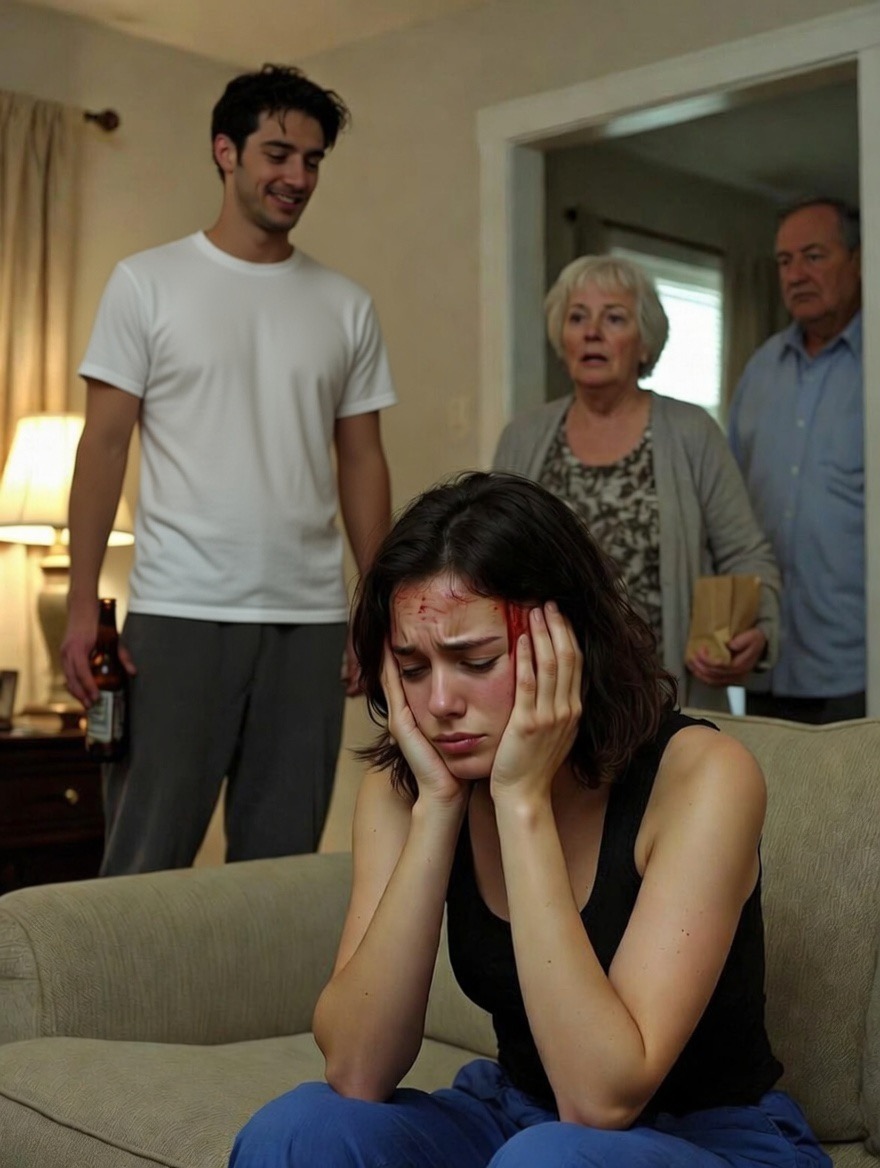
The bruise surfaced with merciless clarity by morning, spreading beneath my right eye in a deep violet stain that
looked almost artistic in its precision, as though someone had carefully painted humiliation directly onto my skin while I slept in exhausted disbelief. I stood in the bathroom staring at my reflection for a long time, turning my face slightly toward the window light, measuring the swelling with clinical detachment while convincing myself that cosmetics and composure could still disguise the evidence of last night’s violence. I reached automatically for concealer, powder, and the rehearsed smile that had gradually replaced authenticity throughout my marriage to Evan Porter, a man who once possessed warmth, humor, and tenderness, yet had slowly transformed into someone whose anger carried weight, calculation, and terrifying unpredictability.
By midday, my parents’ sedan rolled quietly into the driveway, sunlight flashing briefly across the windshield while Ohio’s pale winter sky cast everything in subdued gray tones that somehow amplified the tension already tightening my chest. My mother Linda stepped through the front door carrying two paper bags fragrant with steam and gravy, her expression softened by habitual affection, while my father Harold followed closely behind, his posture relaxed, unaware that this ordinary visit would fracture illusions none of us fully understood. Evan lounged comfortably in his recliner near the television, shirt loose, beer balanced lazily in his hand, his casual indifference radiating a confidence born from certainty that silence would once again protect him.
“Sweetheart,” Mom began gently, her voice warm with familiarity before her eyes settled fully upon my face. For a single fragile heartbeat, compassion flickered visibly across her features, because instinct recognized injury long before denial could intervene. Then recognition hardened into discomfort, and discomfort retreated into something far more devastating.
Her mouth tightened. My father’s gaze slid deliberately toward the family photographs lining the wall, his attention fixed upon smiling memories rather than confronting the swollen reality directly before him. Silence flooded the room with suffocating density, pressing heavily against my ribs until even the refrigerator’s low hum sounded unnaturally loud.
“It is colder than expected today,” Dad muttered awkwardly, his voice strained beneath an avoidance so palpable it made my stomach twist painfully. I stood near the couch, palms damp, heart racing with fragile anticipation, waiting desperately for outrage, concern, protection, anything that resembled the parents who once confronted injustice with fearless conviction. Instead, my mother adjusted her blazer with mechanical precision, her expression composed yet distant.
“We should leave,” she said quietly. “Mom,” I whispered, my voice cracking beneath disbelief, yet she had already turned away. They walked past me carrying untouched dinner, their footsteps steady, their departure swift, the front door closing with a soft click that echoed inside my skull like something irreversibly broken.
Evan’s laughter filled the void immediately, sharp and triumphant, his beer lifting in mocking salute. “What a remarkably polite family you have,” he remarked slowly, savoring each word with cruel satisfaction. Shame and rage collided violently within me, twisting into something suffocating and corrosive, because abandonment by strangers wounds differently than abandonment by those who taught you what safety meant.
Minutes crawled forward with agonizing slowness, the television’s volume rising until it drowned even my breathing, yet thirty minutes later, the doorknob rattled unexpectedly. Evan frowned, irritation replacing amusement. The door opened.
This time, I stood. My parents reentered with faces stripped of hesitation, my father’s jaw rigid with suppressed fury, my mother’s hands trembling yet resolute, while a uniformed police officer stepped forward with calm authority that instantly shattered Evan’s confidence. “Sir, are you Evan Porter?” the officer asked evenly.
Evan’s smirk faltered, the beer lowering slowly as uncertainty crept visibly across his expression. “Officer,” Evan replied smoothly, attempting charm, “there must be some confusion.”
“I need you to remain seated,” the officer responded firmly, positioning himself deliberately between us. My father’s voice emerged, trembling yet unwavering.
“He struck my daughter.”
Evan’s head snapped toward him, anger flashing briefly before calculation returned. “Harold, please reconsider,” Evan murmured, his tone shifting toward persuasion. “I witnessed your hand connect with her face,” my mother said quietly, tears already forming despite her steady voice.
“Do not insult us further with denial.”
The officer stepped forward decisively. “Sir, place your hands behind your back.”
Metal cuffs clicked with chilling finality. Evan leaned toward me as he passed, his whisper sharp with venom.
“You will regret humiliating me.”
Cold air surged through the doorway before silence reclaimed the house, thick yet profoundly altered, because absence of fear carries a stillness unlike any other. The officer returned moments later, his demeanor softened yet professional. “My name is Officer Ramirez,” he said gently.
“Ma’am, you have options, including medical assistance, formal documentation, and immediate protective measures designed to ensure your safety.”
My parents stood motionless near the doorway, guilt radiating visibly now that denial had collapsed beneath consequence. “I am so sorry,” Mom whispered, her voice breaking completely. “Why did you leave?” I asked quietly, my question trembling beneath devastation rather than anger.
Dad’s shoulders sagged heavily. “I believed confrontation might worsen your situation later,” he admitted painfully. “I confused restraint with protection.”
“We reached the car,” Mom sobbed, “and the silence became unbearable.”
“We called for help,” Dad continued hoarsely.
“We chose action over fear.”
Officer Ramirez handed me a card, his voice steady. “No one deserves violence disguised as domestic normalcy.”
That evening, my phone vibrated relentlessly, messages shifting between threats, apologies, manipulation, desperation, each word exposing patterns I had normalized for far too long. Before dawn, we departed quietly under Officer Ramirez’s supervision, my belongings reduced to essentials that felt both insufficient and liberating.
At my parents’ home, familiarity carried unfamiliar comfort, my childhood room preserved like an untouched sanctuary waiting patiently for a return none of us imagined necessary. My mother pressed an ice pack gently against my cheek, her touch trembling with remorse. “I should have spoken immediately,” she whispered.
Dad remained near the doorway, eyes heavy with regret. “I misunderstood strength.”
By afternoon, Evan appeared at their doorstep, his voice honeyed, his posture theatrical, kneeling dramatically before neighbors whose curiosity he shamelessly exploited. “I love you,” he declared loudly.
For one fragile second, habit tugged violently at my resolve, the deeply ingrained reflex to preserve appearances battling the hard clarity forged by survival instinct. “No,” I replied firmly. Officer Ramirez arrived swiftly, his presence dissolving Evan’s performance instantly.
That night, divorce paperwork replaced hesitation, truth replaced secrecy, and for the first time in years, silence felt like peace rather than imprisonment. I understood something essential, something brutally earned through pain and clarity. Rescue is never a singular dramatic event.
Rescue is a decision repeated consistently, courage exercised persistently, dignity reclaimed deliberately. And this time, I was the one who stood.