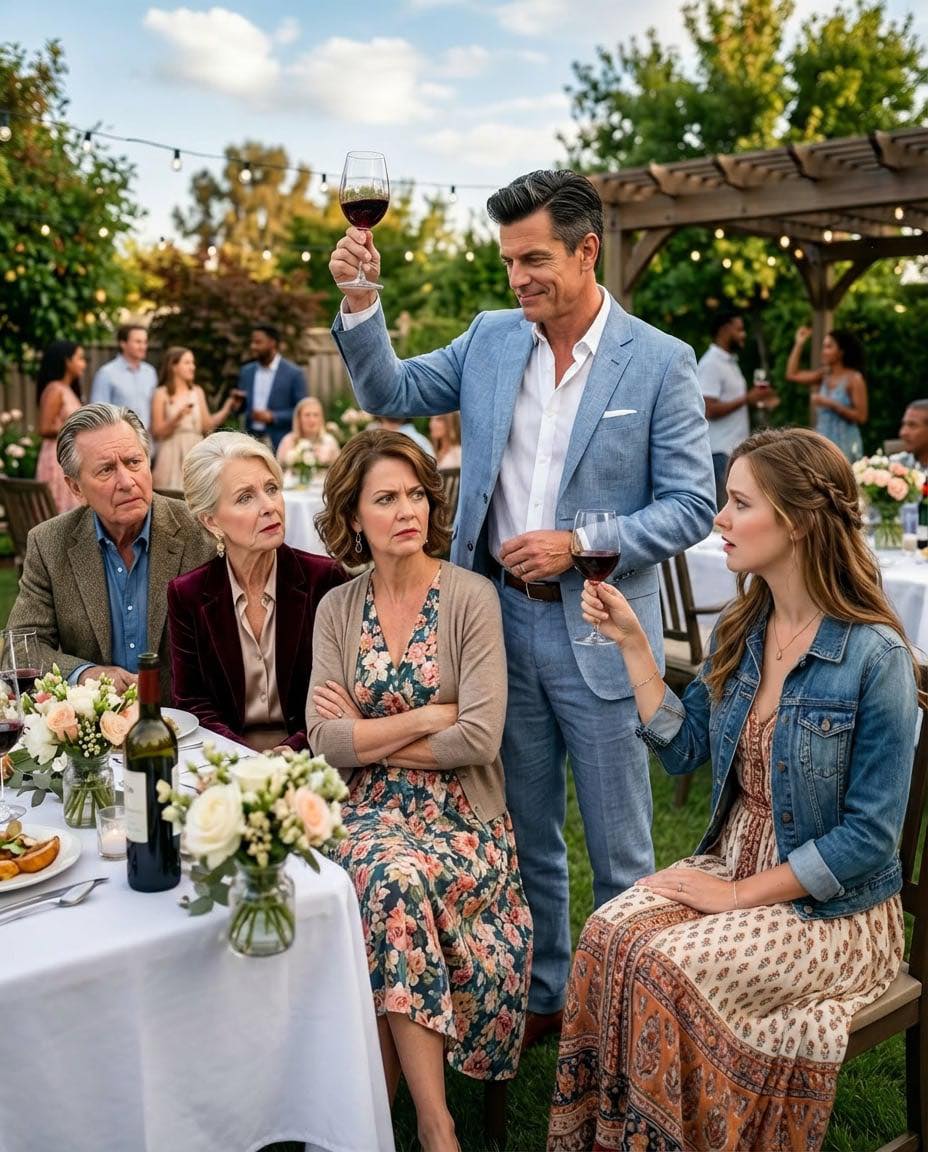
He stood there with the glass still in his hand, waiting, and the silence stretched just long enough to make everyone feel it.
No one moved to claim me.
Not my father, who had spent years curating a version of our family that looked better from a distance. Not my mother, who always believed harmony meant hiding anything that might complicate the picture. Not my brother, who had built his life on soft edges and carefully edited truths.
So I answered for myself.
“I’m his sister,” I said, steady, polite, giving them one last chance to step into the truth beside me.
They didn’t.
And in that small hesitation, the entire illusion unraveled.
What followed wasn’t loud at first. It never is. It was subtle—the shift in the judge’s posture, the narrowing of his eyes, the way he recalculated the room in real time. He wasn’t reacting to me. He was reacting to them. To what had been left unsaid.
He recognized me, of course. Not as someone who needed introduction, but as someone who didn’t belong to the version of the story he’d clearly been told.
“She argued a case in my courtroom recently,” he said, almost to himself.
That was enough.
Because now the question wasn’t who I was.
It was why they had hidden it.
My mother tried to smooth it over with that familiar brightness, the kind that only appears when things are already slipping. My father redirected, deflected, minimized. My brother laughed in that hollow way people do when they realize the ground is shifting under them.
But there’s a difference between controlling a story and surviving a question.
And that night, the wrong person asked the right one.
I didn’t raise my voice. I didn’t need to. The truth, when spoken plainly, doesn’t require volume—just timing. And for once, I didn’t rush to protect them from it.
Years of being labeled “too much,” “too direct,” “too honest” had taught me something valuable: the problem was never what I said. It was when I said it, and who was forced to hear it.
So when the conversation turned—when the judge began asking questions not just about me, but about Grant—I let it happen. I didn’t lead it. I didn’t interrupt it. I simply stopped shielding them from it.
That was enough to change everything.
Because Grant had always thrived in rooms where no one checked the details. Where charm filled the gaps and confidence replaced facts. But under scrutiny, under the quiet, steady attention of someone who understood patterns and inconsistencies, that confidence didn’t hold.
And my parents couldn’t save him from it.
Not with smiles. Not with careful wording. Not with me sitting there, quietly refusing to participate in the version of reality they preferred.
By the time the toast ended, no one was celebrating anymore.
Elise had gone from confused to still in a way that suggested she was processing more than she was saying. Her father, measured and calm, had shifted fully into observation mode—the kind that doesn’t react, just records.
And my family… they looked smaller.
Not because I exposed them.
But because, for once, they weren’t able to control how they were seen.
I left before dessert. No scene, no final speech. Just a quiet exit, the kind they had always wanted from me.
But this time, it wasn’t submission.
It was clarity.