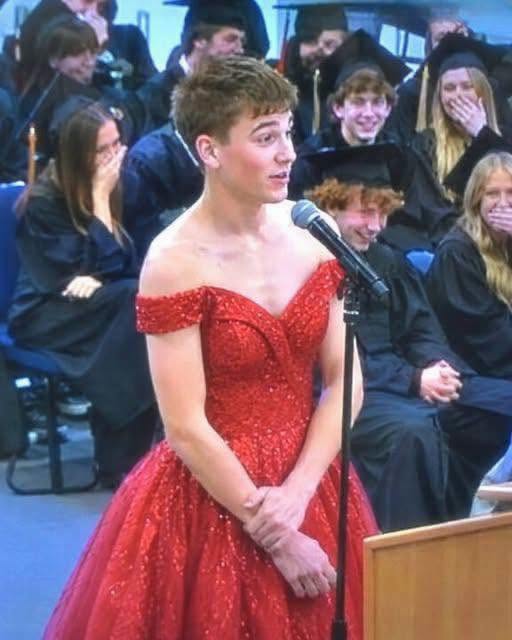
The Red Dress That Silenced the Crowd: How My Son Exposed Everyone’s True Colors

The auditorium was filled with the kind of sharp, predatory energy that only a room full of teenagers can muster.


As my son, Liam, stepped onto the stage, the atmosphere curdled. He was wearing a vibrant, flowing red dress that shimmered under the harsh spotlights, and within seconds, the room erupted in a storm of cruel, jagged laughter. Whispers turned into mocking shouts, and the air felt heavy with judgment. I stood in the back of the room, my hands trembling, my heart shattering into a thousand pieces as I watched my son walk toward the microphone, head held high.

I had become a mother at nineteen, a young woman facing a world that constantly whispered that I wouldn’t survive, let alone thrive. My son, Liam, had become my entire universe, the center of my hard-fought stability. I had spent years losing sleep over whether I had done enough, whether the lack of a traditional father figure had left a void in his life that he would never be able to fill. I watched him navigate his teenage years with a quiet, observant grace that often felt alien to me, but I never expected him to stand alone at the center of such a violent, public storm of mockery.

The audience, composed of his peers and even a few smirking adults, seemed to delight in his supposed humiliation. They saw a boy in a dress and decided that he was a punchline. I, however, saw the set of his jaw and the way his eyes scanned the crowd with a calm, unnerving focus. He reached the podium, adjusted the microphone, and waited. The laughter didn’t die down immediately; it petered out slowly, replaced by a confused, uneasy silence as Liam refused to acknowledge the taunts. He didn’t look angry, and he didn’t look ashamed. He looked like a man holding a secret that was about to burn the entire room down.

“You’re all laughing because you think you know exactly what you’re looking at,” he began, his voice cutting through the thick, judgmental air with surgical precision. “You see a dress, and you see an invitation to mock. But this garment isn’t a joke, it isn’t a cry for attention, and it certainly isn’t a costume.”

He began to explain that he had spent the last several months working in total secrecy with the school’s unsung heroes—the people who arrive before dawn and leave long after the last event has ended. He spoke about the custodians who scrubbed away the filth we were too proud to notice, the cafeteria staff who ensured no child went hungry despite being treated like invisible help, the crossing guards who braved the elements for minimum wage, and the administrative assistants who managed the chaos of our lives while receiving little more than a perfunctory nod.

As he described his process, the room began to shift. He detailed how he had collaborated with local artists to embed symbols of these people’s lives into the very fabric of the dress. The vibrant red hue wasn’t just aesthetic; it represented the passion and the life-force of the people who kept the school running. Every fold, every stitch, and every hidden design element was a deliberate tribute to a specific individual who had supported him when the world felt too heavy to bear.

He didn’t just name them; he told their stories. He told us about Mr. Henderson, the janitor who had tutored him in math in the supply closet so Liam could catch up to his peers. He spoke of Ms. Clara, the lunch lady who always saved a hot plate for him on the days he couldn’t afford to pay. As he connected the threads of the dress to the lives of the people who cleaned our mess, the room grew deathly, suffocatingly still. The mockery that had defined the beginning of his speech had vanished, leaving behind a cold, stinging realization of our own collective ignorance.

By the time he finished, the auditorium was no longer a place of adolescent cruelty. It was a cathedral of reflection. The students who had been sneering were now looking at their own laps, burdened by the sudden, heavy awareness of the invisible labor that sustained their comfortable lives. Liam hadn’t just worn a dress; he had worn a manifesto of gratitude that shamed us all. When he finally stepped away from the podium, the silence held for a heartbeat—long enough for every person in that room to contemplate their own arrogance—before it shattered into a thunderous, shaking standing ovation.

Standing in the back, I felt my eyes stinging with hot, overwhelming tears. I had spent so many years fearing that Liam lacked the structure of a “normal” family, worrying that he would be ill-equipped for the cruelty of the real world. In that moment, I realized that my own insecurities had completely misjudged his character. I had been looking for signs of his failure, while he had been cultivating a strength that I could only dream of. He didn’t need a traditional structure to be a leader; he had found his own way to stand up for the people who were always pushed into the shadows.

That night was the final lesson of my motherhood. I realized that success is not found in the awards we collect or the expectations we meet; it is found in the courage to challenge a room full of people who are too scared to be kind. Liam had walked onto that stage as a target, but he walked off as a giant. He had taught me that true power doesn’t come from being the loudest or the most popular; it comes from having the grace to recognize the worth of others when the rest of the world chooses to look away. My son didn’t just survive the storm—he transformed it, and in doing so, he taught his entire community what it truly meant to be human.