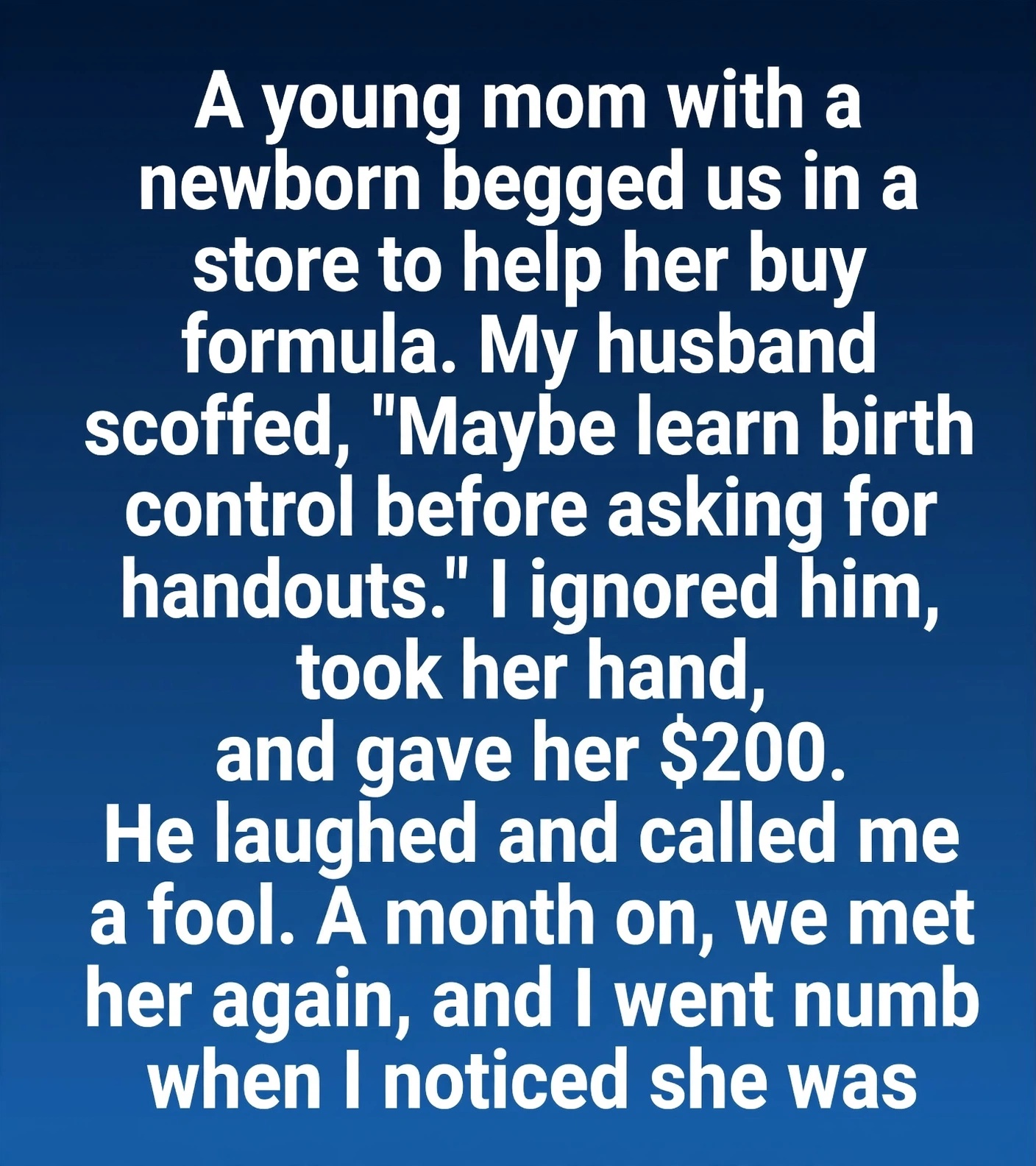
The fluorescent lights of the supermarket hummed with a sterile, soul-crushing drone, indifferent to the silent tragedy unfolding
in the baby aisle. I was just passing through, minding my own business, when I saw her. She stood rigid, clutching her infant so tightly it looked as if she were trying to shield the child from the very air in the room. Her eyes were vacant, scanning the faces of strangers with a desperate, hollow intensity that stopped me dead in my tracks. She wasn’t shopping; she was unraveling. I didn’t know then that a simple $200 bill would rewrite her entire destiny.
At that moment, the world around us seemed to dim. My husband was with me, his presence a steady, practical anchor, but he was focused on the mundane task of our own grocery list. He didn’t notice the tremors in the woman’s hands as she fumbled with the baby’s blanket, nor did he hear the frantic, unspoken plea vibrating through the stagnant air. I felt a tug in my gut—an instinct so primal and loud that ignoring it wasn’t an option. I stepped toward her, my own heart hammering against my ribs, and offered a soft, gentle, “It’s alright. Take your time.”
The mask she had been wearing—that brittle, performative shell of “I’m perfectly fine”—shattered instantly. In her gaze, I saw the reflection of a mountain of despair I could only begin to fathom. I didn’t reach for a philosophy or a life lesson; I reached into my bag and pulled out $200. I pressed the cash into her hand, urging her to use it for formula, for diapers, for whatever she and her child needed to survive the next few days. There were no grand speeches, no exchange of contact information, and no dramatic scene. Just a quiet acknowledgment of shared humanity before she disappeared back into the aisles.
My husband was skeptical afterward, and he wasn’t wrong to be. “You don’t even know her,” he reminded me gently. “You have to be careful.” He was speaking from a place of logic and caution, the kind that keeps us safe in an unpredictable world. I nodded, agreeing with his logic, yet feeling a strange, lingering peace. That day, I hadn’t been guided by logic; I had been guided by a flicker of empathy that felt stronger than any rational concern. For weeks, the memory remained etched in my mind, a fleeting, ghost-like connection to a woman whose story I would likely never know.
But life has a way of circling back to the moments that truly matter. Months later, in a massive, chaotic grocery store on the other side of town, the universe orchestrated a collision I never could have predicted. As I stood at the register, distracted by the bustle of the crowd, I looked up. Time seemed to stop. It was her.
She was standing behind the counter, wearing a crisp uniform, her hair neatly pulled back. The frantic, haunted look was gone, replaced by a calm, focused grace that made her look like a completely different person. She was engaging with customers, smiling, and performing her job with a quiet, earned confidence. I froze, not sure if I should approach, until her eyes locked onto mine. The recognition was instantaneous and electric.
Her expression shifted from professional courtesy to a look of sheer, overwhelming wonder. “You,” she whispered, her voice trembling. The noise of the busy store seemed to fade into a dull hum as the two of us stood there, bridging the gap of time and distance. “I had hoped I might see you again,” she said, her eyes welling with tears. “There were things I didn’t get to say.”
I tried to brush it off, to tell her that it was no big deal, but she wouldn’t allow it. She leaned forward, ignoring the growing line behind me, her voice ringing with a fierce, absolute sincerity. “On that day, what happened… it was more important than you can possibly imagine. I was in a very dark place. I had lost everything, and I didn’t know how I was going to feed my child or keep us afloat. I almost didn’t even ask for your help. I felt invisible, like I was a burden on a world that didn’t want me.”
She looked at me, her gaze steady and grateful. “But you didn’t turn away. You didn’t make me feel small. And you gave me the one thing I had completely run out of: hope.”
Her words hung in the air, heavy and transformative. She explained how that small, impulsive act of kindness had become the turning point. It had given her the breathing room to breathe, to think, and to seek help. It became the foundation upon which she rebuilt her life, her confidence, and her future. That $200 hadn’t just bought formula; it had bought her a second chance.
Walking out of that store, I felt a lightness I hadn’t experienced in years. We spend so much of our lives believing that we need to be giants—that we have to perform grand, heroic gestures to change the trajectory of someone’s life. We think we need money, fame, or power to make a real difference. But the truth is, the most powerful forces in the world are often the smallest ones. They are the quiet glances, the momentary pauses, and the simple willingness to see the person standing right in front of us.
We all carry invisible burdens, hidden weights that drag us down when we think no one is looking. By simply paying attention, we can become the light in someone else’s darkness. It isn’t about being perfect, and it isn’t about changing the entire world. It’s about changing the world for one person, in one moment, in one aisle of a grocery store. Kindness is never wasted, and its influence—though often imperceptible—is the very thing that keeps us all moving forward together.