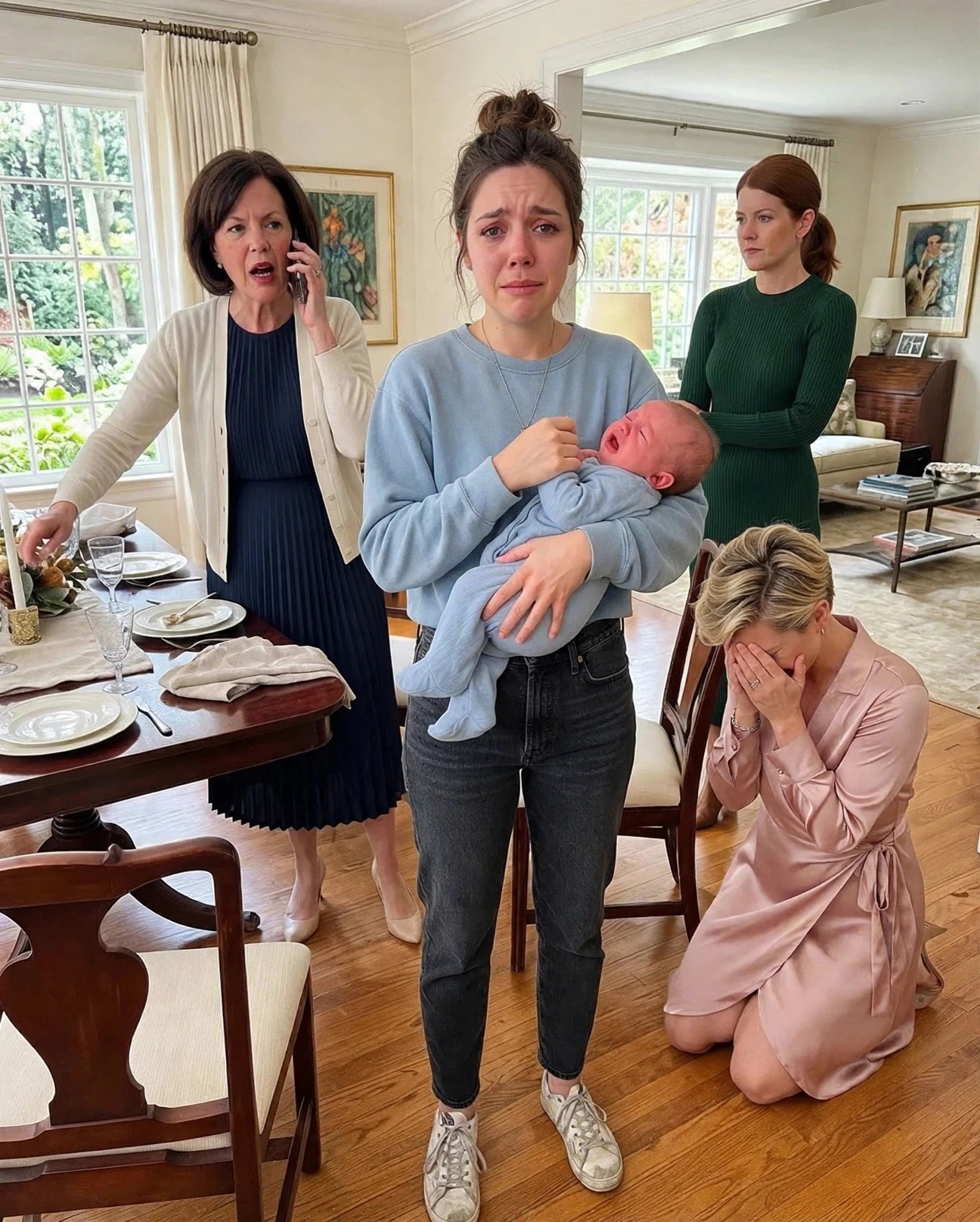
When my grandmother saw me carrying my baby in faded clothes, she stopped in the entrance hall and stared.
“Wasn’t the $180,000 I sent for you enough?”
Her question silenced the room.
I stood inside my aunt Patricia’s Denver home with my nine-month-old daughter, Lily, asleep against my shoulder. My hoodie was worn, my jeans were torn at one knee, and rain had soaked through my old sneakers.
I had not seen Grandma Margaret in nearly two years. She had flown from Boston for Thanksgiving, and I had only come because my cousin Emily said Grandma still asked about me.
“What money?” I whispered.
Patricia dropped the candle she had been arranging. My uncle Robert entered from the kitchen, followed by my mother, Denise. Everyone looked uncomfortable, but no one answered.
Grandma turned toward Patricia.
“I sent $180,000 after Claire’s accident. You told me she needed surgery, childcare, rent, and time to recover.”
My knees nearly gave way.
After my husband Evan died in a highway collision, I had been left with hospital bills, a newborn, and no steady income. I sold my wedding ring to pay rent, skipped meals so Lily could have formula, and begged my landlord for extra time.
During all of it, Grandma believed I was being supported.
“I never received a single dollar.”
Patricia’s face turned pale.
“This is a misunderstanding.”
Grandma immediately called her attorney.
“Bring the transfer records, trust documents, and everything required to begin legal action.”
By the time her attorneys arrived, Thanksgiving dinner had been forgotten. Richard Hale placed three transfer confirmations on the coffee table: $50,000, $75,000, and $55,000.
Clara Jensen opened her laptop.
“The payments went to an account called Claire Bennett Relief Fund LLC.”
“I’ve never heard of it.”
The company had been created two days before the first transfer using my name. Patricia was listed as its manager.
“You created a company with Claire’s identity?” Grandma asked.
Patricia stood quickly.
“Claire was grieving and unstable. I created the account to manage the money for her.”
I laughed bitterly.
“I was counting coins for groceries while you told me Grandma was ashamed of me.”
Clara revealed that the money had funded home renovations, credit-card payments, a vehicle, tuition, restaurants, and luxury purchases.
My daughter had slept in a secondhand crib while Patricia renovated her kitchen with money intended for us.
Richard asked whether I had authorized the company or received any funds.
“No.”
Patricia finally snapped.
“I deserved something! I handled every family crisis while Claire was always treated like the tragic favorite. She would have wasted the money.”
“How much remains?” Clara asked.
Patricia said nothing.
My mother finally admitted that Patricia had claimed I was receiving monthly support.
“You saw how Lily and I lived,” I told her. “You never thought to ask?”
Denise lowered her eyes.
Grandma placed a hand on Lily’s back.
“I trusted the wrong person, Claire. That ends tonight.”
Then she turned toward her attorneys.
“File everything.”
PART 2 — THE LIES COLLAPSE
The lawsuit was filed the following Monday. Patricia hired a criminal defense attorney, Robert moved into the guest room, and Emily left after learning that some of her university expenses had been paid with stolen money.
Grandma stayed in Denver and booked adjoining hotel rooms for Lily and me. The next morning, she brought me coffee.
“Tell me everything that happened after Evan died.”
I told her about the accident, the medical bills, the eviction notices, and the nights I slept sitting up with Lily because I feared I would fall apart.
When I admitted selling my wedding ring, Grandma closed her eyes.
“I wrote you three letters,” I said. “You never answered.”
“I never received them.”
That was when we understood that Patricia had stolen more than money. She had controlled every story moving between us.
She told Grandma I needed distance. She told me Grandma was disappointed. She told Denise I was receiving money but acting ungrateful. She told Emily that grief had made me bitter.
Patricia built walls from lies and stood between them collecting the money.
Within two weeks, Clara uncovered the entire scheme. Patricia had used my Social Security number, legal name, and old address to create the company.
Thirty-two thousand dollars paid for her kitchen renovation. Nineteen thousand went toward Robert’s credit cards. Twenty-six thousand purchased a Lexus. Fourteen thousand covered Emily’s housing deposit. More disappeared through furniture, restaurants, spas, and cash withdrawals.
Only $800 had ever been spent on me—a grocery delivery after Lily’s birth.
Grandma read the report and quietly said,
“Proceed.”
The civil lawsuit accused Patricia of fraud, identity theft, conversion, and unjust enrichment. The district attorney also opened a criminal investigation.
At first, Patricia claimed Grandma had authorized her to manage the funds because I was emotionally unstable. Then she said she intended to repay the money after selling an investment property.
No such property existed.
Next came the blame. Patricia accused Robert. Robert claimed he believed the money came from an inheritance. Denise insisted she had simply trusted Patricia.
But Clara found emails.
In one, Patricia told Robert that Grandma was sending money and warned him not to mention it around me because I believed Grandma had refused to help. Another instructed him to use the company debit card to pay their contractor.
The worst email was sent to my mother. Denise had asked what she should say when I questioned whether Grandma had received my letter.
Patricia replied that she should tell me Grandma did not want drama and that I needed to stop asking for help.
During mediation, Patricia’s attorney spoke about repayment plans and family healing.
Grandma let him finish.
“Your client stole from a widow and an infant. Do not speak to me about family healing again.”
Patricia lowered her head.
“I made a mistake.”
“A mistake is paying the wrong bill,” Grandma replied. “You made deliberate choices for an entire year.”
Patricia looked at me.
“Claire, I know you hate me.”
“I didn’t have time to hate you. I had a baby to feed.”
Three months later, Patricia pleaded guilty to felony theft and identity theft. She was ordered to repay the full amount, along with legal costs. Liens were placed on her home, her vehicle was surrendered, and her wages were garnished.
She received probation, financial monitoring, and community service.
Patricia cried in court.
I did not.
PART 3 — REBUILDING OUR FUTURE
Robert filed for separation before spring. Emily later called me in tears.
“I lived in housing paid for with your money.”
“You didn’t know.”
Not everyone who benefits from a lie understands its cost.
My mother was different. Denise had not stolen the money, but she had accepted the easiest explanation while watching me struggle.
She sent apologies I ignored until she appeared at my apartment carrying soup.
“I should have protected you,” she said. “I should have contacted Grandma myself. I have no excuse. I was weak.”
It was the first apology she gave without adding the word but.
I allowed her inside for fifteen minutes. Trust was not repaired, but she had finally accepted responsibility without asking me to comfort her.
Grandma remained in Denver for six months. She rented a townhouse near my apartment, attended legal meetings, watched Lily while I studied, and helped me freeze my credit.
She paid my overdue rent directly to the landlord.
“Stability first. Pride later.”
She also helped me enroll in a medical-billing certification program so I could work from home.
I did not become wealthy overnight, but the constant fear began to disappear. The first time I bought Lily new pajamas without checking my bank account repeatedly, I cried in the parking lot. They cost only twelve dollars, but they felt like proof that our lives were changing.
The civil case eventually settled. Patricia transferred her share of a family vacation property into a trust for Lily and signed a judgment requiring her to repay the remaining restitution. Grandma removed her from every position of financial authority.
At the final meeting, Patricia looked at me.
“I never thought it would go this far.”
I understood that she meant the consequences, not the theft.
“It went this far the moment you took the money.”
Afterward, my life became quieter. I completed my certification, found remote work with a medical practice, and moved Lily into a safer apartment with sunlight in the kitchen and a bedroom of her own.
On the anniversary of Evan’s death, I took Lily to the mountains and told her about her father—how badly he sang, how he burned pancakes, and how he cried when he first heard her heartbeat.
When we returned, a letter from Patricia was waiting.
She admitted that she had envied Grandma’s love for me. Taking the money initially felt like correcting an unfair balance. Each new purchase made the lie easier to continue.
Near the end, she wrote:
“I told myself you were weak so I would not have to admit I was cruel.”
I folded the letter and placed it inside a drawer.
I never answered.
Sometimes closure is not a conversation. Sometimes it is a locked drawer.
By the following Thanksgiving, Grandma rented a private room at a small restaurant. Emily and Denise attended. Patricia was not invited.
The evening felt awkward, but peaceful.
After dinner, Grandma handed me an envelope. Inside were Lily’s finalized trust documents and a letter explaining that she had created another protected account in my name for education, emergencies, and a future home.
At the bottom, she had written:
*I cannot return the year they took from you. I can only make sure no one takes another one.*
Months later, Lily ran across our apartment and crashed into my knees, laughing. Sunlight filled the rooms. The refrigerator was stocked, the bills were paid, and my identity was protected.
My faded hoodie still hung inside the closet.
I kept it to remember the moment everything changed: one question in a crowded hallway, a carefully constructed lie collapsing, and my tired but steady voice finally speaking the truth.
“I never received a single dollar.”