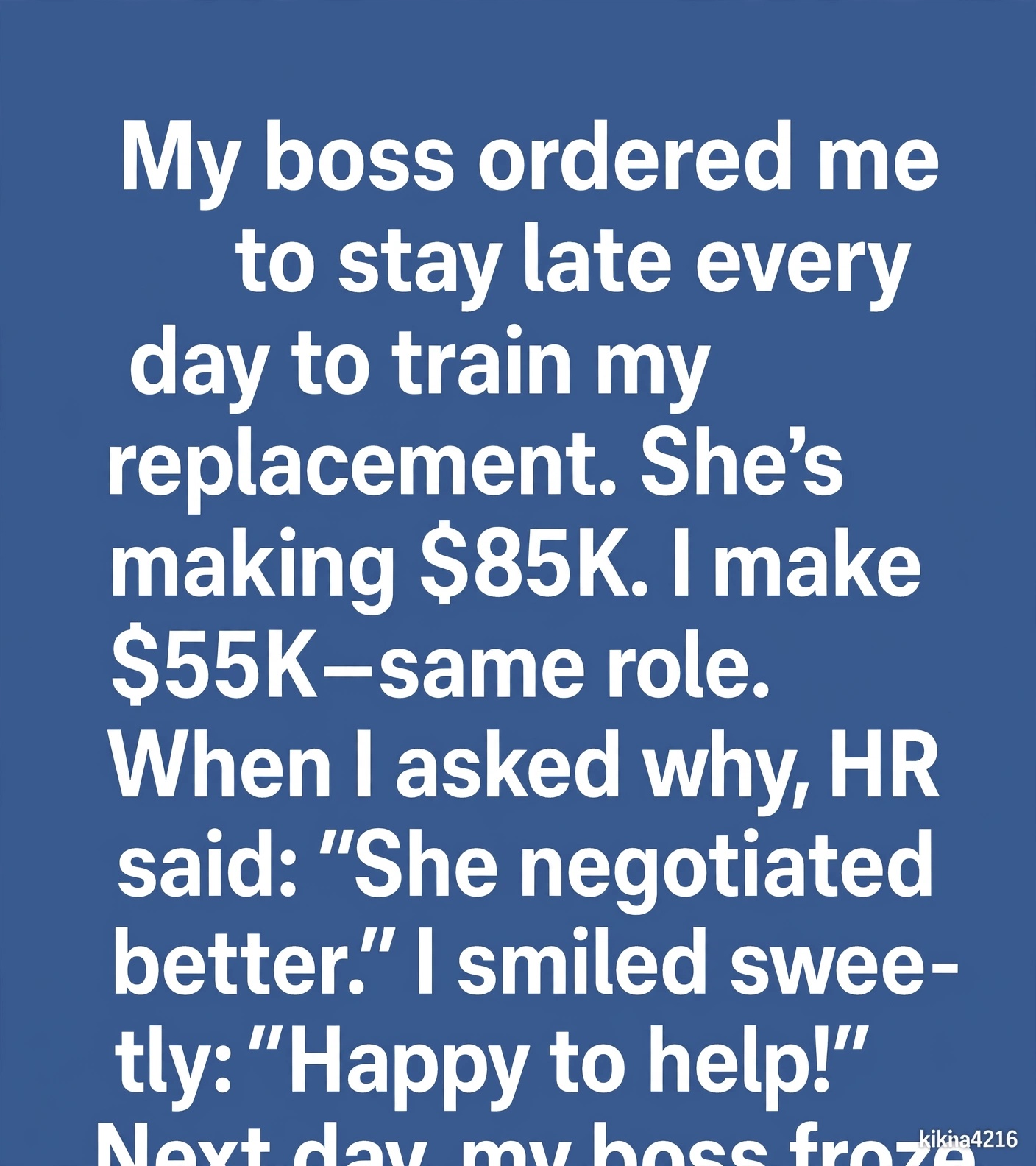
I knew something sinister was brewing the exact moment my boss forced me to stay late all week to train the woman hired to take over my position.
But nothing could have prepared me for the sickening gut punch when HR casually leaked her salary: she was pulling in a staggering $85,000 for the exact same role I had been grinding away at for a measly $55,000. When I demanded an explanation, HR shrugged and sneered, “She negotiated better.” That single phrase shattered my loyalty forever. Instead of exploding, I smiled, agreed to train her, and set a trap that would completely destroy my arrogant boss.
For years, I had poured my heart, soul, and countless unpaid hours into keeping the department afloat. I didn’t just do my job; I acted as the invisible glue holding a crumbling operation together. But learning that the company valued an incoming stranger thirty grand higher than my years of proven dedication changed everything. The stinging betrayal instantly transformed into cold, calculated clarity. I realized that my boss didn’t just want a replacement—he wanted a cheap workhorse, and he was about to learn a brutal lesson in the true cost of undervaluing loyalty.
The next morning, my boss walked into the office to find two meticulously organized stacks waiting on my desk: “Official Job Duties” and “Tasks Performed Voluntarily.” My replacement picked up the second stack, her eyes widening in sheer disbelief as she scanned the mountain of complex, unpaid labor I had quietly absorbed for years. The lesson hadn’t just begun; it had struck a nerve. As training commenced, I made a silent vow to stick strictly, almost robotically, to the literal words printed on my official job description. Nothing more, nothing less. No emergency technical fixes, no weekend crisis management, and zero cross-department negotiations.
Finance
Whenever my bewildered replacement turned to me asking how to handle high-level escalations or intricate system errors—the exact duties I had always volunteered to handle—I offered a calm, polite smile and replied, “You’ll need to check directly with management. I was never officially assigned those tasks.” I could physically feel my boss tense up behind his glass partition as each unassigned responsibility violently bounced off me and slammed right back onto his desk. HR’s condescending remark no longer stung; in fact, it felt deeply liberating. I was no longer a doormat. I was a spectator watching a masterclass in corporate karma unfold in real time.
By the second day, the reality of the situation had fully set in for my replacement. She realized with mounting horror that she hadn’t just been hired for one job, but for two entirely different roles rolled into one chaotic package. To her credit, she wasn’t angry with me at all. Instead, she felt an immense wave of gratitude. She pulled me aside and whispered that she had accepted the salary thinking it accurately matched the modest workload described during her interview, completely unaware of the hidden, backbreaking labor the position actually demanded. She was stepping into a trap, and she knew it.
Meanwhile, my boss was entirely unraveling. He spent the afternoon pacing the hallway, his face turning crimson as he whispered frantic phone calls to upper management. Every advanced task I calmly declined to cover exposed the glaring truth of just how much heavy lifting I had been doing behind the scenes. The house of cards he had built on cheap labor and exploitation was finally collapsing under its own weight, and he had nobody to blame but himself.
On the final day of my notice period, after meticulously checking off the very last item belonging strictly to my actual job description, I printed out my resignation letter and placed it squarely on his desk. It wasn’t a standard two-week notice; it was effective immediately, effective as of right then and there, leaving him stranded in the middle of an operational catastrophe with a brand-new employee who had no idea how to clean up his mess.
Two weeks later, I walked into a brand-new office, having successfully accepted an interview offer from a rival firm that genuinely respected my extensive experience and specialized skill set. Best of all? This time around, armed with hard-earned self-respect, I negotiated my starting salary with absolute confidence. The grueling ordeal taught me a permanent truth about the corporate world: once you truly learn your own worth, you never, ever let anyone diminish it again.