PART 1: THE MONEY I NEVER RECEIVED
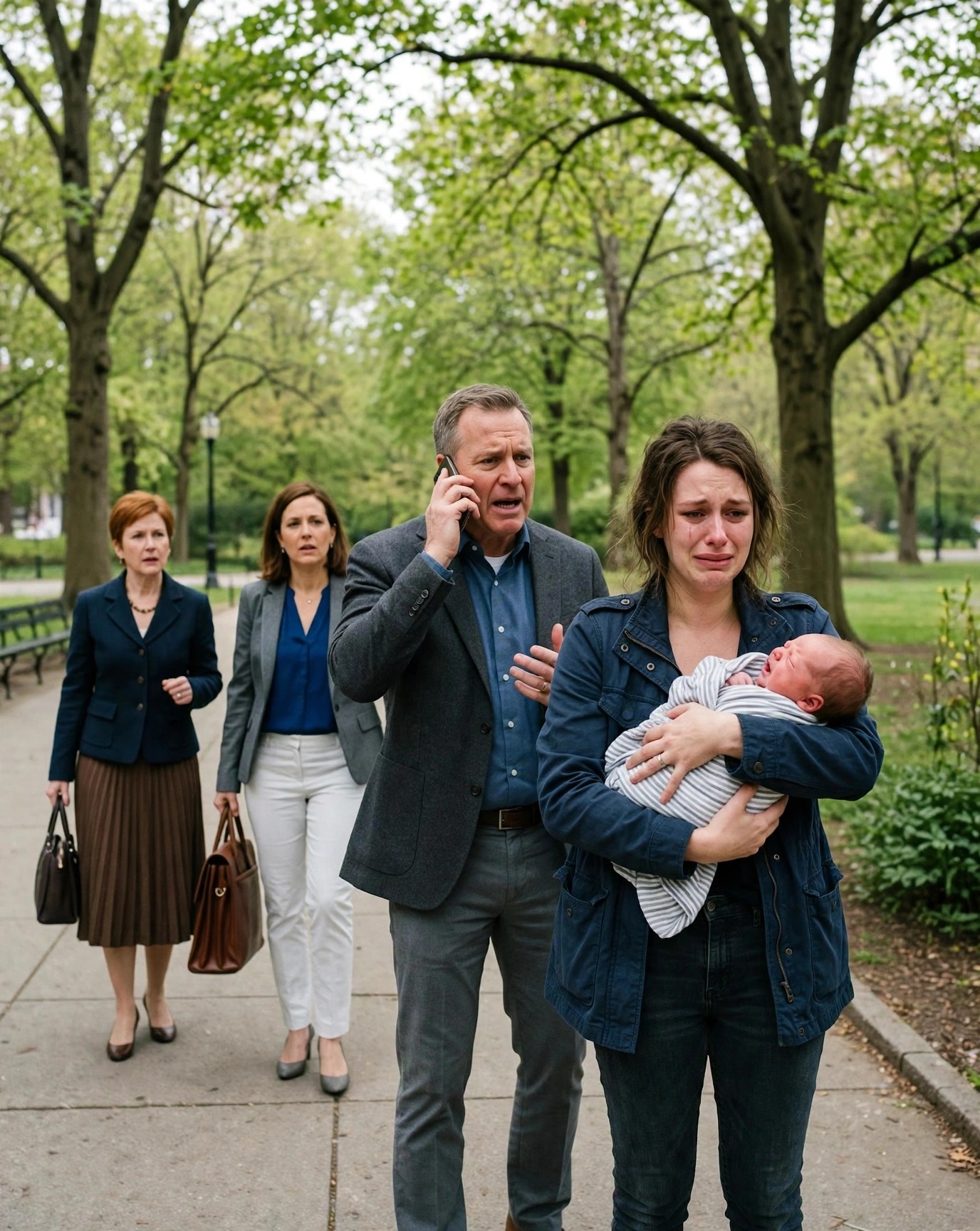
When my grandfather spotted me standing outside Riverside Community Clinic with my two-month-old daughter wrapped in an old hospital blanket, he came to such an abrupt stop that his driver almost ran into him.
It had been nearly three years since I had last seen Grandpa Warren.
The previous time we met, I was twenty-three and had just learned I was pregnant. After my boyfriend, Daniel, drained my savings and vanished, I turned to my father, desperate for help.
Instead of hearing me out, Dad accused me of being irresponsible. My stepmother, Vanessa, behaved as if my pregnancy had brought shame upon her. By the next morning, my phone had been disconnected, my apartment lease had been cancelled, and every family account I could reach had been locked.
Now, at twenty-six, I stood there wearing a coat with a ripped sleeve, clutching the last four dollars I had left.
“Emily?” Grandpa asked quietly.
I wished I could disappear before he noticed the donated diapers in the plastic bag beside me or the worn-out clothes peeking from beneath Lily’s blanket.
But nothing escaped his attention.
Then he asked something I could not understand.
“Wasn’t $250,000 a year enough?”
I looked at him in complete confusion.
“What are you talking about?”
Grandpa explained that after my father insisted I needed time away from the family, he had approved yearly support payments of $250,000. The family trust had also been paying for housing, medical treatment, pregnancy-related costs, and childcare.
“I never got any of that,” I answered.
The color disappeared from his face.
I told him everything. During my pregnancy, I had been homeless for six months. I slept in my car until it was repossessed, depended on free medical clinics, and delivered my baby through emergency healthcare assistance.
Grandpa explained that my father and Vanessa had been sending quarterly reports confirming I was receiving every benefit. They had submitted bank records, rental receipts, and even photographs of an apartment supposedly rented in my name.
“I rent a tiny room behind a laundromat,” I replied.
Without hesitation, Grandpa contacted his attorneys.
“Freeze every payment connected to Richard and Vanessa,” he instructed. “I want every bank record, trust document, wire transfer, and a full forensic accounting investigation.”
Then his eyes shifted to Lily.
“And have someone bring a vehicle with a proper infant car seat.”
The SUV that arrived was stocked with diapers, formula, baby wipes, and a warm blanket. I managed to hold myself together until Lily was safely buckled into the car.
For months, I had carried every burden alone. Watching someone carefully check the baby’s car seat straps twice shattered the wall I had built around my emotions.
When we reached Grandpa’s home in Lake Forest, the household manager had already prepared a guest suite complete with a crib and tiny baby clothes.
I picked up a soft yellow sleeper and felt embarrassed by how desperately I wanted it.
“This isn’t charity,” Grandpa told me gently. “It’s restitution.”
By the next morning, his dining room had turned into the headquarters of a full investigation. Lawyers and accountants uncovered forged receipts, fabricated medical bills, and payments for appointments I had never attended.
There were also photographs of a beautiful apartment and a fully furnished nursery that were supposedly mine. In one picture, a woman was holding what looked like a baby.
“That’s not me,” I said.
The investigator explained that the photographs had been taken from a staged real-estate listing.
Over the course of three years, nearly $812,000 meant for Lily and me had been diverted elsewhere.
While I stood in grocery stores deciding whether to buy formula or save enough money for the bus, someone had been forging my signature and collecting the funds that were supposed to keep us safe.
Grandpa immediately ordered civil lawsuits and criminal referrals.
“No warnings,” he said. “This time, Richard won’t see it coming.”
PART 2: THE BOARDROOM RECKONING
Three days later, Grandpa walked into the quarterly board meeting of Aldridge Development Group.
I followed behind him carrying Lily in my arms.
The room fell completely silent.
My father, Richard, was seated at the polished conference table wearing a navy-blue suit. Vanessa sat nearby in a cream silk outfit, wearing the carefully practiced expression of concern she always used when she wanted to appear blameless.
“Emily,” Dad said firmly. “This is a private meeting.”
“It has become a family trust meeting,” Grandpa replied.
Vanessa rose to her feet.
“We’ve been so worried about her. You know how emotionally unstable she’s been.”
Unstable. Ungrateful. Difficult.
Those were the labels they had always given me whenever I questioned the stories they created.
This time, however, the evidence spoke before anyone else could.
Grandpa’s attorney displayed the records for a bank account opened under my full legal name. I had never opened it. The mailing address belonged to one of Dad’s private offices, and a scanned copy of my old driver’s license had been used during the application process.
Dad insisted that I had given him permission to manage the money because I was too emotional and incapable of handling financial matters responsibly.
“No, I didn’t,” I replied.
I reminded him that after Daniel disappeared, all I had asked for was one night under my parents’ roof.
He had turned me away because he believed I had disgraced the family.
The investigators handed out folders containing forged acknowledgements, manipulated medical bills, and rent payments made to a company registered under Vanessa’s maiden name.
That was the moment Vanessa finally lost her composure.
“We were protecting the family from embarrassment,” she said.
Not protecting me.
Protecting their image.
She argued that I had chosen to leave, gotten pregnant, ignored advice, and expected everyone else to save me. In her opinion, giving me the trust money would only have rewarded my poor decisions.
“We kept it secure,” she insisted.
“Secure?” I echoed.
I adjusted Lily on my shoulder.
“I gave birth with no family beside me. A nurse held my hand because none of you showed up. I washed baby bottles in a janitor’s sink and brought my daughter home to a room behind industrial washing machines. Tell me, what exactly did you protect?”
No one spoke.
Dad lowered his voice, trying to convince me to continue the discussion behind closed doors.
“There’s no need to tear this family apart in front of outsiders,” he said.
Grandpa interrupted before I could answer.
“You destroyed this family the moment you stole from your own daughter and granddaughter.”
The investigation revealed that part of the diverted money had gone toward the mortgage on my parents’ vacation home. Additional funds had been deposited into an investment account controlled by Vanessa. Investigators also uncovered payments made to a consultant hired to produce fraudulent documents.
The attorneys outlined potential charges that included identity theft, bank fraud, wire fraud, and the misuse of trust assets.
For the first time, my father’s confidence faltered.
“After everything I’ve done for this company, you’re choosing to believe her?”
Grandpa looked heartbroken, but his voice never wavered.
“I trusted you with my business, my family name, and my granddaughter. All the while, you fed me lies as Emily and her baby struggled just miles away.”
Dad pointed directly at me.
“She’s manipulating you.”
For a brief moment, I felt that familiar urge to defend myself and make everyone else comfortable.
Then Lily let out a soft cry against my shoulder.
“No,” I said. “I’m done being the excuse for other people’s actions.”
Grandpa immediately suspended my father from every executive position and revoked all access to company accounts and properties. Vanessa was stripped of every responsibility connected to the family trust.
“You’re choosing her over your own son?” Dad demanded.
“I’m choosing the truth,” Grandpa answered.
Security quietly escorted both of them from the boardroom.
As Dad walked past me, he muttered, “You have no idea what you’ve done.”
“I know exactly what I’ve done,” I replied. “I told the truth.”
The moment they were gone, my legs gave out beneath me.
Grandpa came over carefully.
“I should have made sure you were alright myself,” he said.
“Yes,” I answered. “You should have.”
He accepted my words without excuses or arguments.
It wasn’t forgiveness, but it was the most honest conversation we had shared as a family in years.
PART 3: THE LIFE WE RECLAIMED
The investigation uncovered the shell company, fabricated receipts, and concealed financial accounts. Several properties and assets owned by my father and Vanessa were frozen.
Dad resigned before the board had the chance to remove him officially. Both criminal and civil cases moved forward afterward.
I expected their downfall to bring satisfaction.
Instead, I simply felt drained.
Being believed did not erase everything overnight. I still woke up terrified that I was back in the laundromat room. I checked my accounts repeatedly and folded every piece of Lily’s new clothing with care because part of me still feared it could all disappear.
Grandpa gave me the time and space I needed.
The trust restored every dollar that should have gone to me, along with the accumulated interest. New safeguards were put in place to ensure that no family member could ever manage my money again.
I used the funds to pay off medical expenses, create an education account for Lily, and begin therapy.
Eventually, I realized that going to therapy did not mean my family had been right when they called me unstable.
It meant I had survived something deeply painful.
Grandpa came to visit every Sunday. At first, he always arrived carrying far too many gifts. Eventually, I told him he was limited to bringing only one bag.
The following week, he showed up with bananas, coffee, and a stuffed rabbit tucked into a single paper bag.
“I said one bag,” I reminded him.
He looked genuinely puzzled.
“This is one bag.”
It was the first time I laughed with him.
I found an administrative position at a legal-aid organization and returned to finish the degree I had once abandoned. I wanted to help people who arrived frightened, holding paperwork that no one else had bothered to read.
Several months later, my father accepted a plea agreement that included restitution and a recommended prison sentence. Vanessa reached her own separate agreement.
I submitted my victim-impact statement.
I described sleeping in my car while my trust money was paying their mortgage. I wrote about splitting prenatal vitamins in half and bringing Lily home dressed in donated clothes.
I explained that they had stolen far more than money.
They had taken away my sense of security, years of my life, and my confidence in seeing my own name on official documents.
When the judge described their actions as intentional and ongoing, something inside me finally became still.
At last, the official record reflected the truth.
I had not disappeared because I was irresponsible.
I had been cast aside, lied about, and robbed.
One year after Grandpa found us outside the clinic, we celebrated Lily’s birthday in his garden. It was a simple celebration with cake, close friends, and the people who had stood beside us.
Grandpa raised his glass.
“To Emily, who spoke the truth even when the cost was enormous.”
I lifted Lily onto my hip.
“To Lily, who gave me a reason to keep going.”
That evening, Grandpa handed me an updated trust provision naming Lily as the direct beneficiary and appointing me as the sole person responsible for managing anything intended for her.
Attached was a handwritten note.
“I cannot change the years when I failed to see the truth. I can only make certain that no one ever stands between you and what is rightfully yours again.”
I folded the note with care.
“I’m still angry sometimes,” I admitted.
“I know,” he replied.
“I may never completely stop being angry.”
“I know that too.”
Life didn’t suddenly become perfect.
But it became truthful.
Lily had warm clothes, dependable healthcare, and a home where surviving hardship was never mistaken for instability.
Whenever I drove past the community clinic, I remembered the very first question Grandpa had asked me:
“Wasn’t $250,000 a year enough?”
The money would certainly have made life easier.
But what I truly needed was someone willing to look me in the eye, hear my story without filtering it through someone else’s lies, and believe me before the damage defined my entire life.
At last, someone finally did.