Part 1: The Cold Front
“If your baby’s lips are turning blue, wrap him in another blanket and stop pretending you’re the one having the hardest time.”
My mother-in-law, Theresa, brushed off my concern with a casual wave of her hand as she slid her passport into a designer carry-on suitcase.
My baby boy was only three days old. Exactly seventy-two hours had passed since his first cry filled a hospital room in Portland, Oregon; seventy-two hours since my husband, David, wept while holding him and promised he would always keep him safe. We named him Ethan—a name David believed represented strength. A name he felt belonged to a child destined to overcome every challenge.
But that morning, Ethan was fading before my eyes.
I stood in the center of our living room wearing a nursing gown stained with breast milk, my C-section incision throbbing with every breath, my entire body trembling from overwhelming exhaustion. Despite that, my mind was painfully clear. Ethan’s breathing came in irregular gasps, separated by frightening pauses, as though his tiny lungs kept forgetting how to work. His lips had taken on a pale blue tint, and his little fingers were icy to the touch.
“David, please call an ambulance,” I begged.
He kept his attention fixed on his phone, checking over his flight reservation. He didn’t even glance up at me. “Valerie, not this again.”
Theresa let out a brief, emotionless chuckle. She had spent the last week in our home claiming she was there to “help,” but every bit of that so-called help consisted of criticizing how I breastfed, how I walked, how often I cried, and even the way I held my baby. She constantly reminded everyone that women in her generation gave birth and were back in the kitchen cooking dinner the very next day.
“Every first-time mother overreacts,” Theresa said with a sigh. “David, your son is perfectly healthy. The only person who isn’t stable here is your wife.”
Ethan parted his tiny lips, but no cry came out. Instead, only a faint, raspy breath escaped, sending panic surging through every part of me.
“Please… just look at him!”
David finally walked over, glanced at Ethan for no more than two seconds, then let out an irritated sigh. “My mother successfully raised four children, Valerie. You’ve only been a mother for three days.”
Those words shattered something deep inside me. In the middle of the worst crisis of my life, my husband chose to trust his mother’s confidence instead of recognizing that his own son was desperately struggling to breathe.
I reached toward my phone lying on the couch, but Theresa moved faster. She snatched it away, powered it off, and slipped it deep into the pocket of her cardigan.
“We’re not calling 911 because of obvious postpartum anxiety,” she declared. “Go lie down and get some sleep. End of discussion.”
“Give me my phone back.”
“No.”
Ignoring the warm blood slowly running down my leg, I forced myself to stand. None of that mattered. “David, tell her to give it back! I’m calling 911!”
My husband said nothing. Instead, he walked over to the console table, opened my purse, and took out my credit card.
“We’re leaving before you turn this into another dramatic scene,” he said coldly.
“We’re leaving? Going where?”
Theresa smiled with unmistakable satisfaction. “Key West. Five days. Everything has already been booked. Your credit card has more than enough room for it, doesn’t it?”
“You’re flying to Florida while your newborn son can barely breathe?”
“My child deserves a father who isn’t surrounded by constant panic,” David muttered. “And I deserve a vacation away from your endless hysteria.”
The two of them went upstairs to finish getting ready. I remained frozen in the living room, barefoot and shaking, holding Ethan tightly against my chest.
Right before walking out the front door, David leaned down and kissed our son’s cold forehead. “When I get back, we’ll sit down and have a calm conversation like adults.”
Standing in the doorway, Theresa added, “I hid her phone charger too. That should stop her from spending the next five days convincing herself that WebMD knows more than mothers with real experience.”
The heavy oak front door shut with a dull click.
The house was instantly swallowed by an unbearable silence, interrupted only by my baby’s weak, uneven wheezing.
They believed they had left me completely helpless because I had just given birth, was injured, had no working phone, and no access to my own money. What they forgot was that before marrying David, I had spent eight years working as a senior forensic analyst for a corporate law firm in Seattle.
I knew exactly how to trace digital evidence, reconstruct timestamps, uncover receipts, recover surveillance footage, and even restore deleted messages.
The moment Ethan stopped breathing in my arms for the first time, I understood that the sound of that front door closing was not the end of my story.
It was the very first move in a battle they had already lost.
Part 2: The Evidence Locker
I found my powerless phone buried beneath dirty diapers at the bottom of the diaper pail, wrapped inside a damp towel.
My hands shook so violently that I nearly dropped it while trying to power it on. I searched every drawer, looked behind every couch cushion, checked throughout our bedroom, and emptied my hospital bag. There was nothing else.
Theresa hadn’t acted on impulse; every part of her cruelty had been carefully planned.
Ethan let out another weak, fragile breath.
I stumbled outside into the street, tears blurring my vision. Running was impossible because my body simply wouldn’t cooperate.
Every step felt as though my surgical incision was tearing open, but I kept screaming into the cold morning air until my throat became painfully raw.
“Help! My baby can’t breathe! Please!”
Mrs. Gable, the retired schoolteacher who lived across the street, had just arrived home carrying grocery bags. The instant she saw Ethan’s face, she dropped everything onto the ground. Without hesitation, she called 911 and grabbed my shoulders to keep me from collapsing onto the pavement.
At the hospital, everything dissolved into a haze of glaring white lights, rushing footsteps, and urgent voices speaking over one another. A nurse gently took Ethan from my arms. One doctor called for oxygen. Someone slid a wheelchair beneath me.
“How long has his lips had this bluish color?” the attending pediatrician asked.
“Since this morning… I tried to call… they took my phone.”
The hospital social worker stopped typing and looked up. “Who took your phone, Valerie?”
I stared through the glass window into the resuscitation room where doctors surrounded a body that looked impossibly tiny as they connected wires and monitors. “My husband. And his mother.”
Several hours later, the pediatric cardiologist gave us the diagnosis: Critical Congenital Heart Disease, severe hypoxia, and acute respiratory failure. Surgery was still an option, but each hour of delay had caused catastrophic damage to Ethan’s organs.
That night, Ethan continued to fight for his life. The next day, he was still fighting.
While my son remained in the neonatal intensive care unit, David posted an Instagram photo from a yacht near Key West. He was dressed in a crisp white linen shirt, Theresa stood beside him with her arm linked through his, and the setting sun cast a golden glow behind them.
“Finally getting some peace after all that unnecessary drama,” the caption read.
I took a screenshot.
Theresa uploaded a photo of expensive designer shopping bags neatly arranged across the hotel bed.
“Some women invent tragedies. The rest of us simply enjoy the blessings we’ve been given.”
I saved that screenshot too.
On the third day, Ethan’s oxygen levels suddenly plummeted. By the fourth day, his kidneys started shutting down. I no longer cried. My grief hadn’t disappeared; it had transformed into something cold. Focused. Precise. Useful.
I requested certified copies of every record: the exact hospital admission timestamp, the 911 dispatch logs, the ambulance telemetry report, the original physician notes, the social worker’s intake records, and Mrs. Gable’s eyewitness statement. From my hospital room, I called Rachel Cole, my closest friend and an extraordinarily relentless family law attorney.
“I need emergency evidence preservation notices sent out today,” I told her.
“Who exactly are we going after, Valerie?”
“My husband, my mother-in-law, the bank, the airline, the resort, the rideshare company, and the HOA security cameras in our neighborhood. They crossed state lines using my credit card while my newborn was dying.”
Silence hung over the call for several long moments. Then Rachel finally said, “We’re going to make sure every second of this timeline can never be ignored.”
By the time David responded to one of my emails, Ethan had been dead for ten hours.
His entire reply consisted of a single cold sentence:
“Stop trying to manipulate everyone with your panic attacks. We’ll be home Sunday.”
I never responded.
Instead, I forwarded the email straight to Rachel.
Then I went back to the empty house.
The nursery remained exactly as we had left it. A soft yellow blanket was still neatly draped over the rocking chair. I turned on David’s desktop computer in his office; he had never bothered changing his password. Within an hour, I recovered the deleted conversation between him and Theresa.
Theresa: Take her phone and the charger. If she reaches emergency services, she’ll ruin the entire vacation. David: Already handled it. I took her credit card too. It’s about time she paid for something after putting me through all this pointless drama.
I printed three identical copies of those messages.
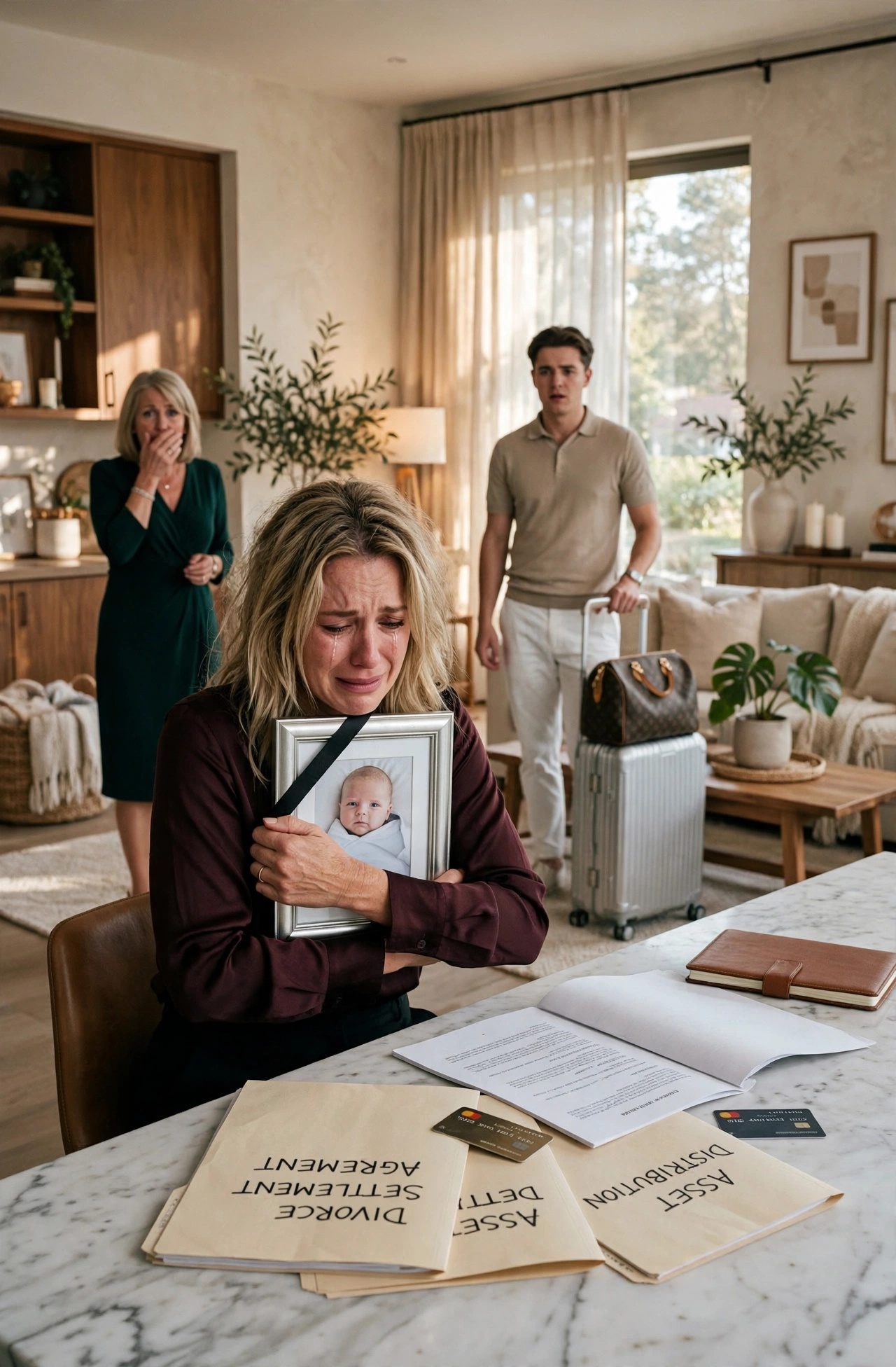
Five days after they abandoned us, I heard a car door slam outside in the driveway. I sat at the dining room table dressed entirely in black. Four neatly organized legal folders were arranged in front of me, with a small handcrafted wooden urn resting in the center.
David was about to walk through the front door believing he was returning to the life he had left behind.
He had absolutely no idea that everything he cared about had already come crashing down.
Part 3: The Price of Silence
They walked through the front door laughing, shopping bags in hand, their faces still glowing with fresh vacation tans.
Theresa came in first wearing a flowing white resort dress, designer sunglasses perched on top of her head, and gold bracelets softly clinking around her wrist. She carried the scent of expensive perfume mixed with sunscreen and the unmistakable confidence of someone whose vacation had unfolded exactly as she had hoped. David followed close behind, pulling his suitcase effortlessly, looking every bit like a man convinced he had solved an inconvenient problem.
Their laughter vanished the moment they looked toward the dining room.
The diaper bag had disappeared from the sofa. The baby swing was no longer beside the window. The soothing melody from the nursery monitor was gone.
Only I remained, seated at the head of the dining table dressed entirely in black. Four neatly organized folders rested before me, with a small wooden urn positioned beneath the overhead light.
David frowned. “Valerie… what is this?”
Theresa spotted the urn, and her expression instantly turned hard—not with grief, but with annoyance. My mourning seemed to bother her far more than the tragedy itself.
“Oh, honestly, Valerie,” she sighed. “What kind of dramatic performance is this supposed to be?”
I never turned toward her.
My eyes stayed on David, searching for even the faintest trace of the man who had once held my hand through every ultrasound appointment.
Instead, all I saw was the coward who had walked away while his own son struggled to breathe.
“Where’s Ethan?” he asked softly, his voice beginning to tremble.
I answered in a calm, steady tone.
“He died Thursday morning.”
David’s suitcase slipped from his hand and slammed onto the hardwood floor. Theresa let go of her shopping bags, and a gold sandal tumbled from an open box, sliding across the room.
“No,” David whispered, shaking his head. “No… don’t do this. Don’t play these terrible games.”
“I’m stating a documented medical fact.”
He buried his face in both hands as tears filled his eyes. Whatever sympathy I had once been capable of feeling had already been buried in that hospital room. I remembered the message he had sent me: Stop trying to manipulate us.
Theresa immediately stepped between us, her voice rising.
“David, don’t listen to her! She’s unstable! She probably left the baby with a neighbor just to get back at us for going on vacation.”
I slowly slid the first folder across the polished mahogany table.
“Official death certificate,” I said. “The hospital admission records. The 911 dispatch log. The diagnosis confirming Critical Congenital Heart Disease. And Mrs. Gable’s sworn statement describing how she found me outside, bleeding, after you took my phone.”
David couldn’t force himself to touch the folder. His breathing grew uneven as he stared helplessly at the documents in front of him.
I pushed the second folder toward him.
“Every financial transaction from Key West. Airline tickets, hotel charges, restaurant bills, boutique purchases—every expense charged to my personal credit card without my permission while your son’s kidneys were failing in intensive care.”
Theresa immediately drew herself up.
“We paid using the family account.”
“No,” I replied evenly. “You used my private account after taking my card while I was hemorrhaging in our living room.”
Then I slid the third folder across the table.
“The deleted text conversation from your phone, David. Your mother instructing you to take my phone and charger. You agreeing. Her saying I would ruin the vacation. You replying that it was finally time I paid for all the ‘drama.’”
David slowly stepped closer and stared at the messages displayed beneath his own name. Every trace of color drained from his face, replaced by a shame so overwhelming that he could no longer conceal it.
“I… I never thought it was actually an emergency,” he whispered, his voice cracking.
“You decided not to believe it,” I replied. “Because protecting your own comfort mattered more than protecting your son.”
He sank into one of the dining chairs, buried his face in his hands, and began to cry with a hollow, broken sound.
Theresa slammed her palm against the table.
“This is all a setup! She’s trying to destroy us! She’s been trying to turn my son against me from the very beginning!”
Three firm knocks echoed through the front door.
I stood, crossed the room, and opened it.
Two detectives in plain clothes stood outside alongside Rachel Cole, who held a thick legal file beneath one arm.
“Mrs. Valerie Prescott,” the lead detective said professionally, “we’re here to execute the warrants and collect the official statements.”
Rachel walked into the dining room and looked directly at David and Theresa.
“David Mercer and Theresa Mercer,” she said, “you are now under investigation for criminal endangerment of a dependent, neglect within a domestic setting, unauthorized use of financial instruments, and intentional interference with emergency services. A temporary restraining order has been issued, and the divorce petition has already been filed.”
Theresa clutched the collar of her dress.
“This is ridiculous! I was protecting my daughter-in-law from postpartum hysteria!”
Rachel opened the legal file.
“The text messages show that you knew she intended to call 911 and that the two of you deliberately worked together to stop her. Neighborhood security cameras captured both of you loading luggage into a rideshare while Valerie was visibly incapacitated inside the house. The evidence is overwhelming.”
David slowly raised his head, his eyes swollen and red.
“Valerie… please. I loved him. I’m so sorry.”
I looked directly at him, and for the first time, I felt absolutely nothing. No anger. No resentment. Only an immense, quiet emptiness.
“I left this marriage the moment you closed that front door, David,” I said softly. “Everything that followed has simply been paperwork.”
The Legacy of Ethan
Justice never moves as quickly as it does in television courtrooms. It unfolds through the steady process of depositions, forensic examinations, financial audits, and countless court hearings.
But the evidence we assembled left David and Theresa with nowhere to hide. Their smiling vacation photographs, matched against the exact timeline of Ethan’s worsening medical condition, created an undeniable record of deliberate indifference that no jury could have overlooked.
Rather than face a highly publicized trial, they both chose to accept plea agreements.
David pleaded guilty to criminal neglect and financial fraud. He was sentenced to three years in prison and immediately lost his executive position.
Theresa pleaded guilty to conspiracy and obstruction. She received a two-year prison sentence and was ultimately forced to sell her upscale suburban home to cover mounting legal expenses as well as the civil restitution awarded to my estate.
Even so, my greatest victory was never handed down inside a courtroom.
One year after Ethan’s death, I returned to the hospital’s pediatric wing carrying a carefully handcrafted wooden box. In the garden beside the NICU, a young cherry blossom tree had been planted in his memory.
At the base of the tree rested a simple bronze plaque.
Ethan Prescott. A voice that taught the world to trust mothers.
Using the restitution funds along with the wave of corporate donations that arrived after our story became public, Rachel and I founded The Ethan Project. The organization provides secure, pre-activated emergency phones to postpartum mothers who lack reliable support systems or who are living in controlling, isolating households. We also developed educational programs for nurses and social workers, helping them recognize the warning signs of medical gaslighting and family-based coercion.
A nurse named Sarah stepped outside the clinic holding a printed photograph.
“I wanted you to see this, Valerie,” she said gently.
The photograph showed an exhausted young mother cradling her healthy newborn son in a hospital room, tears of relief shining in her eyes.
“She used one of your emergency phones last night,” Sarah explained. “Her relatives insisted she was overreacting to her baby’s fever. Instead, she called us. We admitted him before the infection had a chance to spread.”
I rested my fingertips on the glossy photograph and felt a quiet, steady warmth spread through my chest.
For a long time, I believed justice would mean watching David and Theresa lose everything they valued. In the end, they did. Their money vanished. Their reputations crumbled. Their pride was stripped away. But true justice was never the sound of a judge’s gavel striking wood.
It was the voice of an emergency dispatcher answering without delay.
It was a mother being believed before she had to beg for help.
It was the sound of a baby taking one deep, healthy breath.