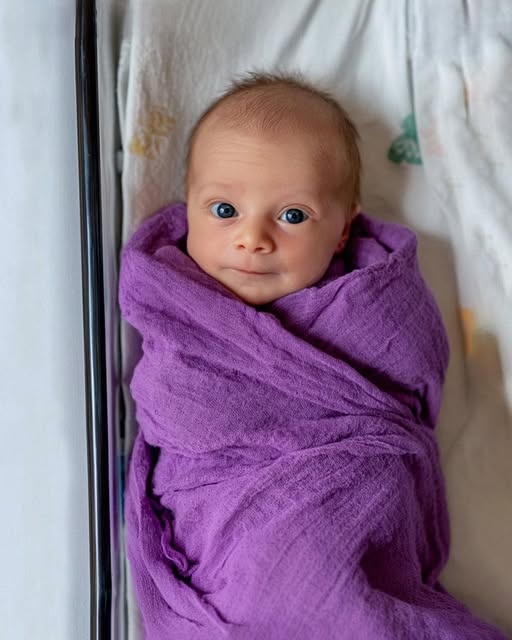
I thought surviving childbirth would be the hardest thing I’d ever do. Eighteen hours of agony
a hemorrhage, and a doctor shouting, “We’re losing her!” before everything went black. When I woke, my husband Ryan was there — eyes red, voice cracked. “She’s here,” he whispered. “She’s perfect.” He placed our newborn daughter, Lily, in my arms, and for a fleeting moment, everything felt right. Until he held her. Something in his expression faltered — joy melting into something darker. He handed her back too quickly, his voice distant: “She’s beautiful.” I blamed exhaustion. Trauma. But as days turned into weeks, the distance only grew.
At night, Ryan would feed her, change her, care for her — but never look at her. His hands moved mechanically, his eyes fixed anywhere but her face. Then, without explanation, he began disappearing after midnight, returning hours later smelling of cold air and sleepless guilt. One night I followed him — through quiet streets and out beyond the city — to a small building glowing faintly against the dark: Hope Recovery Center. Through a cracked window, I saw him in a circle of chairs, head bowed. “Every time I look at my baby,” he said, voice trembling, “I see Julia bleeding. I see her almost die. I love them, but I can’t let myself feel it. I’m scared if I do, I’ll lose them again.” An older woman leaned toward him, calm and kind. “You’re not broken,” she said. “You’re healing.”
Outside, I wept — not from anger, but from understanding. He wasn’t running from us; he was running from the fear that loving us meant losing us. The next day, while he worked, I called the center. They offered a support group for partners — women who, like me, were learning that birth trauma doesn’t end in the delivery room. It seeps into love, into silence, into the way a husband looks away instead of holding on. That night, I waited up for him, Lily sleeping against my chest. When he came home, I said softly, “I followed you.” He froze. “I didn’t want you to worry.” “We’re a team,” I whispered. He looked at me then — really looked — and for the first time since that day, he met our daughter’s gaze without flinching. “I was so afraid of losing you both,” he said. “You don’t have to be afraid alone anymore.”
Two months later, we sit in counseling side by side. The nightmares still come, but less often. Ryan now wakes before Lily, lifts her gently from the crib, and presses his cheek to hers as sunlight spills across the nursery. The man who once couldn’t bear to look at her now holds her like he’s anchoring himself to life. We didn’t get a perfect beginning — we got a hard, human one. But healing, I’ve learned, isn’t a straight road. It’s a long, trembling walk back toward each other, one night at a time. And sometimes, the distance a loved one takes isn’t abandonment — it’s just the quiet road back home.