Not ordinary silence, but the kind grief leaves behind when the last condolence has been spoken and the world finally steps
back, leaving you alone with what has been taken. I expected that hollow stillness. That awful, unreal quiet where mourning is no longer public performance but something private and brutal.
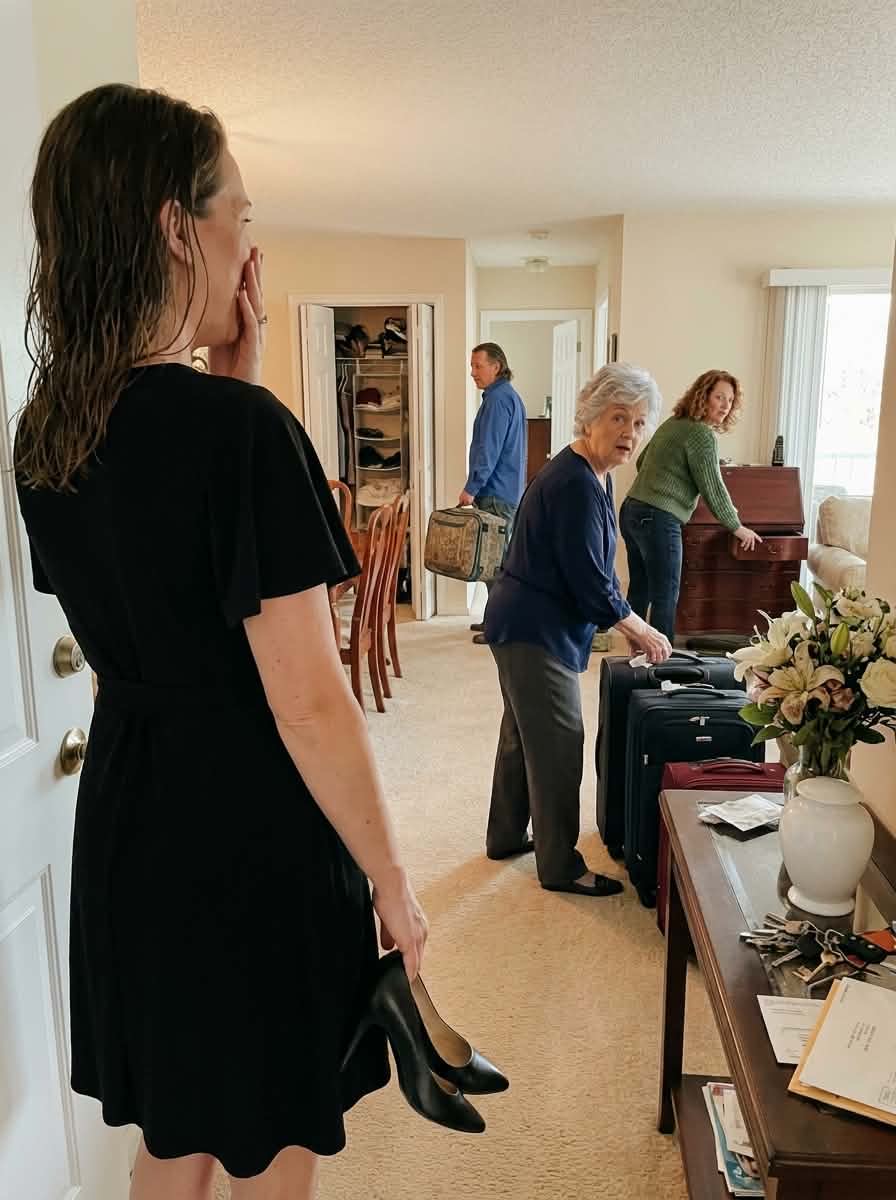
Instead, I stepped into my living room and found my mother-in-law directing traffic while eight of Bradley’s relatives packed up his life.
For one impossible second, I honestly thought I had walked into the wrong apartment.
Closet doors stood open. Hangers scraped against wood. A carry-on bag rested on the couch where Bradley used to sit in the evenings with a book in his lap. Two of his cousins were stacking boxes in the hallway like they were moving out of a rental, not stripping a widow’s home bare before the flowers from the funeral had even begun to wilt.
On the dining table, right beside the bowl where Bradley and I used to drop our keys, sat a handwritten list in Marjorie Hale’s hard, slanted handwriting:
And near the entryway, untouched but somehow more violated than anything else, sat Bradley’s temporary urn beside the funeral arrangement.
That sight hit me somewhere too deep for tears.
Not because it made me cry.
Because it showed me, with terrifying clarity, how quickly some people can move from mourning to looting.
Marjorie turned when she heard the door.
She didn’t gasp. She didn’t blush. She didn’t even pretend to be caught.
She simply lifted her chin with that familiar expression of superior patience, as though she were the only adult in the room and I had interrupted something important.
“You’re back,” she said.
I stayed in the doorway for a beat, my heels hanging from one hand, my head still light from not eating, my whole body so exhausted it barely felt inhabited.
“What are you doing in my home?” I asked.
Marjorie ignored the question as if I hadn’t spoken.
She tapped the dining table once with two fingers and said, very clearly, “This house is ours now. Everything of Bradley’s too. You need to leave.”
I looked around the room slowly.
Fiona was rifling through drawers.
Declan was zipping up one of Bradley’s travel bags.
One of the younger cousins carried framed photographs under his arm as if they were party leftovers.
No one stopped. No one looked ashamed. No one even looked surprised to see me.
It was as if I had been buried along with my husband.
“Who let you in?” I asked.
Marjorie reached into her handbag and held up a brass key.
“I’m his mother,” she said. “I have always had one.”
That key landed harder than her words.
Bradley had asked for it back months ago.
He told me, one quiet evening, that he suspected she still had a copy, but he didn’t want to turn it into another fight. He had wanted peace, or at least a version of it.
Now she stood in my apartment holding that old access like proof of ownership.
Fiona yanked open Bradley’s desk drawer and shuffled through the papers inside.
Something in me tightened instantly.
“Don’t touch that,” I said.
She turned toward me with a look of cruel amusement.
“And who are you now?” she asked. “A widow. That’s all.”
There are words that wound.
And there are words that clarify.
That one clarified everything.
I laughed.
It came out before I could stop it—sharp, unsteady, too loud for the room, but not soft and not broken. It was the laugh of a woman who had just realized that the people standing in front of her had walked, almost eagerly, into a trap set by the one man they had underestimated his entire life.
Every head turned.
Marjorie’s expression hardened. “Have you lost your mind?”
I brushed beneath one eye and finally looked at her properly.
“No,” I said. “You’ve all just made the same mistake with Bradley that you’ve made for thirty-eight years. You assumed that because he was quiet, he was weak. Because he was private, he was broke. Because he never staged his life for your approval, he must not have built one.”
Declan straightened from the suitcase. He was Bradley’s cousin from his father’s side, always smelling faintly of cologne and borrowed money.
“There’s no will,” he said. “We already checked.”
“Of course you did,” I replied. “And of course you didn’t find one.”
What none of them knew was that six days earlier, beneath fluorescent hospital light and the endless hiss of oxygen, Bradley had predicted this almost word for word.
If they come before the flowers die, he had whispered, laugh first. Elena will handle the rest.
He had been so pale then. Pale in that frightening way that makes a person look almost lit from within, as though their body has become too fragile to fully contain them. Rain streaked down the hospital window behind him in thin silver lines. The monitors blinked steadily. He squeezed my hand with what little strength he still had and made me repeat every instruction back to him.
Call Elena.
Don’t argue.
Don’t let them take anything
Laugh first.
At the time, I thought the morphine was making him dramatic.
Bradley was not a dramatic man.
That was one of the reasons I loved him.
But then he looked at me with more clarity than I wanted to see and said, “They won’t come as family, Avery. They’ll come as collectors.”
He was right.
To understand how right, you have to understand who Bradley really was.
To his family, Bradley Hale was the difficult son. The one who kept to himself. The one who moved away. The one who replied late, skipped family trips, and never treated every manipulative emergency like a command.
To most people, he seemed ordinary in the safest, most trustworthy way.
Mid-thirties. Calm eyes. Measured voice. Two watches he rotated between. Linen shirts. Old books. Quiet restaurants. He could disappear into a crowd if he wanted to.
Marjorie mistook that for insignificance.
She had spent his entire life confusing silence with submission.
Her world ran on hierarchy, performance, and entitlement. There was always some cousin in financial distress, some aunt who needed “help,” some family story that somehow required someone else to pay for its ending. Bradley had long been useful because he was capable. He understood forms. Paid bills on time. Fixed problems without drama.
Then he met me, and something in him stopped volunteering to be used.
We met years ago in Valencia. I was doing translation work for an archive project. He was consulting for a law firm that specialized in historical asset recovery.
That was how he described it at first—consulting.
A neat word. Quiet. Forgettable.
Only later did I understand what he really did.
Bradley had an unusual talent. He could trace what other people worked desperately to conceal. Not the kind of intelligence people make speeches about, but the unnerving, practical kind that hears theft inside paperwork. He could follow shell companies, hidden trusts, forged transfers, beneficiary swaps, estate manipulation, quiet fraud.
He built that skill the slow way—first helping lawyers, then banks, then private clients whose assets had been quietly stripped by greedy relatives, dishonest partners, and smiling thieves in respectable clothing.
Eventually, he started taking equity instead of fees.
Then a quiet stake in a recovery firm.
Then another in a title analytics company.
He used his middle name, Rowan, in most of those ventures. Partly for privacy. Partly because he already understood what his family did when they smelled money.
By the time I married him, Bradley had built something his relatives never would have believed, because belief would have required respect.
He had built wealth.
Not flashy wealth. Not yacht-in-the-harbor wealth. Not social-media wealth.
The quiet kind.
The kind that sits behind trusts, LLCs, and deliberate structures. The kind that comes from patience, privacy, and years spent understanding how other people hide things.
Once, while we were walking under balconies draped with ferns in St. Augustine, he told me, “When you spend enough years tracing greed, you either become greedy or you become private.”
He chose private.
We lived well, but never loudly. We rented at first, then bought the condo through a holding company that later became part of a trust structure I barely paid attention to because I trusted him and because he hated letting money dominate a room.
We traveled. Ate well. Collected books instead of status symbols. He paid debts early. Donated quietly. Never once gave his mother a number.
That last part infuriated her.
Marjorie hated any mystery she couldn’t control.
At family dinners, she would ask if Bradley was still doing that small consulting job. She’d laugh too loudly and say she hoped he wasn’t trusting me with all the passwords because women could be unpredictable around money.
For a long time, Bradley let it slide.
Then one night, after she left our apartment, he locked the door, leaned his forehead against it, and said very quietly, “My family does not love information. They love access.”
That was the night he told me the ugliest part.
Years earlier, after his father died, Bradley discovered Marjorie and Declan had been leveraging estate documents to secure short-term loans. At first, it was small. Slight signature adjustments. Temporary substitutions. Family borrowing from the dead because they were sure the living would keep forgiving them.
Back then, Bradley cleaned it up to protect his father’s name. He paid for some of it. Legally blocked the rest. Quietly, always quietly.
They mistook that for weakness.
It wasn’t weakness.
It was grief.
Later, when he stopped saving them, they called him cold. Ungrateful. Changed. Marjorie told anyone who would listen that I had turned him against his own blood.
The truth was simpler.
Once Bradley experienced a life without constant taking, he no longer volunteered to be consumed.
Then came the hospital.
It happened quickly. Chest pain that was supposed to mean nothing. A night in emergency that turned into intensive care. A diagnosis that suddenly made every hour feel counted.
He stayed clear-headed long enough to do what men like Bradley do when they know chaos is coming.
He prepared.
Attorney Elena Cruz arrived the next morning with a leather portfolio and a notary. I remember the click of the pen. The blue seal. Bradley’s hand trembling once before steadying.
He signed documents I barely understood because I was trying not to imagine life without him.
He transferred final control of the condo and every related holding interest into the St. Augustine Harbor Trust.
He named me sole trustee and beneficiary.
He updated his investment account beneficiaries.
He revoked every lingering family access authorization in older records.
He finalized a letter of instruction for Elena.
And because he knew exactly who his family was, he created something he called a contingency file.
“If they behave like human beings,” he said, exhausted, “it won’t matter.”
I asked what was in it.
He smiled, tired and faintly amused.
“Enough.”
He died two days later.
Now, standing in our half-ransacked condo with his relatives pawing through his life, I finally understood exactly what enough meant.
My phone buzzed in my hand.
Elena: We’re downstairs.
I looked at Marjorie. At Declan. At Fiona still hovering near Bradley’s desk as if something valuable might be hidden under the paper clips.
“You should probably put those suitcases down,” I said.
Marjorie let out a sharp laugh. “Or what?”
There was a knock at the door.
I crossed the room, past the urn and the funeral flowers, and opened it.
Elena Cruz stood there in a navy suit, rain damp on her shoulders. Beside her was Luis Ortega, the building manager, holding a clipboard. Next to him stood Deputy Collins from St. Johns County, broad-shouldered and already wearing that dry, professional expression that says other people’s entitlement has become paperwork.
Elena held a black folder under one arm.
“Mrs. Hale,” she said.
Marjorie appeared behind me. “Who is this?”
Elena glanced past me, taking in the open closets, the suitcases, the list on the dining table, the half-packed room.
Then she looked directly at Marjorie.
“Elena Cruz,” she said. “Counsel for the late Bradley Hale and for the St. Augustine Harbor Trust. I’m here because this residence is under active legal protection, and the trustee has reported unauthorized entry and attempted removal of property.”
You could feel the room change.
Declan stepped back.
Marjorie lifted her chin. “This is family property.”
Luis opened his clipboard. “No, ma’am. This unit is owned by Harbor Residential Holdings, retitled into the St. Augustine Harbor Trust six days ago. Occupancy rights belong solely to Mrs. Avery Hale. We also have written revocation of all prior access permissions.”
Marjorie’s face tightened. “That’s impossible.”
Elena slid the first document from the folder and held it up just enough to show the seal.
“It is not impossible,” she said. “It is recorded.”
Fiona recovered first. “There’s no will. We checked.”
“Exactly,” Elena replied. “There is very little left to probate. That was intentional.”
The silence that followed was exquisite.
Because in one calm sentence, Bradley had defeated them with the one thing they had never respected: structure.
Marjorie turned to me then, really looked at me, and for the first time that day uncertainty flickered across her face.
“What did he tell you?” she asked.
“Enough,” I said.
Deputy Collins stepped forward. “I’m going to need personal belongings identified and this residence cleared. If anyone wants to dispute ownership, that happens somewhere else.”
Declan made one last pathetic attempt, claiming Bradley had promised him repayment for some business deal. Fiona muttered that Marjorie, as his mother, had every right to secure family documents. One of the younger cousins quietly started unzipping the suitcase he had packed, as though perhaps invisibility might still save him.
Elena opened the black folder again.
“Before anyone says another careless thing,” she said, “you should know Bradley anticipated this challenge. He left signed copies of prior demand letters concerning unauthorized use of his name, evidence of attempted account access, and surveillance stills from an earlier visit to this property during his hospitalization.”
Declan went pale.
That was when I knew: Bradley hadn’t merely expected them.
He had anticipated exactly who would touch what.
Elena placed three still images on the dining table.
In the first, Declan stood in Bradley’s study during the week of his hospitalization, one hand in a drawer.
In the second, Fiona held a folder open beneath the desk lamp.
In the third, Marjorie used her key at the front door while glancing over her shoulder.
No one spoke.
Even Deputy Collins looked impressed.
“He installed interior cameras after a prior incident,” Elena said. “Those files are backed up offsite.”
Marjorie’s mouth opened, then closed.
Finally, she said, “He wouldn’t do this to family.”
I almost answered, but Elena was quicker.
“He did exactly this to family,” she said, “because of what family repeatedly did to him.”
Then she withdrew one last item from the folder: a sealed envelope with my name in Bradley’s handwriting.
She handed it to me.
“He asked that you read this only if they came into the condo after his death,” she said.
My hands trembled as I opened it.
Inside was a single sheet of paper.
Avery,
If you are reading this with my mother in the room, then I was right and she arrived before the flowers faded.
Laugh first.
I did.
More quietly this time, but enough.
The rest of the letter was short. Bradley apologized for leaving me to handle ugliness while grieving. He told me he loved me. He told me not to negotiate with people who saw loss as an opportunity. And then he said he had left his family exactly what they had earned in a separate probate instruction.
That caught Marjorie’s attention immediately.
“What does that mean?” she asked.
Elena answered with perfect calm.
“It means Bradley did make one probate provision. Each named relative receives one dollar and a no-contest warning. Any continued interference triggers release of supporting records to the appropriate civil and criminal counsel regarding prior fraudulent activity involving estate instruments and unauthorized credit use.”
Fiona sank into one of my dining chairs.
Declan cursed under his breath.
Marjorie stared at Elena as if language itself had betrayed her.
“He left me one dollar?”
“Yes,” Elena said.
“His mother?”
“His decision.”
Marjorie turned to me then, and what flashed across her face was not grief.
It was exposure.
The quiet shock of someone realizing that the person they dismissed had kept records the entire time.
For years, she had treated Bradley like he existed to absorb the consequences of her appetites. His final act had been a clean, deliberate refusal.
Deputy Collins instructed everyone to gather only what belonged personally to them. No documents. No electronics. No boxes.
Luis supervised while suitcases were reopened and Bradley’s things were returned piece by piece.
His shirts went back into the closet.
Cables went back into drawers.
His two watches were returned to the valet tray in the bedroom.
No one touched the urn.
Before leaving, Marjorie paused in the doorway and turned toward me.
“You think this makes you safe?” she asked.
I stood beside the entry table with Bradley’s flowers at my shoulder and Elena behind me.
“No,” I said. “Bradley made me safe. This only makes you visible.”
She left without another word.
The door shut.
And finally, the condo fell quiet.
Not peaceful. Not yet.
But honest.
I stood there for a long time, taking in the room they had almost stripped bare. The half-open closet. The legal papers on the dining table. The couch where Bradley used to fall asleep with a book on his chest. The temporary urn beside flowers already beginning to droop.
Then Elena placed a gentle hand on my arm.
“There’s one more thing,” she said.
We sat at the table after Luis and the deputy left. Elena opened the final section of the black folder and slid a small flash drive toward me.
“Bradley recorded a message the morning after he signed everything,” she said. “For you. And one portion for the record if the family contested the trust.”
I plugged it into Bradley’s laptop.
His face appeared on the screen.
Hospital light. Tired eyes. Skin pale, but still so unmistakably him.
He smiled at the camera with that crooked expression he wore whenever he knew he was being a little more sentimental than he preferred.
“Avery,” he said. “If you’re seeing this, then first, I’m sorry. Second, if my family is in the condo while you watch it, I hope you laughed.”
I laughed again then, and it cracked something open inside me.
He said he had spent too many years confusing loyalty with surrender. He said loving me had taught him that peace requires boundaries, not just patience. He said he had arranged everything because he wanted the one person who never reached for his wallet before his hand to be protected first.
Then his expression changed.
“For the record,” he said, and his voice lost its softness, “my mother, Fiona Hale, and Declan Hale have no authority over any property, account, or file associated with me, Rowan Ledger Recovery, Harbor Residential Holdings, or the St. Augustine Harbor Trust. Any claim otherwise is false. Any use of old keys, old papers, or old family stories should be treated as what it is: trespass dressed as grief.”
The screen went dark.
I sat there crying with one hand over my mouth.
Not because I was surprised.
Because even in death, Bradley sounded exactly like himself—precise, careful, and quietly devastating.
The legal challenge Elena expected never came.
Maybe Marjorie understood Bradley had built the kind of case no one touches unless they are prepared to lose publicly. Maybe Declan remembered the surveillance stills. Maybe Fiona understood probate is a terrible place to improvise innocence.
Whatever the reason, they never contested the trust.
Within three weeks, the transfers were complete.
The condo remained mine.
The investment accounts settled outside probate.
Bradley’s charitable instructions continued exactly as he had arranged them.
And in those weeks, I learned more about his work than I had in ten years of marriage—not because he had hidden himself, but because I had never measured him by what he controlled.
That was the irony.
The people who wanted Bradley’s assets had never cared enough to understand Bradley himself.
A month later, I walked alone through the historic district at sunset. St. George Street glowed the way it does when the tourists thin out and the city starts sounding like itself again.
I stopped in front of the café where we once sat and argued about whether private people are born that way or made.
“Made,” Bradley had said. “Usually by surviving the wrong kind of attention.”
He had been right about that too.
When I got home, the condo was quiet.
My quiet.
I placed fresh flowers beside his urn. Opened the windows. Let the humid Florida air drift through the rooms.
Nothing had been taken.
Nothing had been lost—except the illusion that blood guarantees decency.
I stood in the doorway for a long time before turning on the lights.
Then I laughed once more, softly this time, and whispered into the apartment he had protected until the very end:
“They never knew who you really were.
But I did.”