Eleanor Mitchell didn’t understand the full weight of her husband’s final words when he said them.
“Do what’s right, not what’s easy.”
At the time, they felt like something meant for later—a quiet kind of guidance meant to surface in small decisions. Not something that would one day ask her to stand against her own child.
She only understood what he meant at the funeral.
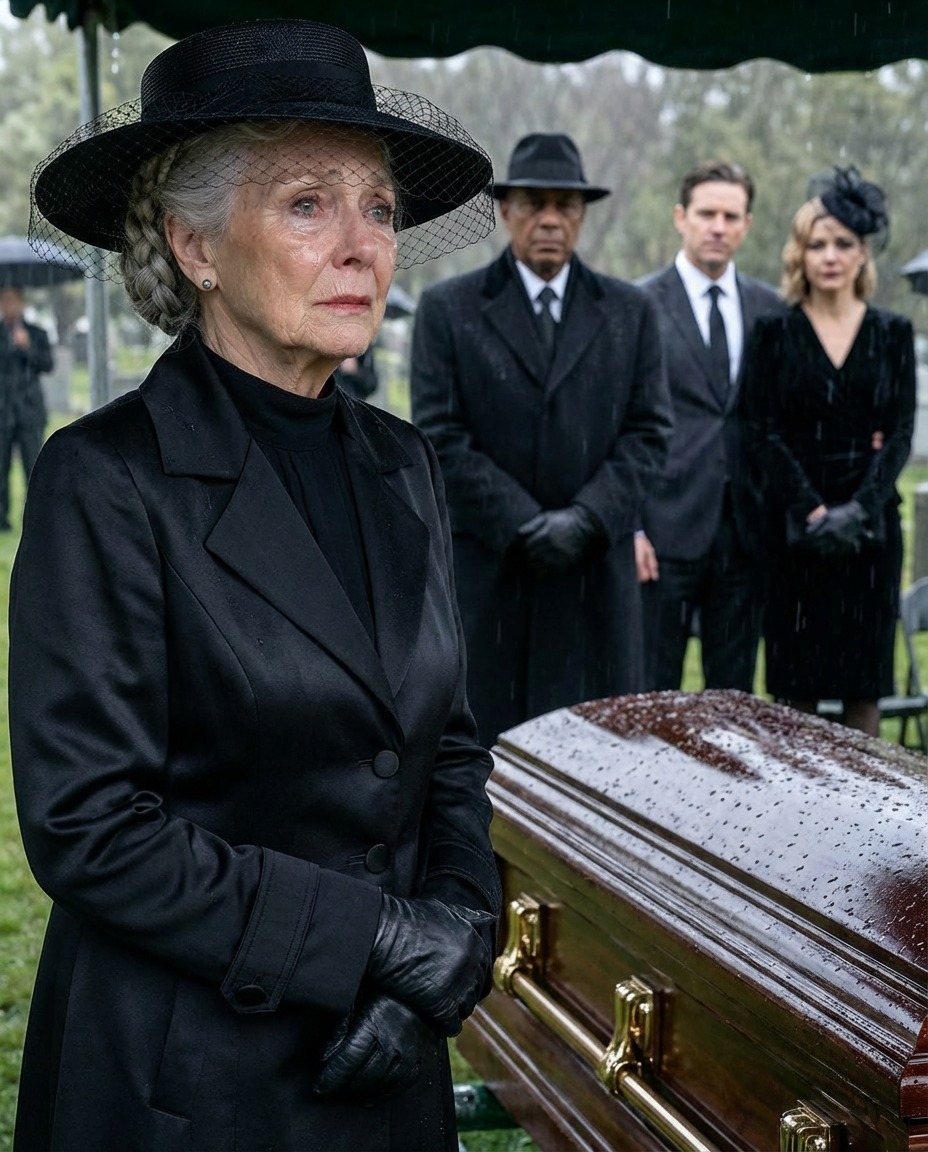
It was a gray November afternoon, the kind where the sky feels heavy enough to press down on everything beneath it. Rain fell in steady sheets as people gathered under black umbrellas to say goodbye to Richard Mitchell—founder, leader, husband, father.
Hundreds came.
Employees. Partners. Friends. People whose lives had been shaped, directly or quietly, by the man being lowered into the ground.
But in the front row, beside Eleanor, there was an empty chair.
It had been reserved for Thomas.
Their only son.
The boy Richard had raised with belief, defended long after it stopped being easy, and trusted with a future that now felt uncertain even in death.
Thomas wasn’t there.
He had chosen to be somewhere else—at a lavish birthday celebration in Aspen, surrounded by noise and distraction while silence settled over his father’s grave.
Eleanor didn’t cry in that moment.
Something else happened instead.
She stopped making excuses.
“Begin,” she told the pastor, her voice steady in a way that surprised even her.
What followed wasn’t an act of anger. It was clarity.
The next day, that clarity became something permanent.
At the reading of the will, Thomas arrived composed, almost impatient. He expected control—of the company, the legacy, the future his father had spent a lifetime building.
Instead, he was given a condition.
His inheritance depended not on blood, but on character. On Eleanor’s judgment.
“If his conduct proves unworthy,” the lawyer read, “the inheritance shall be redirected.”
Thomas didn’t understand at first. Then he looked at his mother, expecting reassurance.
Instead, he found truth.
“Mrs. Mitchell,” the attorney asked, “do you wish to invoke the clause?”
The room held its breath.
Eleanor looked at her son—not as a mother protecting a child, but as someone honoring the man she had buried the day before.
“Yes,” she said.
“I invoke the clause.”
In that moment, Thomas lost everything he thought was already his.