vf I bought my parents a $650,000 oceanfront cottage for their 40th
anniversary so they could finally slow down and enjoy life. A few months later, my mother called me in tears. My sister’s husband had changed the locks, listed the place for short-term rentals, and told my father, “Get out. This isn’t your home.” My sister accused me of overreacting. What they didn’t realize was that I had already put safeguards in place.
“Get out.”
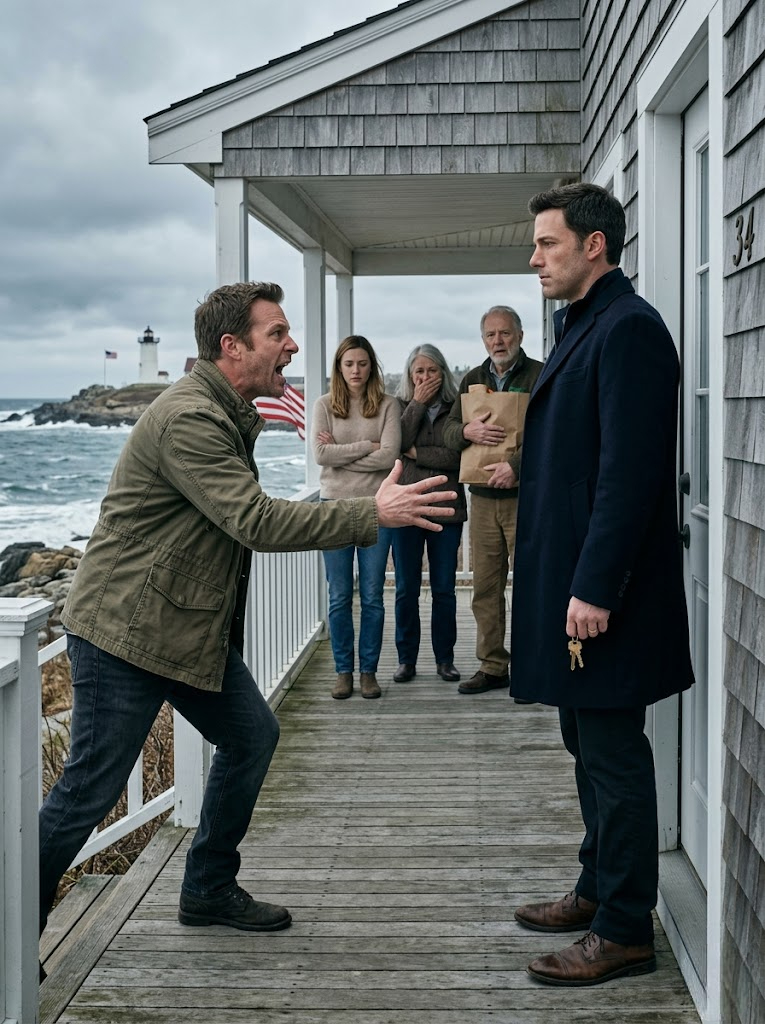
Those were the first words I heard when I turned into the gravel driveway, and even now I can still hear the way they seemed to cut through the sea air like something metallic and unnatural. Rockport mornings usually carried softer sounds. Wind skimming across salt grass. Gulls arguing above the bluff. The steady percussion of the Atlantic throwing itself against dark boulders below. But that morning the coast sounded like a witness, cold and distant, and my brother-in-law’s voice rose above it all with a sharpness that did not belong on that porch.
My father, Franklin Pritchard, stood frozen in the doorway of the cedar house I had bought for my parents on their fortieth anniversary. One hand gripped the brass door handle so tightly that his knuckles had gone nearly white, as though the metal might offer some explanation for what was happening. In his other hand he held a paper bag from the bakery in town. The top of a fresh baguette poked through the fold. A bunch of parsley had been crushed sideways, its stems bent under the pressure of his grip. It was such an ordinary thing to be holding in the middle of such humiliation that the sight of it hit me harder than the shouting did.
My mother was not on the porch at all. She was standing in the gravel driveway in her house slippers and a light teal cardigan, one hand pressed hard over her mouth as if she could stop the sobs from escaping if she pushed firmly enough. Black mascara had streaked down both cheeks in uneven lines. Her shoulders shook with the kind of crying that comes from somewhere primitive, a place beneath language, a place where dignity stops mattering because shock has taken over the body. Seeing my mother cry like that at seventy was not like seeing her cry when I was a child. Back then, a mother’s tears still fit inside the world somehow. At seventy, those tears felt like structural damage.
And on the porch, standing one step above my father as if he had been waiting his entire life for the opportunity to look down on him, was Chadwick Vance.
“This is no longer your residence,” Chadwick said again, louder this time, with the smug patience of a man pretending to explain something obvious to someone stupid. “You cannot just wander into this property whenever you feel like it.”
He even had the keys dangling from one finger. He gave them a little jingle as if he were an innkeeper making a point about policy.
I killed the engine so hard I almost snapped the key in the ignition. Gravel sprayed from beneath my tires. A cluster of gulls lifted off from the low stone wall in a burst of white wings. For a second no one moved except the birds and the ocean, and then I opened the car door and stepped out into the cold wind with a kind of calm that always means I am far angrier than I sound.
One hour earlier I had been in a boardroom in downtown Boston listening to a junior partner explain why a shipping miscalculation in New Jersey was causing a chain reaction of delays. He had charts projected across a wall of glass. Someone beside me had been taking notes. My phone vibrated once against the mahogany table, and I very nearly ignored it because my mother never called me during work hours unless it was something simple like asking for the name of a plumber or whether I thought a certain kind of wildflower would survive coastal wind. But something in me told me to look.
When I answered, I heard her breathing before I heard her voice.
“Gavin,” she whispered.
I stood up before she said anything else. Not because of the words, but because of the sound. I had heard fear in the voices of investors, executives, attorneys, clients, employees waiting to find out if their jobs still existed. Fear had a thousand accents. My mother’s was the worst of them.
“What happened?” I asked, already moving toward the door of the boardroom. “Mom, what happened?”
“You need to come here right now.”
I was halfway down the hallway before she finished the sentence.
“What is it?” I said, shoving at the elevator button hard enough to bruise my thumb. “Is Dad all right? Did someone get hurt?”
There was a silence so long that I thought maybe the call had dropped, and then I heard her take a shaking breath.
“He changed the deadbolts.”
For a second the words meant nothing. My mind rejected them. My brain tried to turn them into something logical, something ordinary. A repair. A mistake. A lock that had jammed. A local handyman doing unnecessary work. Anything but what she actually meant.
“Who changed the locks on your house?”
Another silence. Then, smaller than before, almost ashamed to say it aloud: “Chadwick.”
I remember the exact sequence of what happened next because anger has a way of sharpening memory. I walked straight past my assistant. I took the stairs instead of waiting for the elevator. I nearly ran into a man carrying coffees in the lobby. I threw my briefcase into the passenger seat without caring that my laptop was inside. By the time I backed out of the garage, I was already calling Sandra Levin, the attorney who had helped me set up the trust two years earlier.
“If this is what I think it is,” I told her, “I’m going to need every document within ten minutes.”
“What happened?” she asked.
“My brother-in-law changed the locks on my parents’ house.”
She did not gasp or curse or ask a string of panicked questions. Sandra was too good for theatrics. She simply said, “He has no authority to do that,” in the same tone a surgeon might use to say a bullet has missed the heart. Then she began telling me exactly which files she would send, exactly whom I should call if the situation escalated, and exactly what language to use with the police if my parents had been physically excluded.
By the time I hit the highway north, I was driving faster than I should have been and gripping the steering wheel so hard that the tendons in my forearms stood out like cables. The city receded. Glass towers gave way to old neighborhoods, then to stretches of gray road bordered by trees still wet from the previous night’s mist. The closer I got to Rockport, the rougher the sea looked through occasional breaks in the landscape. I remember thinking, absurdly, that the ocean looked offended.
Then I turned into the driveway and saw my mother in slippers.
That image rearranged something inside me.
Our parents spend your whole life making you believe they are permanent. Even when they age, even when the lines around their eyes deepen and their hands grow thinner and the stories begin to repeat, some part of you still thinks of them as the walls around your life. You do not imagine finding them on a windy morning, weeping in their own driveway because someone has told them they no longer belong in the house where they sleep.
“What is going on here?” I asked.
My voice came out level, almost mild. That made Chadwick smile, because Chadwick had never learned the difference between quiet and weak.
“It is a good thing you’re here,” he said, folding his arms over his chest with theatrical confidence. “We really need to get this situation clarified for everyone.”
He was dressed the way he always dressed when he wanted to project authority he hadn’t earned: expensive loafers, pressed navy sweater, collared shirt left open one button too low, sunglasses tucked into the neck as if he might be photographed at any moment. He had the polished, self-satisfied look of a man who believed his reflections were evidence of substance.
My sister Megan stood behind him near the railing, her arms wrapped tightly around herself, her face pale in a way that made her look younger and meaner at the same time. She would not meet my eyes. She kept staring at the boards of the porch, at the boots on her feet, at the horizon behind me—anywhere but my face.
My parents’ suitcases were lined up on the porch planks as if they had checked out of an inn. My mother’s straw hat sat upside down on top of one bag, the ribbon fluttering helplessly in the wind. There was a second grocery bag on the steps with a jar of jam inside it, tilted on its side.
My father turned his head toward me. He looked bewildered more than furious, which was somehow worse. Franklin Pritchard had spent his entire life being a man other people relied on. Even at sixty-eight, even after retirement softened him slightly, there was still something solid about him, something load-bearing. He knew how to fix motors, install insulation, read insurance policies, anchor shelves, sharpen knives, patch drywall, negotiate with salesmen, and spot a lie before it was finished. He trusted doors. He trusted receipts. He trusted handshakes from the right people and written agreements from everyone else. To see him standing at his own threshold looking as if reality had become slippery under his feet made my chest ache with a fury so deep it felt almost clean.
“He claims he has a legal right to occupy the house,” my father said.
“A legal right?” I repeated.
I walked toward the porch slowly. Not dramatically. Just slowly enough that no one could miss the fact that I was not there to argue from the driveway.
“On what basis,” I asked, looking directly at Chadwick, “would you make that claim?”
Chadwick bent down, lifted a leather portfolio from a wicker chair, and tapped it against his palm. He loved props. Men like him always did. A portfolio. A ring of keys. A clipboard. Anything that made improvisation look official.
“Megan and I have been reviewing the practical realities of this property,” he said. “Your parents are getting older. Coastal maintenance is expensive. Liability is increasing. Property taxes are absurd. It is no longer reasonable to leave an asset like this underutilized when it could be producing significant income.”
There are words that can expose a person faster than actions. The moment he called the house an asset, something in me settled.
“You decided this?” I asked, turning to Megan.
She finally looked at me then. Her expression hardened too fast, like someone putting on a face they had practiced.
“Gavin, remain calm,” she said. “You’re overreacting to a management decision.”
I stared at her.
Behind me, my mother made a sound like a swallowed sob. The ocean kept hitting the rocks below with indifferent force.
“Overreacting,” I said slowly. “Mom is crying in the driveway. Dad has been locked out of his own house. Their bags are on the porch. And you think I’m overreacting.”
Chadwick jingled the keys again.
“I’m protecting the property from further depreciation,” he said.
That was it. Not the shouting. Not the forged authority. Not even my mother in tears. It was that word. Depreciation. He had taken the place where my parents drank coffee at sunrise and watched storms roll in, the place where my mother finally slept through the night without worrying about money, the place where my father sat with crossword puzzles he barely completed because he spent more time watching the water than looking at clues—and he had reduced it to a line item.
“Give me the keys,” I said.
He laughed.
Actually laughed.
“The answer is no,” he said. “And before you make this uglier than it needs to be, remember that Megan is your sister. We’re family.”
At the word family, my father flinched. My mother lowered her hand from her mouth and looked at me with a devastation so raw it nearly undid me.
I could tell this story by beginning that morning, but the truth is the morning on the porch started much earlier. It started with the kind of parents I had been born to, and with the kind of son Chadwick never imagined he was dealing with.
My parents built their lives out of restraint. That was their greatest skill and, for many years, their greatest trap. They were not dramatic people. They were not reckless people. They were not people who ever expected indulgence from the world. My father managed a warehouse in the valley for almost thirty years, working in a concrete building that smelled like dust, cardboard, and hot machinery. He left before sunrise, came home with his shirt sticking to his back in summer, and never once described himself as exhausted even when he plainly was. My mother did accounting for three small businesses that all believed her competence was ordinary and her patience infinite. She balanced ledgers in dim offices, fixed errors no one thanked her for fixing, and somehow still came home with enough gentleness left to make dinner feel like an act of grace rather than labor.
We were never starving. We were never cold. But we were always one major repair away from panic. The checking account had that delicate quality familiar to families who know exactly what milk costs, exactly when the electric bill is due, exactly how long tires can wait before dangerous becomes unavoidable. They never let Megan and me feel the full weight of that. We understood limits, yes, but not dread. They carried the dread themselves.
Love in our house was practical. My father did not say the words often, but he made sure the snow tires went on before the first storm. He replaced the thermostat before it failed. He checked locks at night. He drove across town for the right medication. My mother said the words often enough for both of them, but she also ironed clothes, clipped coupons, made birthdays feel ceremonial, and had a way of touching your cheek when you were sick that made you believe fever itself had manners.
Every summer they drove to the coast. They could never afford a rental, so they packed sandwiches, a thermos of coffee, and sometimes a tin of my mother’s lemon cookies, then drove east for the day and sat on public benches staring at houses they would never enter. I used to think they were looking at the ocean. Years later I realized they were looking at peace. Not luxury. Not prestige. Just peace. A place where nobody needed anything from them for one afternoon.
My father would sit with the local paper open on his knee, pretending to do the crossword while really studying the horizon. My mother would take off her shoes, curl her toes against sun-warmed boards or sand, and close her eyes for a moment as if memorizing the smell of salt in case life asked her to survive on memory later.
“Someday,” she used to say.
It was the gentlest word in our family and the saddest.
Someday they would live near the water. Someday they would wake up without alarms. Someday my father would learn the names of clouds the way other men learned baseball statistics. Someday my mother would drink coffee while looking at the sea instead of a parking lot. Someday meant never, most of the time. It meant hope dressed up to survive reality.
I learned early that if I wanted a different life, I would have to understand numbers better than the people who set the rules. I was not the charming child. Megan had charm. She could walk into a room and make adults laugh within minutes. She had a warmth when she wanted to, a brightness people liked to gather around. But she also had a habit of drifting toward consequences until someone else cleaned them up. Forgotten deadlines. Emotional emergencies. Crises with roommates. Car trouble that somehow always became my father’s Saturday. Rent shortfalls explained with tears and a promise that next month would be different.
I was the child who liked structure. I liked the certainty of math and code and systems that either worked or failed plainly. I built my first business in my twenties out of equal parts obsession and terror. I knew what rent felt like when the bank account dipped too low. I knew what cheap takeout tasted like for six nights in a row. I knew what it meant to sleep three hours because the product had to launch and nobody else was coming to save you. When the company finally took off, when one acquisition led to another and I found myself wealthier than anyone in our family had ever imagined being, I did not start by buying myself something extravagant.
I started by looking east.
I kept the house search secret because I understood my parents well enough to know that if they had even a week to think about it, they would refuse. They would tell me it was too much. They would say that money should be invested, protected, used wisely. They would ask whether I was sure. They would turn gratitude into hesitation because that is what decent people do when a gift exceeds their self-image. So I found the place first.
It sat on a bluff outside Rockport, not ostentatious, not palatial, but beautiful in the way honest things can be beautiful. Weathered cedar shingles silvered by salt. A wraparound porch facing the Atlantic. Wide kitchen windows. Stone steps leading down to a path lined with beach grass. A living room with built-in shelves and a fireplace deep enough for real winter fires. The bedrooms were simple. The ceilings low in places. The floorboards creaked. It was not a showpiece. It was a life.
I stood in that empty living room before closing and imagined my mother setting flowers on the table. I imagined my father by the windows with a mug in his hands. I imagined the radio low in the kitchen. I imagined no more someday.
Because I knew the family I came from, and because I knew exactly the type of man my sister had married, I did not simply buy the property and hand over a deed. I built legal walls around it first.
Sandra Levin helped me establish the Pritchard Family Residential Trust. I funded it, placed the property inside it, and created an endowment that covered taxes, maintenance, insurance, and a reserve for repairs. My parents were designated lifetime occupants with absolute residential rights. No sale. No transfer. No sublet. No management conversion. No encumbrance. No outside authority. If either of them wanted help with the house, it came through a property manager I selected and paid. If either of them became unable to live there safely, the decision-making process was clearly defined and required multiple independent determinations. The documents were, in Sandra’s phrase, “aggressively unfriendly to opportunists.”
I knew it was excessive. I also knew exactly why I was doing it.
The anniversary dinner took place at a quiet restaurant with linen tablecloths and candlelight soft enough to make my parents look younger. My father wore his charcoal blazer, the one he only used for weddings and funerals and occasions my mother insisted justified dry cleaning. My mother had on a new silk dress in deep blue. She kept smoothing the fabric over her knees as if she still could not believe she deserved to wear it.
Megan and Chadwick arrived late, as they often did. Chadwick ordered a bottle of wine too expensive for the evening and announced his choice as if curating an event. I remember watching him spin the stem of his glass while talking about real estate markets in places he had never lived.
After dessert, I slid the navy envelope across the table.
My mother frowned at it. “What is this?”
“Open it,” I said.
She looked at my father first. He smiled uncertainly. She pulled the papers out, saw the address, and stopped breathing for a second. My father leaned in, then sat back, then leaned in again as if the words might rearrange if he checked a second time.
“What is this?” he asked, but differently now.
“It’s yours,” I said. “Both of yours. The house in Rockport.”
My mother’s hands began to shake. My father removed his glasses and polished them, which was his oldest method of buying time when emotion arrived too quickly for him.
“You bought us a house?” he said finally, almost offended by the scale of it.
“I bought you your someday.”
My mother covered her mouth, and then she cried. But those tears were light-filled tears, disbelieving tears, the kind that make a room feel blessed. My father stared at the deed, then at me, then at my mother, and there was a softness in his face I had only seen a handful of times in my life. When he spoke, his voice broke on the first word.
“This is too much.”
“No,” I said. “It’s late. That’s different.”
He stood and hugged me with the stiff ferocity of a man raised to think emotion should be controlled until it cannot be. My mother kissed both my cheeks and kept saying my name like it had changed meaning.
Across the table, Chadwick’s smile never quite reached his eyes.
He asked all the wrong questions.
Not where it was. Not whether the sea air was strong. Not whether my parents would be happy. He asked about tax treatment, maintenance exposure, carrying costs, appreciation potential, seasonal demand. I told him calmly that everything was handled. The trust owned the property. The endowment covered expenses. There was nothing for anyone to manage.
He nodded too many times. That was when I first saw the calculation behind his eyes. Not gratitude. Not even envy. Strategy.
For a while, though, none of that mattered. The house transformed my parents more than I had even hoped it would. The first few months were almost miraculous to witness. My mother started sending me pictures of dawn light on the porch railing, hydrangeas blooming along the fence, gulls perched like old men on the rocks below. My father, who had once spent entire years moving between work, bills, and sleep with almost no leisure in between, developed routines. He learned which mornings brought fog and which brought a clean horizon. He discovered the bakery in town and began appearing there often enough that the owner knew his name. He bought weather books. Actual weather books. He stood on the porch with a mug of coffee and debated wind direction with the seriousness of a retired admiral.
When I visited, I could see the difference in their bodies. My mother slept better. My father’s shoulders lowered by an inch. They laughed more. Not loudly. Just more often. The house gave them space inside themselves they had never possessed before.
Megan visited too, though not with the same reverence. She admired the kitchen, the views, the stone path to the bluff. Chadwick admired everything in a different way. He admired like a man taking inventory.
At first his comments were small. Clever. Casual on the surface.
“Prime rental market out here in July.”
“Properties like this command impressive weekly rates.”
“Wild to have this much equity sitting idle.”
I always answered him the same way. “It isn’t sitting idle. My parents live here.”
He would smile as though I were missing a larger point.
When his latest business venture started to wobble, the comments became more direct. Chadwick never seemed to stay attached to a single line of work long enough to become truly competent at it. He moved through industries the way some men move through self-help books—hungry for the next language that would make them sound powerful. Private equity. Boutique consulting. Venture syndicates. Real estate strategy. Capital placement. There was always a new vocabulary, always a new reason previous failures were actually transitional phases misunderstood by less visionary people. The money never seemed to last as long as the self-belief.
I began hearing things indirectly. A friend in Boston mentioned that Chadwick had described himself at a dinner as “managing a luxury coastal property.” An acquaintance in finance who knew Megan socially said Chadwick was looking into short-term rental margins on the North Shore. My mother called me one afternoon and asked, in that careful tone she used when trying not to sound worried, whether I had authorized Chadwick to speak with the insurance company.
“Why would he be speaking with the insurance company?” I asked.
“He said he was helping. He asked questions about flood coverage and guest liability.”
“Did you sign anything?”
“No. He said he only needed copies of some documents.”
“Do not give him anything,” I said. “And if he asks again, tell him to call me.”
She sighed in relief, but under the relief I heard something else. Fatigue. Parents like mine often mistake invasiveness for concern because they are too decent to assume manipulation at first glance.
The next few months brought more signs. Megan began referring to the house not as Mom and Dad’s place but as “the property.” She talked about how isolated they were becoming, how dangerous coastal living could be at their age, how practical it might be to move them into something more manageable inland. She said it all with a veneer of concern so polished that a stranger might have believed her motives were pure. But she was not speaking like a daughter worried about safety. She was speaking like someone rehearsing a case.
I asked her once, “Are you actually worried about them, or worried about what they’re living in?”
She snapped back at me that not everything was about money. Which, in our family, had always been the fastest way to confirm that in fact it was.
Then came the call from Sandra telling me someone had attempted to request administrative information about the trust through a third-party records service using incomplete documentation. She had blocked it, but the effort itself mattered.
“Was it Chadwick?” I asked.
“I can’t prove that,” she said. “But if I were you, I would remind your parents that no one—no one—has authority to make changes.”
I drove to Rockport that weekend and reviewed everything with my parents over coffee at the kitchen table. My father was irritated by the whole discussion.
“If he tries something, I’ll throw him off the porch myself,” he said.
My mother gave a nervous laugh and said we were all being dramatic.
But I saw it then, the faint uncertainty in her eyes. The possibility that maybe she and my father were old enough to be managed, old enough to be spoken for, old enough to have the practical people take over.
That is how theft begins in families like ours. Not with burglary. With language. With concern. With the gradual recasting of capable people as burdens and of love as inefficiency.
Three weeks later, Chadwick arrived with a locksmith.
All of that passed through my mind in fragments while I stood at the foot of the porch steps facing him. I held out my hand once.
“Keys.”
He curled them into his fist.
“No.”
“Then we’re done pretending this is a discussion.”
I took the portfolio from him before he had time to register movement. He lunged once, not effectively. I stepped back, opened it, and found exactly what I expected: printed rental agreements pulled from generic templates, a draft listing for a vacation rental site, fake management language, notes about cleaning service schedules, a page of projected revenue figures, and—most offensive of all—photographs of the house interior taken without my parents’ knowledge, staged to make their life look like a brand.
My mother’s kitchen described as “airy and guest-ready.” Their bedroom called a “serene primary suite.” The porch advertised as “ideal for sunset cocktails.” A note in the margin read: remove personal clutter from shelves.
Personal clutter.
Their framed wedding photo. My father’s weather books. My mother’s ceramic bowl of sea glass. Forty years of marriage translated into clutter by a man who had never built anything worth inhabiting.
“This is worthless,” I said, flipping through the pages. “Legally worthless.”
“It is a transition plan,” Chadwick said. I noticed then that some of the confidence had drained from his face. “Someone has to think clearly here.”
“I am thinking clearly,” I said. “You committed trespass, fraud, and unlawful exclusion of elderly occupants. That’s just from what I can see standing on this porch.”
Megan finally stepped forward. “Oh my God, Gavin, stop making this sound criminal.”
I looked at her. “You put Mom outside in slippers.”
Her face changed then. Only slightly, but enough. Shame entered through a crack and quickly got plastered over by anger.
“We did not put her outside,” she said. “She chose to dramatize this.”
My mother actually gasped.
My father went utterly still.
I pulled out my phone and called Sandra. When she answered, I put her on speaker without preamble.
“Sandra, can you state for everyone present who has legal authority over this property?”
“The property is owned by the Pritchard Family Residential Trust,” she said in her clipped, precise voice. “Franklin and Elaine Pritchard are lifetime residential beneficiaries with absolute right of occupancy. No other party has authority to remove them, exclude them, manage the residence, convert it to rental use, or alter access. Any such attempt is unlawful.”
I looked directly at Chadwick while she continued.
“The trust documents specifically prohibit subletting, short-term rental use, managerial assumption by relatives, or transfer of operational control without express written authorization from the grantor. There is no such authorization.”
Chadwick swallowed.
“Thank you, Sandra,” I said. “Please send everything to me and be available if the local police have questions.”
“Already sent,” she said. “And Gavin? Tell your parents not to sign anything.”
When the call ended, the wind seemed louder. Chadwick opened his mouth, then shut it. Megan hugged her arms tighter around herself.
I was about to call the police when another vehicle turned into the driveway—a white SUV with the logo of a local real estate media company on the side. A woman stepped out carrying a camera case and a folded tripod. She smiled in the professional, brisk way of someone expecting to work inside a lovely house.
“Hi there,” she called. “I’m here for the eleven o’clock shoot.”
Nobody answered immediately.
Her eyes moved from Chadwick to my mother to the suitcases on the porch. Her smile faded.
“There will be no shoot,” I said, walking toward her. “This property was listed without consent. The occupants were illegally locked out this morning.”
The woman’s face changed at once. No hesitation, no defensiveness. Just horrified clarity.
“Oh,” she said. “I’m leaving.”
She took two steps backward toward her vehicle. “I’ll notify my office that the booking was fraudulent.”
“Thank you,” I said.
She nodded once at my mother, got in the SUV, and backed out of the driveway so quickly the tires spun in the gravel.
Then I called the police.
I had enough experience with crises to know that the words you choose in the first thirty seconds matter. So I did not say family dispute. I did not say argument. I did not say misunderstanding.
“My elderly parents have been unlawfully excluded from their residence by an unauthorized individual who changed the locks and attempted to list the property for rental,” I told the dispatcher. “We have trust documents establishing occupancy rights. We need officers at the scene.”
It took less than fifteen minutes for the cruiser to arrive, though it felt longer. In that time, nobody on the porch managed to say anything useful. My mother cried more quietly now, leaning against the side of my car with a blanket from the back seat around her shoulders. My father remained at the threshold as if he could not quite bear to step away until the door was truly his again. Chadwick tried two or three times to revive his authority, muttering phrases like “private family process” and “best interests.” Megan stared at the ocean.
Two officers got out of the cruiser. Officer Higgins was older, broad-faced, with the kind of expression that suggested he had spent years sorting truth from nonsense without much patience for theatrics. The younger officer, Ramirez, took in the scene with a quick, efficient scan—bags on porch, woman crying, keys in Chadwick’s hand, older man standing locked out—and I could almost see the story arranging itself in her mind.
Officer Higgins spoke first. “Who called?”
“I did,” I said, stepping forward. “I’m Gavin Pritchard. These are my parents. That man changed the locks and excluded them from the house this morning.”
Chadwick interrupted immediately. “This is being wildly misrepresented. I’m family. I’m managing a property transition—”
“Do you own the house, sir?” Higgins asked.
Chadwick hesitated half a beat too long. “The ownership structure is more complex than that.”
“Do you own the house?”
“No, but—”
“Do you have written authority to exclude the occupants?”
Chadwick lifted the portfolio papers like a magician producing a rabbit. Higgins did not take them. He took the printed trust documents from my phone instead, glanced through the email Sandra had sent, and asked for everyone’s identification.
Megan’s hands were shaking by then. She kept saying things like, “It’s not what it looks like,” which is never a sentence that improves a situation.
Officer Ramirez went up the steps and checked the lock. New deadbolt, freshly installed. Higgins read the trust summary, then called Sandra directly from the number on the letterhead to confirm the essentials. He listened for about ninety seconds, said “Understood,” and hung up.
Then he turned to Chadwick.
“The law says you have no authority to deny these people access to the residence,” he said. “Turn over the keys.”
Chadwick actually tried one last pivot.
“This is a family issue and we are resolving it internally.”
“No,” Higgins said. “What you did is not resolved, and it is not internal if you unlawfully removed people from their home. Keys. Now.”
Chadwick’s hand trembled when he passed them over.
I did not take the keys. My father did.
He held out his palm. Higgins placed the ring there. Something about that small gesture nearly broke me. My father looked down at the keys in his hand as if they had become sacred by returning.
Before anyone went inside, I asked the officers to accompany us through the house. I wanted witnesses. I wanted a record of whatever Chadwick had already touched.
The interior hit my mother harder than the porch had.
He had begun erasing them.
Her landscape painting from the living room wall—gone, leaned facedown behind a sofa. The hall table cleared of the bowl where she dropped shells and bits of sea glass after walks. The pantry relabeled in block lettering: linens, guest snacks, coffee station, cleaning supplies. In the downstairs bathroom, he had removed her embroidered hand towels and replaced them with rolled white towels stacked in a basket like a boutique inn. On the dining table sat a three-ring binder labeled Welcome Guide. It included Wi-Fi instructions, local restaurant recommendations, check-out procedures, and a note asking guests to report “any issues with sea-facing window latches.”
My mother reached out and touched the binder as if it might burn her.
“He turned our life into a hotel,” she whispered.
Upstairs, the violation continued. Their bedroom had been partially staged. Some of my father’s shirts had been moved from the closet. My mother’s slippers were missing from beside the bed. In the guest room, boxes of their belongings had been shoved against a wall to “declutter” the main spaces. The open window let in wind that lifted the edge of a curtain in a way that would have looked lovely on a brochure.
I found printed labels on the kitchen counter listing check-in instructions. I found a draft cleaning schedule on the refrigerator. I found a legal pad where Chadwick had begun calculating occupancy rates by season.
Officer Ramirez photographed everything.
Megan stood in the hallway halfway to tears. For one fleeting moment, I thought maybe remorse had arrived. But when she finally spoke, what came out was not remorse but self-protection.
“We were trying to solve a problem,” she said weakly.
My father turned toward her.
“A problem,” he repeated.
He did not shout. My father rarely shouted. But there was something in his voice then that made even Higgins glance up.
“I spent forty years getting your mother to a place where she could wake up to this ocean,” he said. “Your brother gave us that. And you looked at it and saw a problem.”
Megan’s face crumpled.
Chadwick said nothing. He had become very interested in the floorboards.
The officers remained while Chadwick and Megan gathered the things they had brought into the house. It was not much. A garment bag. A duffel. A laptop case. Some folders. A bottle of wine in the kitchen that Chadwick had likely intended to offer future guests as a “welcome amenity.” Higgins stood by the front door while they moved around, and the humiliation of being monitored by law enforcement was, in my opinion, exactly the right size for what they had done.
When Chadwick carried his final bag down the steps, he paused as if he might attempt one last speech. I think he wanted to preserve some fragment of his self-image, some narrative in which he had not simply been exposed as a failed grifter trying to turn his in-laws’ peace into cash.
Instead he said, “You’re making a mistake by treating this like a crime.”
“No,” I said. “Your mistake was treating my parents like inventory.”
Megan looked at me then, finally, fully. There was rage in her eyes, yes, but underneath it something more frightening to her than rage: recognition. She knew I was never going to smooth this over for the sake of appearances. She knew I was never going to call it a misunderstanding to keep Thanksgiving easier. She knew there was no version of family loyalty in which I would stand by while my parents were expelled from their own home to subsidize her marriage.
She got into the passenger seat of Chadwick’s car without another word. They drove away in silence.
After the officers left, the house felt wrong. Not ruined. Not damaged in any catastrophic sense. But violated. Air can hold violation. Objects can. Even rooms can remember the hands that moved through them with bad intentions. My mother sat at the kitchen table and wrapped both hands around a cup of tea she did not drink. My father stood at the window for a long time with the keys in his palm.
“I’m sorry you had to come all the way up for this,” he said eventually, still looking outside.
I stared at him. “Dad.”
He glanced over, ashamed of something that had never been his burden.
“You have nothing to apologize for,” I said. “Nothing.”
My mother began crying again then, but more softly. Exhaustion had replaced panic. I sat between them and listened to the house settle around us. Floorboards clicked. Wind moved through the eaves. Somewhere outside a gull landed hard on the porch railing and scraped its feet. My parents had always taught me that dignity mattered. That morning I understood something else: dignity sometimes has to be defended by people willing to be impolite.
I stayed the night.
First I called a locksmith of my own and had every lock on the property changed again. Then I called a security company in Gloucester and scheduled an emergency installation for cameras, motion sensors, smart access controls, and monitored alerts. I asked Sandra to begin formal documentation of the attempted interference, including notices to Chadwick and Megan that any future unauthorized access would be treated as trespass. I called the local property manager already associated with the trust and instructed him to stop discussing anything with anyone except me or my parents. I called the insurance carrier and placed written notes in the file about attempted fraudulent contact.
Then, after all the calls were made and the systems put into motion, I walked through the house alone putting things back where they belonged.
My mother’s painting went back on the wall. The sea glass bowl returned to the hall table. The ridiculous rolled guest towels disappeared and her embroidered ones came back out. I threw the welcome binder into the outdoor trash and watched the pages curl in the damp wind. I opened the pantry and removed every label Chadwick had added. When I found the printed rental listing in the kitchen drawer, I tore it cleanly into four pieces and dropped it into the fire.
That evening, my father and I sat on the porch with glasses of bourbon while my mother slept upstairs, exhausted. He watched the darkening water for a long time before speaking.
“I should have known better,” he said.
“Known better than what?”
“Than letting him get too familiar. Than not seeing what he was after sooner.”
“You saw enough,” I said. “You called me.”
He shook his head. “Your mother always wanted peace in this family. I kept trying to think it could be managed.”
I looked at him then, at the profile I had inherited in pieces but never fully, at the weathered face of a man who believed in work more than talk and decency more than strategy.
“Peace isn’t the same thing as surrender,” I said.
He let out a dry laugh. “You always did learn the harder version of things.”
He was right. I had. Not because I wanted to, but because somebody in a family often has to become fluent in boundaries if everyone else is committed to generosity.
Over the next week, the rest of the truth came out in ugly fragments. Sandra’s office sent formal notices. The locksmith submitted documentation showing he had been presented with fabricated authority papers. The real estate media company confirmed Chadwick had booked a shoot using language implying he represented ownership. A vacation rental platform flagged the listing and removed it. Higgins filed his report. And then, inevitably, the financial story beneath everything surfaced.
Chadwick and Megan were nearly insolvent.
Their mortgage was months behind. Credit cards were maxed out. Chadwick’s last venture had not merely underperformed; it had collapsed. There were personal loans. Outstanding tax issues. Calls from creditors. They had reached that point familiar to desperate people with entitlement problems: the point where theft begins to feel like strategy because need and resentment have fused together.
The beach house was supposed to save them.
Not by asking. Never by asking. Asking would have required honesty, humility, and the possibility of hearing no. Instead they had convinced themselves that my parents did not truly need such a valuable property, that age made them inefficient users of it, that family gave them standing, that logistics justified cruelty, that profit could be dressed up as concern.
Megan called me the third day after the incident. I answered once because some part of me still hoped I might hear my sister in her own voice again instead of Chadwick echoing through her.
She did not start with an apology.
“You humiliated us,” she said.
I laughed. I could not help it. The sound even surprised me.
“You put Mom in the driveway in slippers.”
“You’re being dramatic.”
“No,” I said. “You being escorted out of a house you tried to steal is consequences. Learn the distinction.”
She inhaled sharply. “You always think you’re better than everyone.”
“I think I am better than a person who locks elderly parents out of their own home, yes.”
There was a long silence. Then she said, with sudden venom, “You love throwing your money around.”
That one landed because beneath all the anger there was always that old family wound—who had done well, who needed help, who got praised, who got rescued, who got to define value. But truth matters more when it hurts.
“I did not buy that house to throw money around,” I said quietly. “I bought it because they spent forty years postponing rest. You tried to monetize it because your husband ran out of shortcuts.”
She hung up. I blocked the number.
My parents, being my parents, did not block hers.
They were not ready to stop hoping yet. That is one of the cruel facts about kind people: they remain emotionally available long after wisdom would advise otherwise. My mother still asked after Megan in a tone full of hurt rather than hatred. My father stopped saying her name as often, which for him was worse.
I visited Rockport every weekend for the next month. Sometimes I told myself it was because of security installations or paperwork or trust updates. The truth was that I could not bear the thought of them sitting there alone with the memory. Trauma stains routines. A house that had once meant release now contained an intrusion. I wanted to fill it back up with family before fear claimed any corners.
We restored the place through repetition more than labor. My mother replanted herbs in the kitchen window. My father rehung the bird feeder. I replaced the gate hardware and added a camera hidden near the porch beam. We bought a new lockbox for emergency access and gave the code only to three people: me, my father, and the property manager whose loyalty had been tested over years rather than announced in impressive language. My mother insisted on baking something each weekend I came, partly for comfort and partly because she had always believed kitchens should answer pain with warmth.
One Saturday I found my father standing in the pantry, staring at the shelves.
“What’s wrong?” I asked.
He gave a slight, embarrassed shake of the head. “Nothing. Just forgot where your mother put the tea.”
But the tea had not moved.
That was when I understood that violation lingers physically. He was not forgetting tea. He was confronting the fact that someone else had once stood in that space and tried to reorganize his life. I started helping without calling attention to it. Fixing what did not need fixing. Tightening hinge screws. Replacing one warped porch board. Cleaning gutters. Checking batteries. Any task that made the house feel again like something maintained by love rather than evaluated for yield.
The first real rupture in Megan and Chadwick’s marriage came from the place it usually does in relationships built on denial: reality stopped being ignorable. Creditors became louder. Appearances got harder to maintain. Chadwick needed a villain and could not convincingly make one out of me beyond private complaints. Megan, who had spent years translating his confidence into credibility, began to see the emptiness under the polish with no buffer left between them.
Six months after the morning on the porch, she came to the house alone.
I was there that day, working from the dining table while my mother prepared chowder and my father was outside trimming back an overgrown patch of beach rose. The doorbell rang. When I opened it, Megan stood there without makeup, without the armor of a curated outfit, without Chadwick. She looked tired in the honest way, not the fashionable way. Smaller somehow.
For several seconds neither of us spoke.
“Can I come in?” she asked.
Every instinct in me said no. But behind me I heard my mother’s footsteps.
She saw Megan over my shoulder and stopped. I watched a hundred emotions move through her face in a second—relief, hurt, hope, caution, maternal reflex.
My mother opened the door wider herself.
Megan cried on the porch before she even crossed the threshold. Not elegantly. Not strategically. With ugly, swallowing sobs that bent her forward and made her cover her face with both hands. My mother, God help her, immediately reached for her.
I stepped aside because there are moments when being right and being useful are not the same thing.
They sat on the porch together for nearly an hour while the tide climbed. I stayed inside and let the sound of their voices drift through the screen door without trying to catch every word. Some things belonged to mothers and daughters, even after betrayal. Later my mother told me that Megan had apologized. Truly apologized. Not for the embarrassment. Not for the police. For the lockout itself. For the lies. For letting Chadwick convince her that need justified harm. For envying me.
That evening, after my parents went to bed, Megan asked if she could speak to me alone. We sat in the living room with the windows cracked to let in the ocean air. She stared at her hands for a long time.
“I hated the way they looked at you after you bought this place,” she said finally.
I did not answer.
“I know how that sounds.”
“It sounds true.”
She winced, but nodded. “It is true. You gave them something I couldn’t. I kept telling myself money wasn’t everything, that you were just doing what rich people do when they want to feel noble, but that wasn’t it. They looked… safe. With you, they looked safe. And every time I showed up, I felt like the problem.”
I leaned back in the chair and studied my sister’s face. The child version of her still flickered underneath—the girl who had once climbed into my bed during thunderstorms and whispered stories into the dark until she fell asleep. The woman in front of me had made herself an accomplice to something ugly. Both things were true.
“So you tried to take the thing that made them feel safe.”
She started crying again, silently this time. “I let him convince me it was temporary. That it was practical. That they’d be better off. That we’d stabilize, and then everyone would calm down. But the truth is I knew it was wrong before the locksmith even arrived. I knew it when Mom called asking why the lock didn’t work. I knew it and I stood there anyway.”
“Yes,” I said. “You did.”
She nodded once, absorbing the blow because it had the virtue of not being exaggerated.
“Are you still with him?” I asked.
“For now.” She gave a hollow little laugh. “Which probably tells you everything about how much of a mess I still am.”
“It tells me you’re not finished facing what you chose.”
She looked up at me then. “Do you think they’ll ever trust me again?”
I considered lying for comfort. I chose respect instead.
“Not the same way,” I said. “Maybe not ever. Forgiveness is one thing. Trust is architecture. You damaged load-bearing walls.”
She closed her eyes.
I do not know whether that conversation helped her, but it was the truest one we had had in years.
My parents forgave more quickly than I did. That is what parents like mine do. They are historians of your best qualities even when your worst ones have taken center stage. They remembered Megan at eight with scraped knees and tangled hair, Megan at twelve practicing flute terribly in the hallway, Megan at sixteen bringing home bad report cards and crying before dinner, Megan at twenty-two after her first heartbreak. A mother does not stop seeing those earlier versions just because the adult one has become dangerous. My father forgave more quietly, but I knew he had crossed some internal bridge when he started asking whether Megan had eaten, whether she was sleeping, whether she had somewhere stable to go.
I never tried to stop them. Forgiveness was theirs to give or withhold. But I did insist on structure. Megan was welcome only with notice. Chadwick was not welcome at all. If she needed financial help, it would be discussed openly and documented. No private arrangements. No favors through back channels. No more confusion between care and access.
When Chadwick finally called me months later, it was from a number I did not recognize. I almost hung up once I heard his voice, but curiosity kept me on the line.
“I’m calling as a courtesy,” he said.
Even then. Even then he could not speak plainly.
“As a courtesy,” I repeated.
“I think things got blown out of proportion.”
I laughed again. “Do you hear yourself when you talk?”
He ignored that. “Megan and I are separating.”
I said nothing.
“She’s emotional,” he continued. “She may try to rewrite some things to improve her standing with your parents.”
“Your standing with my parents disappeared the morning you used forged documents to evict them.”
He exhaled hard. “I did what I thought was necessary.”
“No,” I said. “You did what you thought you could get away with.”
Then I ended the call.
He sent one follow-up email through his attorney months later, a carefully worded attempt to avoid liability by framing the incident as a misunderstanding arising from informal family discussions about elder care and property efficiency. Sandra responded with the kind of letter that makes future contact feel expensive. That was the last meaningful thing I heard from him.
The house remained.
That may sound obvious, but after a family rupture people often speak as if the emotional drama is the central event and the physical setting merely backdrop. It was not backdrop. The house mattered because it was the point. It was the shape love had taken. And because it mattered, its survival in the right hands became a quiet victory every single day.
Seasons passed. My mother’s herbs returned in the spring, lush against the kitchen window. My father learned to predict fog with unnerving accuracy. He started volunteering twice a week at the maritime museum in town because apparently retirement, peace, and sea air had conspired to make him sociable. My mother hosted a small book club with three local women and once mailed me a photo of the porch set for four with slices of lemon cake and said, Look at me having a life. I kept that text longer than I should admit.
There were still scars. My mother jumped the first time an unexpected service van turned into the driveway. My father checked the locks at night with more force than before. When unfamiliar cars slowed near the property in summer, I sometimes caught both of them watching too carefully. But life resumed, and then deepened.
A year after the lockout, I drove up on a clear September evening and found my parents on the porch exactly the way I had imagined them years earlier before I ever bought the place. My mother in a light sweater with a blanket over her knees. My father pretending to do the crossword. The light turning the water silver-blue. A pot of chowder on the stove. Their shoes by the door. Their life intact.
My mother looked up as I climbed the steps and smiled in that immediate, unguarded way that still made me feel ten years old for a second.
“You’re just in time,” she said. “The sunset is showing off.”
My father glanced over the top of his paper. “You’re late. Tide’s already turning.”
“Good to see you too,” I said.
He folded the paper, set it aside, and stood to clap a hand on my shoulder. We watched the horizon together for a while without speaking. The ocean moved with its old indifference. Wind combed through the grass. Somewhere down the bluff a buoy bell rang.
After a few minutes, my father said, “I used to think peace was something you found.”
I looked at him.
He kept his eyes on the water. “Turns out it’s something you build. Then defend.”
That sentence contained more of him than most fathers manage in a lifetime.
He was right, of course. Peace is not passive. Peace is not the absence of conflict. It is the presence of protection. It is locks that hold. Boundaries that mean something. Papers written by competent lawyers. Sons who answer the phone. Mothers who eventually sleep again. Fathers who relearn how to stand in a doorway without bracing for challenge. It is also forgiveness, when forgiveness does not require surrendering reason. It is the rebuilding of routines after violation. It is putting the painting back on the wall.
Sometimes people hear this story and think the house was the gift. It was not. The house was the vessel. The real gift was permanence. Relief. Rest without debt. Morning coffee not earned by another week of exhaustion. A place where my parents did not have to justify occupying beauty.
That was what Chadwick never understood, and maybe what Megan understood too late. Some things are not inefficient just because they do not generate revenue. Some homes are not underutilized because only two old people live inside them. Some porches are not wasted when they hold silence, salt air, and a marriage that survived forty years of ordinary hardship.
Those things are not idle. They are the point.
These days the house has cameras tucked discreetly near the eaves and at the gate. The locks are stronger. The trust has even tighter language. Only three people in this world have the access codes. The old vulnerability is gone, replaced by something firmer than innocence.
My mother still wears that teal cardigan sometimes, though she pretends not to notice when I glance at it. My father still carries paper grocery bags home from the bakery, though now he sets them down inside the kitchen before doing anything else. Megan comes rarely but better. She brings humility now, which is heavier than flowers and more useful. She and my mother have made a kind of peace that bears scars honestly. My father can speak to her without bitterness most days. I have not returned to what we were, and perhaps I never will. But I no longer wake in anger over it. Time has a way of sanding fury into knowledge.
And on certain mornings, when the fog lifts slowly off the water and the porch boards are cool beneath my shoes, I stand where Chadwick once stood with his keys and his arrogance and his illusions of control, and I look at the sea, and I think about how close greed came to touching what it had no right to touch.
Then I hear my mother laughing inside the kitchen. I hear my father telling her the weather is changing. I smell coffee and toast and the Atlantic all at once. And I know that the house still belongs to the people it was meant for.
Not because the law says so, though it does.
Not because the locks say so, though they do.
But because after a lifetime of sacrifice, my parents finally learned to inhabit peace without apologizing for it, and no one—no polished failure with a forged document, no frightened daughter hiding inside the language of practicality, no family myth about keeping things smooth at all costs—gets to take that from them again.
That morning in the driveway changed all of us. It showed me exactly where my sister’s fear could take her when paired with the wrong man. It showed my parents that love without boundaries invites predators. It showed Megan the difference between being insecure and becoming cruel. It showed Chadwick that confidence borrowed from jargon evaporates when it meets actual law and actual witnesses. It showed my father that even strong men can be targeted. It showed my mother that tears are not weakness when they are followed by doors reopening.
As for me, it confirmed something I had suspected for years and resisted admitting because it sounded too harsh: in every family, someone must be willing to become the wall when necessary. Not the warm center. Not the forgiving voice. The wall. The one who says no and means it. The one who remembers the documents. The one who recognizes that a home can be stolen without being sold, that dignity can be attacked through logistics, that the language of concern can conceal hunger.
I did not especially want that role. But the morning my mother called me from the driveway, crying in her slippers because the locks had changed, wanting it stopped mattering.
There are moments when love must become administrative. Legal. Exact. There are moments when devotion looks like contracts, cameras, and a police report. There are moments when protecting the people who raised you requires not softness but force applied cleanly and without apology.
And if I learned anything from the waves below that porch, from their endless collision with stone, it is this: what matters does not remain whole by accident. It remains whole because something keeps meeting the impact and refusing to yield.
So the house stands.
The cedar has weathered a little more. The railings need repainting every few years. The wind still rattles one upstairs window in winter unless my father latches it twice. My mother’s flowers sometimes lean sideways from salt gusts and recover. The bakery still knows my father’s order. The porch still catches the last light in a way that makes conversation slow down. The horizon still gives nothing away.
And every time I pull into that driveway now and see my parents exactly where they belong, I think of that terrible morning and of the sentence my father says these days with a small, wry smile whenever he checks the front door at night.
Peace is a beautiful thing.
But it deserves a very strong lock.