“I am.”
He studied my face a little longer, probably trying to figure out whether I was cruel, unstable, or both.
“I’m Stan,” he said finally.
“Miley.”
He gave a short laugh, half disbelief, half surrender. “You know what? Fine. Why not. I’ve had worse offers from life.”
That was how it began.
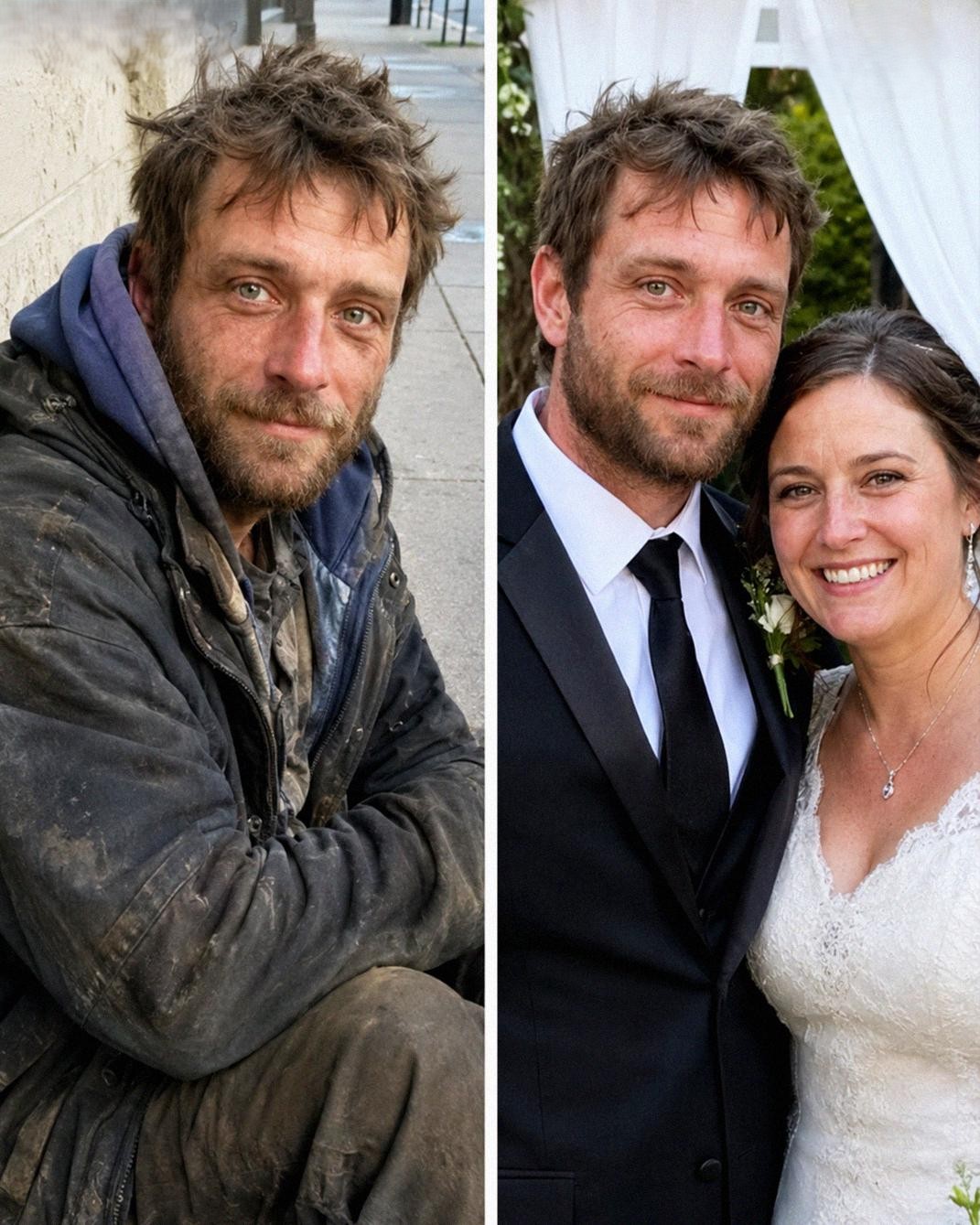
I took him shopping the next day. Then to a barber. Then to a decent restaurant where he ate like a man trying not to look too hungry. Under the dirt and beard was a face I hadn’t expected — handsome, sharp, and strangely familiar in the way some people seem instantly easier to trust than they should.
Three days later, I introduced him to my parents as my secret fiancé.
They were ecstatic.
My mother nearly cried. My father shook Stan’s hand like he’d personally delivered a miracle. And Stan, to his credit, played his role perfectly. He was charming, warm, attentive, and somehow believable enough that even I almost forgot we’d met on a sidewalk.
A month later, we were married.
I insisted on a thorough prenup. I was impulsive, not foolish. But once the paperwork was signed and the performance settled into routine, something unexpected happened.
Living with Stan was… easy.
Too easy.
He was funny without trying hard. Helpful without making a show of it. He cooked. Fixed things. Asked thoughtful questions. Gave me space when I wanted it. We became something like friends, then something even more dangerous — comfortable.
The only thing that never changed was the wall that came up whenever I asked about his past.
If I asked how he ended up homeless, his whole expression shifted. His eyes would go flat, and he’d redirect the conversation so smoothly it almost felt rehearsed.
I told myself not to care.
This wasn’t supposed to be real.
Then one evening, about a month after the wedding, I came home from work and found rose petals scattered across the entryway floor.
At first I thought I’d entered the wrong house.
The trail led into the living room, where I stopped dead.
Roses were everywhere. On the table. Across the mantel. Around the windows. In the center of the room, a huge heart had been made from petals across the floor.
And standing in the middle of it all was Stan.
Only it barely looked like the Stan I knew.
He was wearing a perfectly tailored black tuxedo that probably cost more than my car payment, and in his hand was a velvet ring box.
For a second, I genuinely thought I was hallucinating.
“Stan?” I managed. “What is this?”
He smiled, and my heart did something deeply inconvenient inside my chest.
“Miley,” he said, “you changed my life the moment you stopped for me. You saw me when no one else did. You gave me dignity when you thought I had nothing to offer you. And somewhere along the way, I fell in love with you.”
I just stared.
“I know we’re already married on paper,” he continued, “but that isn’t enough for me anymore. I want you for real. I want a real marriage, a real life, a real future. Will you marry me again? This time because you want to?”
Any coherent response I might have had vanished under one immediate, practical question.
“Where,” I asked slowly, “did you get the money for all this?”
He exhaled and set the ring box down for a moment.
“I owe you the truth.”
Then he told me everything.
He wasn’t broke.
He had been betrayed.
Stan had owned a company with his brothers. According to him, they’d forged documents, stolen his identity, manipulated financial records, and effectively pushed him out of his own life. When he tried to fight back, they used money and influence to shut every door in his face — including legal help. By the time they were done, he’d been stripped of access to his accounts, his name, and eventually even his stability.
They hadn’t just ruined him.
They had erased him.
He said being on the street had broken something in him. Not only because of the loss, but because he saw how quickly the world stopped looking at him like a person. Then I appeared — a woman ridiculous enough to propose marriage to a stranger, but kind enough to offer help without knowing whether he could ever repay it.
When I brought him home, gave him clothes, food, and a place to breathe, he said something shifted.
He decided to fight back.
Using the small amount of money I’d given him, and later contacts he’d managed to recover, he reached a powerful law firm outside his brothers’ influence. They took the case. His documents were being restored. His accounts were no longer frozen. Court proceedings were already moving.
“I didn’t tell you,” he said quietly, “because I didn’t want you dragged into it before I knew anything could be fixed. And because… I loved the life we had. The ordinary version. The one where you weren’t looking at me because of money.”
I sat down because my legs genuinely forgot how to function.
I had married a homeless man to avoid being manipulated by my parents.
And now that same man was standing in my living room telling me he was wealthy, wronged, in love with me, and asking for a real chance.
It should have felt absurd.
Instead, it felt like the room had quietly rearranged itself into honesty.
I looked at him for a long moment.
Then I said the only truthful thing I could.
“I think I have feelings for you too. Real ones. But this is a lot. Too much, all at once.”
He nodded immediately. No pressure. No wounded pride. Just patience.
We sat down for dinner — a dinner he had cooked himself, because apparently dramatic proposals weren’t enough and he had to make mushroom risotto too.
And somewhere between the first glass of wine and the end of that meal, the panic inside me softened into something steadier.
No one had ever chosen me this carefully before.
Not for appearances. Not for expectation. Not for what my life could provide them.
Just me.
When we finished eating, I reached across the table and took his hand.
“I will marry you for real,” I said. “But ask me again in six months.”
His eyes widened.
“I mean it,” I continued. “Not because I doubt you. Because this deserves a real beginning. You have a legal war ahead of you, and we both need time to breathe through what this actually means. If I still feel the same in six months — and I think I will — then we do it properly.”
The smile that spread across his face then was worth every strange twist that had led us there.
“So,” he asked, lifting the ring box again, “can you at least wear the ring until then?”
This time, I laughed.
“Yes.”
He slipped it onto my finger, and when he pulled me into his arms, everything about it felt different from our first wedding.
That one had been strategy.
This one, somehow, was beginning to feel like fate.
If you had told me a year earlier that I’d marry a homeless stranger to spite my parents and end up falling for a man who turned out to be far more than he seemed, I would have laughed in your face.
But life has a strange way of humiliating your plans and then rewarding your heart anyway.
And honestly?
I’ve never been so glad to have been wrong.