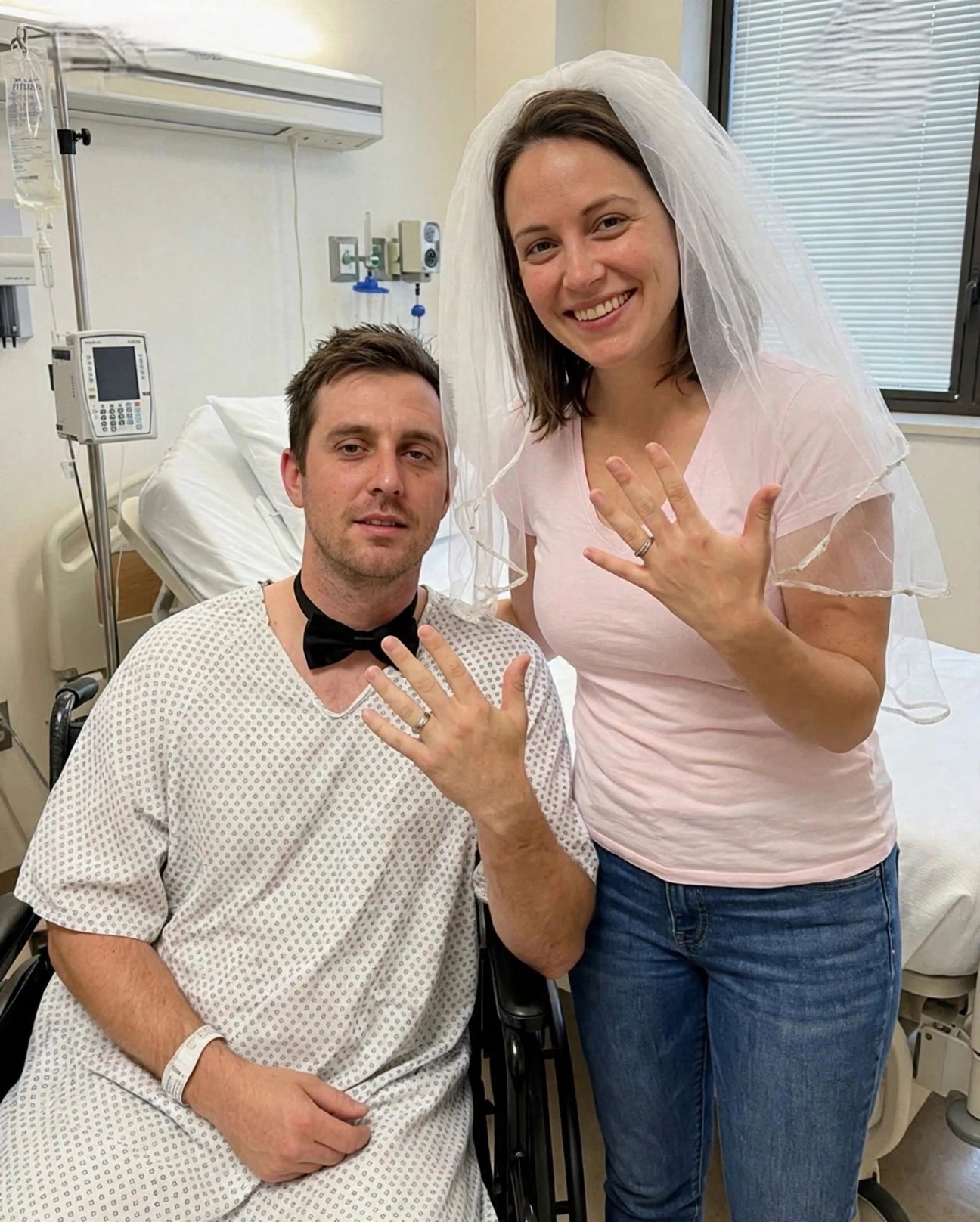
I stood in Room 407, my heart shattering as I promised forever to my childhood sweetheart.
Ben was dying, his body frail, the doctors saying we had only months. We exchanged vows between beeping monitors, desperate to find joy in our final chapter. But the moment I finished my “I do,” a nurse gripped my arm, her eyes wide with terror. “He’s lying to you,” she whispered, her voice trembling. “Before you leave tonight, look under his mattress.” I thought I was losing my husband to cancer, but as I reached beneath the bed, I realized I had never known him at all.
I had loved Ben since we were eight years old. By sixteen, our families were already planning our future, and by twenty-eight, we had finally mailed the invitations. But fate is a cruel architect. Two months before the wedding, Ben collapsed. The diagnosis came like a hammer blow: an aggressive, advanced cancer. The doctor’s words—”months, not years”—turned our lives into ash. We canceled the ballroom and the flowers, settling instead for a sterile hospital room where a borrowed, cheap veil served as my wedding finery. Ben insisted on a crooked black bow tie, joking that a groom had standards, even when he looked like a sick penguin.
I stood there, my voice cracking, promising him a lifetime that we both knew was being measured in weeks. When the chaplain finally pronounced us husband and wife, Ben pulled me close, his forehead pressed against mine. “Best day of my life,” he whispered. I echoed the sentiment, never imagining that we were operating from entirely different realities. As he drifted into a medicated sleep, I stepped into the hallway to find a moment of peace, clutching a cup of lukewarm vending machine coffee. That was when the nurse, a woman I barely knew, cornered me. Her warning was chilling: Ben was a fraud, and he was hiding the truth in the one place no one would think to look.
My mind raced. How could he be lying? I had seen the charts, the pain, the decay. Yet, the conviction in the nurse’s eyes was impossible to ignore. When I returned to the room, every instinct screamed at me to maintain the charade. I forced a bride’s smile, even as I watched Dr. Klein enter with a tablet. The doctor’s casual demeanor and his mention of a “schedule” felt suddenly sinister. After they shooed me out for the night, I seized my chance. The moment the bathroom door clicked shut, I dove for the bed, my heart hammering against my ribs.
My trembling fingers lifted the heavy mattress, revealing a hidden manila folder tucked between the frame and the springs. I retreated to the shadows of the room and opened it, bracing myself for the worst. Instead of a terminal prognosis, I found lab reports dated mere weeks ago. The conclusion was singular and damning: No evidence of malignancy. Ben was not dying. He was perfectly, disturbingly healthy.
The world tilted. My husband was a fabricator, orchestrating a grand, tragic play to trap me in a marriage built on a foundation of lies. I managed to photograph the documents before the bathroom door opened, snapping the folder back into place just as Ben shuffled out, his IV pole clicking rhythmically against the floor. When he asked if I was okay, I lied through my teeth, claiming fatigue. I left that room feeling like a ghost, realizing that the man I had worshipped for two decades was a stranger wearing a familiar face.
The following morning, I bypassed Ben and went straight to hospital administration. The truth, revealed through their database, was far worse than I had dared to imagine. Ben wasn’t just a liar; he was a desperate man drowning in a six-figure gambling debt. He had targeted me, using the guise of a terminal diagnosis to rush our wedding and gain legal access to my trust. The “medical plan” he and his accomplice doctor had cooked up was a calculated heist, with me as the primary victim.
I walked back into Room 407 that afternoon with a folder of my own, followed by the hospital administrator, two attorneys, and a state medical board official. Ben’s transition from a dying man to a cornered predator was instantaneous. The frail, pathetic groom vanished, replaced by a man whose eyes were cold and calculating.
“You went through my things?” he sneered, his voice shedding its synthetic weakness.