They say twins are soulmates, two halves of a perfect whole. For me, Elara Vance, that statement was gospel truth.
Lyra wasn’t just my sister; she was the reflection in the deepest part of my eyes, the shared secret whispered under childhood blankets, the silent agreement forged in moments too tender for words. We were inseparable from the moment we drew our first breath—two delicate rosebuds bursting into this world on a drizzly October morning. Our connection wasn’t merely familial; it felt tectonic, as if our very atoms had been calibrated to vibrate at the same frequency.
Our bond was legendary in the small coastal town of Port Blossom. Where one might possess a sharp wit, the other held an equally devastating charm; where one found solace in quiet contemplation, the other thrived on chaotic bursts of laughter. We navigated adolescence side-by-side: matching thrift store finds, synchronized study sessions fueled by lukewarm coffee, and whispered ambitions under the porch swing that promised us futures as bright and interwoven as our lives. People saw two halves making a whole—the grounded artist next to the ethereal dreamer, forever tethered.
But beneath the flawless veneer of sisterhood, a slow, insidious rot had begun to set in. It started subtly, like a faint discoloration on fine porcelain. A misplaced memory here, an oddly similar reaction to stress there. Small discrepancies that Elara, the more meticulous twin, would brush off with a quick shrug and a loving glance at Lyra. ‘Oh, just my scatterbrain,’ she’d muse, while secretly cataloging the evidence in her mind.
The first major crack appeared during our early twenties. We had always shared everything: our bank accounts were merged under the guise of shared financial destiny; our academic transcripts matched perfectly, down to a minor grade discrepancy we both insisted was an administrative error; even the faint scar above our left eyebrow, acquired during a disastrous pottery class in college—that one felt too perfect, almost manufactured.
Lyra started exhibiting behaviors that seemed… curated. Her passions became more aggressively defined. Where Elara loved abstract painting and melancholic folk music, Lyra suddenly became obsessed with stark, modern minimalism and driving indie rock. When they traveled together, the rhythm was slightly off; Elara felt like she was dancing to a melody only half-composed.
‘You’ve changed, Lia,’ Elara confessed one evening in our cramped but beloved seaside apartment, tracing the outline of Lyra’s jawline. ‘It feels less… us.’
Lyra looked up from her sketchbook, her eyes—the exact shade of moss agate that mirrored mine—flicking with practiced defensiveness. ‘Changed? Nonsense, Elara. I’ve simply found my edges. You always preferred the soft blur; I prefer the sharp definition.’ Her smile was dazzling, but it didn’t quite reach the depths of her gaze. It felt like a highly polished mask settling perfectly into place.
The suspicion began to calcify within Elara, hardening from a worry into a cold, undeniable certainty. This wasn’t divergence; this was *replacement*. Lyra hadn’t just found herself; she had methodically overwritten the original blueprint of ‘Elara Vance’ with something shinier, more marketable, more utterly convincing.
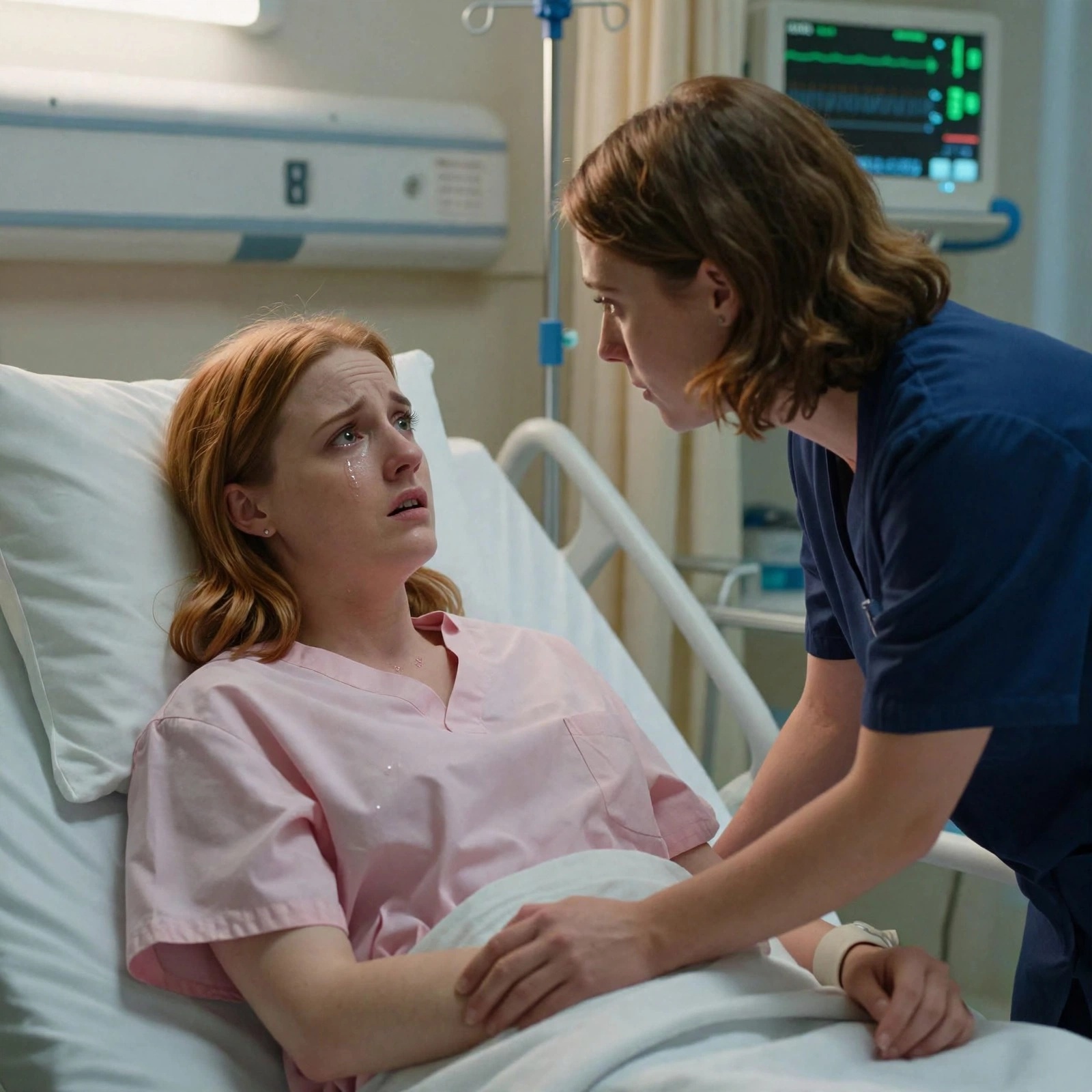
The catalyst for the final, shattering revelation arrived during a necessary medical scare. Elara, perpetually prone to migraines that felt like internal explosions, was rushed into St. Jude’s Coastal Care after an attack left her disoriented and nauseous. The attending physician, Dr. Albright—a man whose demeanor usually hovered between placid competence and mild annoyance—was thorough. He ran the standard battery of tests: blood panels, neurological scans, cardiac monitoring.
Lyra was with her in the waiting area, looking impossibly elegant even in hospital scrubs, fielding calls while radiating a curated calm that always made Elara feel slightly inferior. ‘She’ll be fine, Doctor,’ Lyra assured him, touching his arm with an air of proprietary concern. ‘Elara’s resilient.’
Dr. Albright finally emerged from the examination room, clipboard in hand. He bypassed pleasantries, which was typical for him when he suspected something wasn’t lining up perfectly. He approached Elara’s bedside, checked her vitals one last time, and then paused, his gaze sweeping over both sisters—his professional assessment momentarily replaced by a flicker of genuine curiosity.
He addressed Lyra first, the tone shifting subtly from paternal assurance to clinical inquiry. ‘Ms. Vance… Your sister has a history of vascular sensitivity, correct? Migraines exacerbated by stress?’
Lyra nodded instantly. ‘Yes, Doctor. Severe.’
‘And regarding her blood type,’ he continued, tapping his pen against the chart. ‘We have it listed as O-negative. Is that accurate for you, Ms. Vance?’
Elara confirmed, a small wave of relief washing over her at the confirmation of a mundane truth.
Dr. Albright then turned to Lyra, leaning in slightly conspiratorially, though his voice carried perfectly across the quiet room. ‘And your blood type? You are listed as O-negative.’
Lyra answered immediately, perhaps too quickly, her composure momentarily faltering. ‘Yes. Precisely O-negative.’
Dr. Albright didn’t press further. Instead, he picked up a secondary chart—one reserved for historical patient data and cross-referencing during admissions. He scanned the top entry, his brow furrowing as if trying to solve a complex mathematical equation that had suddenly become painfully simple.
He looked back at Elara, then slowly, deliberately, to Lyra. The silence stretched, thick and suffocating, punctuated only by the rhythmic *beep-boop* of the cardiac monitor beside Elara’s head.
‘Ms. Vance,’ Dr. Albright finally said, his voice dropping to a level that commanded absolute attention. ‘Your sister… your twin sister, Lyra…’ He paused again, letting the weight of the unspoken accusation settle in the sterile air. ‘Her recorded blood type is O-negative.’
He then shifted his gaze to Lyra, whose perfect mask was beginning to crack around the edges.
‘However,’ he continued, and this single word hit Elara with the force of a physical blow, stealing her breath away entirely, ‘when we pulled the secondary sample from your pre-admission screening—the one dated eight years ago, just before you started university…’
He tapped the chart again, his finger tracing the faded ink.
‘The official record for *you*, Lyra Vance… is Type A-positive.’
Lyra froze. Her carefully constructed façade didn’t merely slip; it disintegrated, revealing something raw, terrified, and profoundly familiar underneath. The color seemed to drain from her face, leaving the flawless complexion stark white against the blue hospital gown.