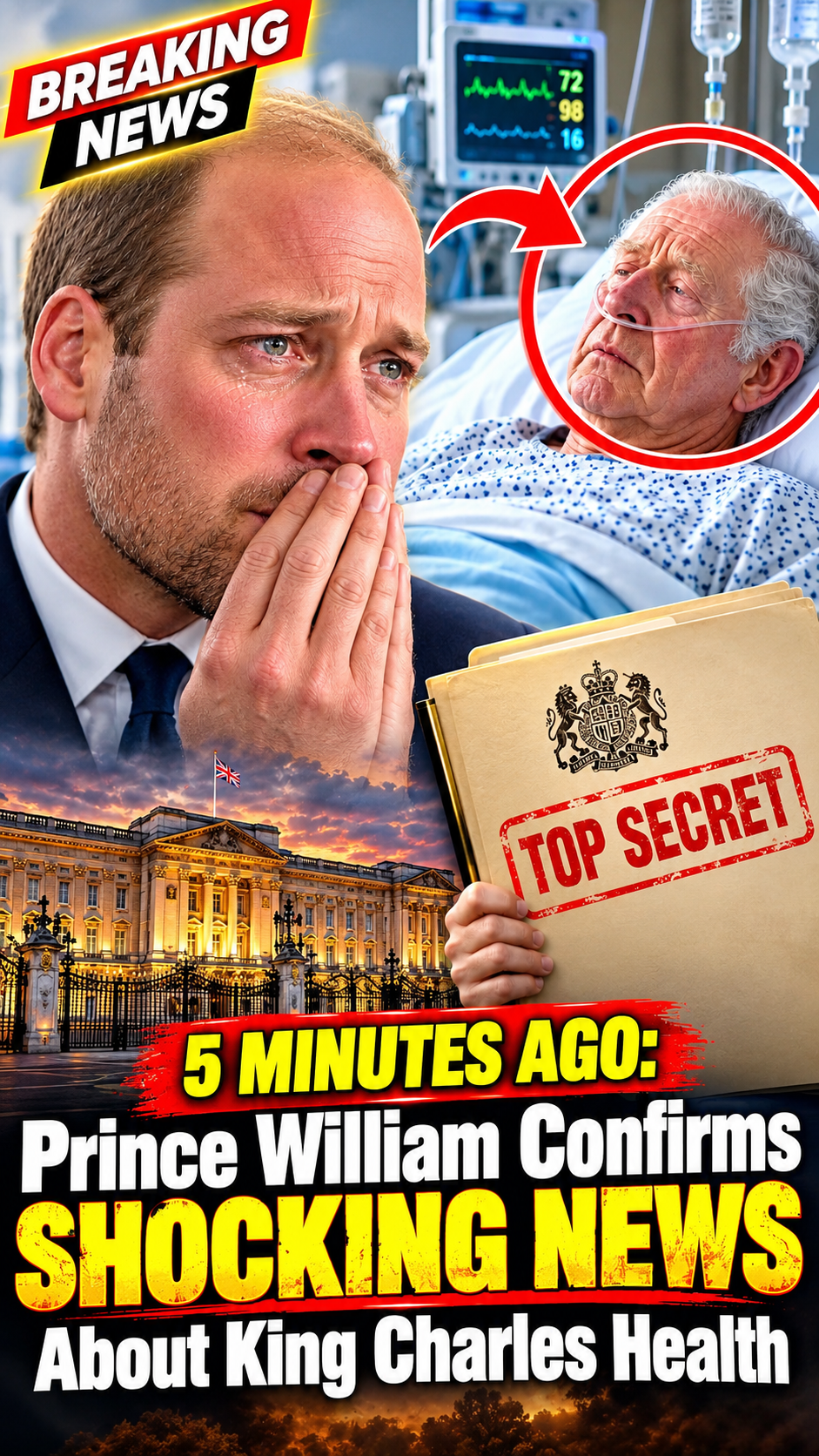
Concern surrounding King Charles III’s health has returned to the spotlight after a dramatic viral video claimed that Prince William had shared troubling information about his father’s medical condition.
The online story has generated questions about the monarch’s health, the future of his royal responsibilities, and the possibility of the Prince of Wales assuming a greater public role.
The video, circulating under the headline “5 MINUTES AGO: Prince William Confirms Tragic News About King Charles Health,” suggests that the King has experienced a serious medical setback and that his family may be preparing for significant changes behind palace doors.
However, the central allegations remain unverified. No authenticated statement from Prince William or Buckingham Palace has been established by the material provided, and there is no confirmed evidence here that the King has announced an immediate withdrawal from his major constitutional or public responsibilities.
The situation highlights an important challenge in modern royal reporting: distinguishing legitimate public interest in the monarch’s health from emotionally charged speculation that can spread rapidly across social media.
Prince William at the Center of New Royal Health Speculation
Prince William has increasingly become a central figure in discussions about the monarchy’s future, particularly since his father’s cancer diagnosis was publicly announced in February 2024.
As Prince of Wales and heir to the British throne, William occupies a position of considerable responsibility. His public engagements, charitable initiatives, and official appearances are closely watched as indicators of how the Royal Family is preparing for the years ahead.
The latest viral narrative attempts to connect those responsibilities with an alleged private conversation about King Charles’ health.
According to the video’s description, William supposedly communicated deeply concerning information during a private gathering, raising the possibility that the monarch’s medical treatment might require a significant reduction in royal duties.
Yet several essential details are missing.
The account does not provide an independently verified date or location for the alleged gathering. It does not identify reliable witnesses, publish an authenticated statement from William, or cite a medical professional authorized to discuss the King’s condition.
These omissions matter because an allegation involving the health of a reigning monarch carries substantial public and constitutional significance.
Without independent confirmation, the supposed conversation cannot be treated as an established event.
What We Know About King Charles’ Cancer Diagnosis
King Charles III publicly disclosed his cancer diagnosis in February 2024, marking a significant moment in the modern history of the British monarchy.
Buckingham Palace explained that the condition had been identified during medical investigations following treatment for an enlarged prostate.
The Palace clarified that the King had been diagnosed with a form of cancer, although the precise type was not publicly disclosed in the initial announcement.
Following the diagnosis, Charles began a schedule of regular treatment and temporarily postponed public-facing engagements.
Nevertheless, the King continued certain official responsibilities, including state business and government paperwork.
His decision to acknowledge the diagnosis publicly drew considerable attention, particularly because the Royal Family has historically maintained strict boundaries around private medical matters.
The announcement also encouraged wider public discussion about cancer awareness, treatment, and the importance of seeking medical advice.
However, the existence of a previously confirmed cancer diagnosis does not establish that the King’s condition has recently worsened.
Cancer treatment and recovery vary considerably between individuals, and the public cannot determine a person’s current medical condition solely from previous announcements or changes in their public schedule.
Any credible report of a new medical development would require updated evidence.
Has Buckingham Palace Announced a Serious Deterioration?
The most important question raised by the viral story is whether Buckingham Palace has officially confirmed a serious decline in King Charles’ health.
The material available for this article does not establish such an announcement.
Likewise, the claim that Prince William has personally revealed a major medical crisis has not been supported by an authenticated public statement.
A significant change in the monarch’s health would ordinarily attract substantial attention from established news organizations, royal correspondents, and official Palace communication channels.
That does not mean every private medical development must be publicly disclosed. The King retains personal medical privacy, even while carrying out a prominent constitutional role.
But claims involving an immediate withdrawal from duties, a major medical emergency, or an imminent transfer of royal responsibilities require a higher standard of verification than an anonymous online account.
Readers should therefore distinguish between what has been publicly confirmed and what remains speculation.
King Charles’ Royal Engagements and Public Responsibilities
King Charles has sought to maintain an active role in public life while managing the demands associated with his health.
Royal engagements serve several purposes beyond ceremonial appearances. They support charitable organizations, recognize public service, strengthen diplomatic relationships, and maintain connections between the monarchy and communities across the United Kingdom and the wider Commonwealth.
One previously reported engagement involved the launch of Apple x King’s Trust Creative Labs at Battersea Power Station in London.
The initiative focused on helping young people explore opportunities in creative industries and digital skills.
Such activities reflect the King’s longstanding interest in education, youth development, sustainability, and community engagement.
A royal programme also listed overseas engagements for the King and Queen Camilla from October 27 through November 4, 2026, involving The Bahamas, Guyana, Antigua and Barbuda, and the Commonwealth Heads of Government Meeting.
Because this article is dated October 28, the itinerary should be treated as a previously announced programme rather than proof that every engagement is proceeding unchanged. Its current status would need to be checked against the latest official Palace updates.
Importantly, a planned engagement does not disclose the King’s medical condition, just as a change in an itinerary would not automatically prove a serious health setback.
Why Prince William Could Face Greater Royal Responsibilities
Even without the viral allegations, Prince William’s position makes him an important figure in conversations about the monarchy’s long-term future.
As heir apparent, he is expected to support the sovereign, represent the Crown at appropriate events, and maintain his own programme of public and charitable activities.
His responsibilities include work connected to homelessness, environmental protection, mental health awareness, and community development.
If King Charles were to reduce his public schedule, William could potentially undertake additional engagements or represent the Royal Family at more events.
However, taking on additional public appearances is not the same as becoming monarch or assuming the sovereign’s constitutional powers.
The British constitutional system provides specific arrangements for circumstances in which a reigning monarch is temporarily unable to perform certain functions.
These arrangements are distinct from ordinary delegation of public engagements.
Therefore, suggestions that Prince William is preparing for an immediate transfer of the Crown cannot be justified merely by reports of increased royal responsibilities.
Queen Camilla’s Role During a Period of Public Concern
Queen Camilla also occupies an important position in discussions surrounding King Charles’ public duties.
As Queen Consort, she supports the monarch through official engagements, charitable activities, ceremonial responsibilities, and public representation.
During periods when the King’s schedule has required adjustment, Camilla’s continued participation in royal activities has helped maintain the visibility of the monarchy.
Her work includes supporting literacy, domestic abuse prevention initiatives, and organizations focused on community welfare.
However, the Queen’s public engagements should not be interpreted as medical evidence about her husband.
Royal duties are frequently shared among senior family members, and the presence of one royal at an event does not establish that another is medically unable to attend.
This distinction is particularly important when social media commentary attempts to turn routine scheduling decisions into evidence of a hidden crisis.
Could King Charles Temporarily Reduce His Duties?
The possibility of a monarch adjusting their schedule because of medical treatment is not inherently unusual.
Royal duties involve travel, lengthy ceremonies, meetings, public appearances, and substantial preparation.
When health considerations arise, some activities may be postponed, shortened, or undertaken by another senior royal.
The constitutional responsibilities of the sovereign, however, are not identical to the public-facing elements of royal life.
Under established legal arrangements, certain royal functions can be delegated to Counsellors of State in appropriate circumstances.
There are also separate constitutional provisions addressing more serious questions of incapacity.
Neither arrangement should be confused with abdication or automatic succession.
A temporary reduction in engagements would not, by itself, mean that King Charles had ceased to be monarch.
Equally, speculation about potential arrangements should not be presented as evidence that those arrangements have been activated.
The Emotional Impact of Royal Health Rumors
Stories involving the health of senior royals often attract an unusually strong public response.
For many people, the British monarchy represents continuity, tradition, and national history.
King Charles’ accession following the death of Queen Elizabeth II in September 2022 marked the beginning of a new chapter after an exceptionally long reign.
Consequently, questions about his health can also prompt broader discussions about the future of the institution.
The emotional language used in viral headlines can intensify those concerns.
Words such as “tragic,” “devastating,” and “emergency” suggest that a serious event has already occurred, even when the accompanying content provides no reliable evidence.
This can create confusion, particularly when videos use dramatic narration, archival royal footage, and images from unrelated public appearances.
Audiences may reasonably feel concerned after encountering such material, but concern alone does not establish the truth of the claims.
Why the Phrase “5 Minutes Ago” Should Raise Questions
The headline’s opening phrase is especially significant.
“5 MINUTES AGO” creates the impression that the information is exceptionally recent and requires immediate attention.
Yet online videos can retain the same headline for days, weeks, or longer.
A time-sensitive phrase is not a substitute for a verifiable publication date, a named source, or an official statement.
For royal health stories, readers should examine whether the report identifies when the alleged development occurred and whether the supporting evidence is contemporary.
It is also important to distinguish between a video published recently and an event that actually happened recently.
A newly uploaded video may discuss old information, repeat previously debunked claims, or present speculation as a fresh revelation.
In this case, the headline alone does not demonstrate that Prince William has delivered a new announcement.
The Difference Between Royal Privacy and Public Accountability
The health of a reigning monarch presents a delicate balance between privacy and legitimate public interest.
King Charles holds a constitutional position that makes his ability to perform official duties a matter of national importance.
At the same time, holding public office does not eliminate the right to personal medical privacy.
The public may reasonably expect accurate information about changes that materially affect the King’s official responsibilities.
That expectation does not justify inventing medical details, circulating unsupported diagnoses, or attributing statements to family members without evidence.
Responsible reporting should focus on confirmed announcements, observable changes in public duties, and clearly attributed information.
Where facts remain unknown, acknowledging that uncertainty is more accurate than attempting to fill the gaps with dramatic assumptions.
How Royal Succession Actually Works
Another issue raised by the viral story is whether Prince William could soon become King.
Under the established order of succession, William is first in line to the British throne.
However, succession does not occur simply because a monarch becomes ill, undergoes treatment, or temporarily reduces public appearances.
The Crown passes according to constitutional law.
If a sovereign is unable to carry out particular duties, legal mechanisms may allow specified functions to be performed by authorized individuals without changing who holds the Crown.
This distinction is crucial because online commentary sometimes treats additional responsibilities for the heir as evidence that succession is imminent.
In reality, senior members of the Royal Family can assume more public work without any change in the monarch’s constitutional status.
As things stand in the information established for this article, King Charles remains the reigning monarch, and Prince William remains heir apparent.
What Reliable Royal Health Reporting Should Include
A credible report about a significant change in King Charles’ health should provide clear supporting information.
That might include an official statement from Buckingham Palace, a directly attributable comment from an authorized representative, or independently corroborated reporting from established news organizations.
Reliable coverage should also explain precisely what has been confirmed.
For example, an announcement that an engagement has been postponed is not equivalent to a medical statement that the King’s condition has deteriorated.
Similarly, a report that Prince William will attend an event in his father’s place does not necessarily mean that a serious health emergency has occurred.
The strongest reporting separates confirmed developments, relevant background, expert explanation, and unresolved questions.
This allows readers to understand the significance of a story without being misled by speculation.
What the Viral Video Has Not Established
Despite its dramatic presentation, the online narrative leaves several important questions unanswered.
It has not established that Prince William made the alleged private statement.
It has not provided a verified medical assessment confirming a new deterioration in the King’s condition.
It has not demonstrated that Buckingham Palace has announced the suspension of the King’s principal responsibilities.
Nor has it shown that any extraordinary constitutional process has begun.
These are not minor details. They form the foundation of the video’s central claims.
Until reliable evidence emerges, presenting those allegations as confirmed facts would risk misleading readers about both the King’s health and the constitutional position of the monarchy.
What Could Happen Next for the Royal Family?
Public attention is likely to remain focused on King Charles’ engagements, Buckingham Palace communications, and Prince William’s official activities.
If the Palace releases a new health update, that statement would provide a more reliable basis for assessing any change in circumstances.
Likewise, an officially announced adjustment to the King’s programme could clarify whether particular engagements have been postponed, delegated, or rescheduled.
However, any such development would need to be evaluated on its own terms.
A routine scheduling change should not automatically be interpreted as a medical emergency, and an increase in William’s public appearances should not be described as a constitutional transition without supporting evidence.
For now, the most responsible approach is to monitor authenticated announcements and credible reporting rather than treating viral speculation as established royal news.
What Is Confirmed and What Remains Unverified?
Several important distinctions emerge from the available information.
Confirmed historical background: King Charles publicly disclosed a cancer diagnosis in February 2024 and initially adjusted his public-facing responsibilities while receiving treatment.
Established constitutional position: Prince William is the heir to the throne and already performs significant official duties.
Previously announced royal activity: Public information has described continued royal engagements and an overseas programme for late October and early November 2026, although the current status of that programme requires up-to-date verification.
Unverified viral allegations: The claim that William privately announced a serious new deterioration in his father’s health has not been substantiated by the evidence supplied.
Unconfirmed constitutional implications: There is no established basis in the provided material for claiming that an immediate succession, abdication, or extraordinary transfer of royal authority is underway.
Keeping these categories separate is essential to understanding the story accurately.
Final Thoughts: Royal Health Concerns Deserve Facts, Not Fear
The viral claim that Prince William has confirmed tragic news about King Charles’ health has attracted attention because it combines a genuine historical medical diagnosis with an emotionally powerful account of an alleged new crisis.
But the two should not be confused.
King Charles’ cancer diagnosis is a matter of public record. The suggestion that his condition has suddenly worsened, that Prince William has delivered a private warning, or that the King is being forced to abandon his major duties requires separate and credible confirmation.
The Royal Family’s future will naturally remain a subject of public discussion, especially as William continues preparing for the responsibilities associated with being heir to the throne.
Nevertheless, speculation about succession should not be mistaken for evidence of an immediate constitutional change.
Until Buckingham Palace or reliable independent reporting establishes otherwise, the dramatic allegations circulating online should be treated as unverified.
The central takeaway is clear: public concern about King Charles’ health is understandable, but the latest viral claims do not, on the evidence presented, establish a new royal medical emergency.
As interest in the monarchy continues, accurate reporting, careful attribution, and respect for medical privacy remain essential.
What do you think? Should Buckingham Palace provide more frequent health updates about the monarch, or should the Royal Family maintain greater privacy around personal medical matters?