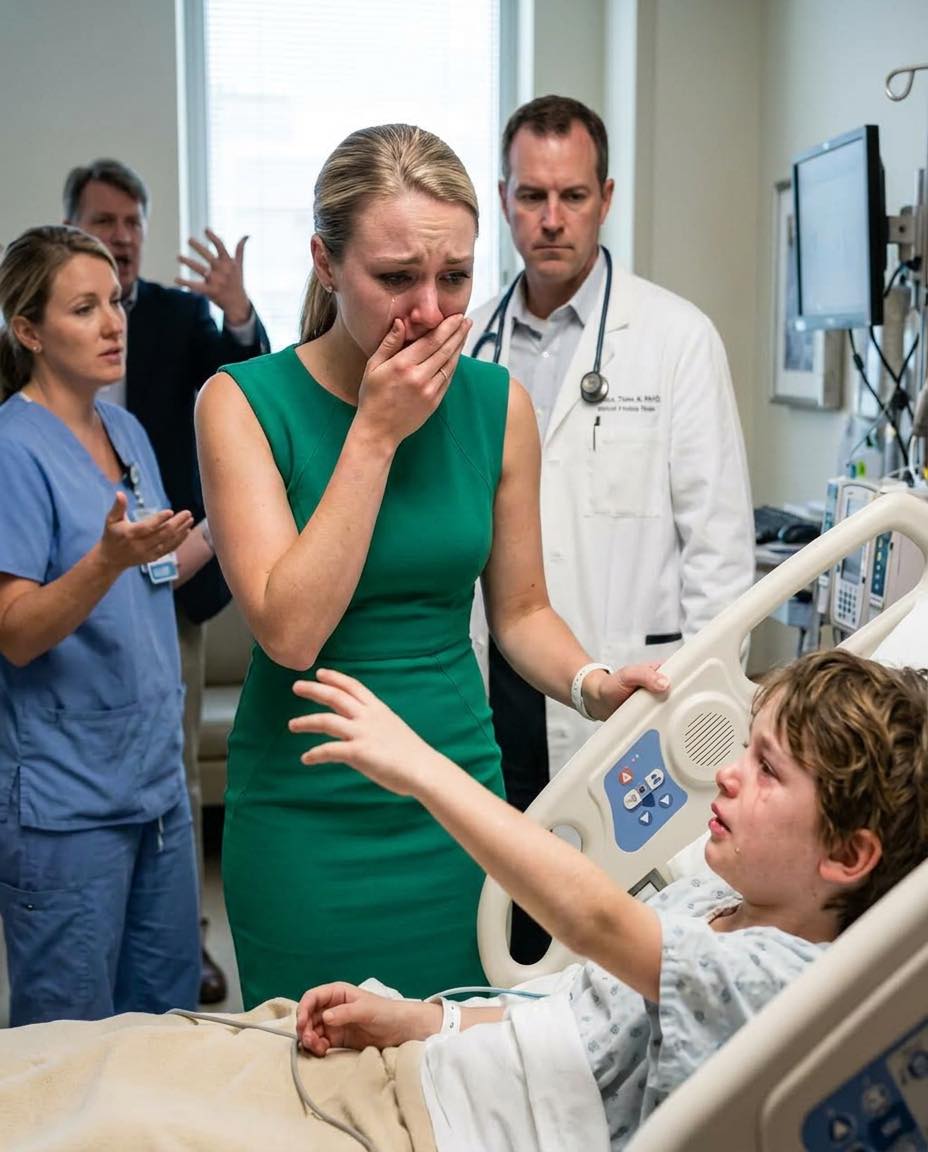
That opening lands because it taps into something deeply unsettling: the idea that a life you’re certain about can be quietly contradicted by a stranger—especially a child who seems to know you.
What makes this story work isn’t just the twist, but the way it unfolds from disbelief into responsibility.
At first, Nora’s reaction is completely rational. A hospital claims a boy has listed her as his emergency contact, yet she has no children. The instinct is to dismiss it as an error. But the detail that pulls her in isn’t logic—it’s persistence. He won’t stop asking for you. That shifts it from administrative confusion to something personal.
And the moment she enters the room, the tone changes.
The boy doesn’t hesitate. He recognizes her. That’s the emotional pivot: she’s still trying to understand how, while he already accepts that. His certainty forces her into a role she didn’t choose but can’t ignore.
The phrase “the lady with two eyes” is doing quiet heavy lifting here. It’s symbolic, not literal. It frames Nora as someone who sees complexity—someone who doesn’t reduce people to a single version of themselves. That ties directly to Rachel, the past, and the unresolved conflict. In other words, the story isn’t random at all—it’s built on a buried connection resurfacing at the worst possible moment.
Then the narrative deepens.
This isn’t about a secret child or a hidden past in the conventional sense. It’s about trust transferred across time. Rachel didn’t choose Nora because of convenience—she chose her because, years earlier, Nora saw the truth when others chose comfort. That makes the hospital call less mysterious and more inevitable.
The tension with Mark sharpens the stakes. He represents the past that never resolved—the threat that Rachel once minimized and is now trying to escape. His arrival at the hospital is not just a plot point; it’s the collision of denial and consequence. And Oliver’s reaction confirms everything before the adults even explain it.
What’s particularly effective is the restraint in Nora’s role.
She doesn’t become a hero in the dramatic sense. She doesn’t take over or try to “fix” everything. She does something much quieter: she stays. She listens. She becomes a stable point in a situation built on instability. That’s far more believable—and, in many ways, more meaningful.
By the end, the story doesn’t resolve into perfection.
Rachel is safe, but still healing. Oliver is protected, but still processing. Nora is connected to them, but not transformed into something she isn’t. The bond that forms is chosen, not assigned—and that’s what gives the ending weight.
If there’s a central idea here, it’s this:
Sometimes the people who matter most in a crisis aren’t the ones closest by blood or time—but the ones who once saw the truth and didn’t look away.
And when that kind of recognition comes back—unexpected, inconvenient, even disruptive—it doesn’t ask for permission.
It simply asks whether you’ll answer.